Tuesday, 19 February 2013

Horizontal Throwing.


            Throwing objects in self-defence is a legitimate tactic if your life is in danger. Some missiles may be capable of injuring an attacker but a more likely consequence is that you will distract them long enough to press home a counter-attack or affect an escape.  

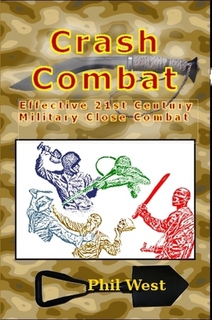
            In my book I describe a number of throwing techniques, some of them not that well known. In this post we will look at an addition technique,  that of horizontal or side-arm throws. Horizontal throwing is harder to master than vertical throwing and generally has less range and power. On the other hand, it has several features that make it more applicable for self-defence. One of these is that horizontal throws are less telegraphic than most vertical techniques, which increases the surprise element and distracting ability of a missile attack. Another element is that a horizontal throw can be combined with drawing a missile from a place of concealment. If a supply of projectiles are held in the other hand a number can be launched in a short period of time, the action of moving the throwing hand back to take another missile naturally setting up for another horizontal throw.

            To throw an object such as a pencil, nail or knife it is held in the palm, parallel to the fingers, as is described in the book for push-throwing. Bend the elbow so your hand is near the opposite shoulder or hip, palm downwards. The action you are going to make is rather like a horizontal karate-chop. Your arm should be relaxed during the motion and you should avoid the temptation to hurry the movement. Lock your gaze on your intended target.  Smoothly let your arm swing straight and let the missile leave your hand when your fingers are nearly towards the target. At the same time, sway your body towards the target to add momentum. If you are throwing consecutive missiles you will rock back and forth as you throw and “reload”.  Some sources talk of the missile being “pressed” towards the target and this is probably a better description of the release you are aiming for rather than thinking of this as a throw. Unlike some of the other throws described in the book this technique adds very little stabilization to the missile so is more suited to “nose heavy” objects.
 

            To throw missiles such as coins or washers the same basic action is used but the missile is head slightly differently. The object is held horizontally between the thumb and second finger, with the forefinger on the edge to apply a little drag and induce some reverse spin. Lock your eyes on the target and in a smooth, relaxed and unhurried manner swing your arm out straight so your thumb points towards the target. If the missile you are using has a sharp edge you may need to hold it between thumb and first finger and adding some spin-stabilization may require a little bit of a snapping action on release.

            You will need to practice this to get the correct feeling and timing. Generally the missile is released just before or as your hand reaches the same vertical plane as your target. Depending on distance you may have to aim above your intended target rather than pointing your hand right at it.

Wednesday, 13 February 2013

Gladiator: Benn vs Eubank

            Something a little different today. Many years back there was a one-off TV special that had two professional boxers training as Gladiators. This clip shows the final fight between them. For those of you unfamiliar with them, there was a very real rivalry between them, if not actual dislike, and the combat is quite spirited.

            The main technical point of interest in this combat is the clockwise spinning tactic that Benn (in silver) performs several times. The first is at about 43secs, another around 58sec, 1:37secs and a couple more times later. The move blocks Gold’s sword with the shield and takes Silver into a position to strike Gold’s right side or back.
         If you have enjoyed this article or it has been helpful to you please feel free to show your appreciation. Thank you.
The Books

http://www.angelfire.com/art/enchanter/epsdbook.html
http://www.lulu.com/shop/http://www.lulu.com/shop/phil-west/survival-weapons-optimizing-your-arsenal/paperback/product-21488758.html
http://www.lulu.com/shop/phil-west/crash-combat/paperback/product-22603842.html
https://www.amazon.com/Anatopismo-Underrealm-Novella-Phil-West-ebook/dp/B077G7MMFM

Tuesday, 12 February 2013

Shuriken Styles

            Came across this image so I decided to post it as a follow on to the previous article discussing shuriken.


         A cross-shaped shuriken, as described in the previous article and used in the movie is a Juji Shuriken, so named because a cross resembles the Japanese character for the number ten. So some four-point shuriken are in effect called "Figure Ten Shuriken".
        Three-point Shuriken are called Sankou, which means "Three Rays". They may also be called Mitsubishi which means "three diamonds". Now you know why the car company uses the logo that it does.
        The square shuriken with concave edges seems to appear in movies a lot. This type are called Senban shuriken. Many modern shuriken on sale are of this type since they are probably very simple to manufacture. Concavity and therefore acuteness of the points will vary and they may or may not have sharpened or bevelled cutting edges. A similar design to these are the Taisha ryu Shiken shuriken. These look very similar but have thickened tips and sharpened edges and are apparently made from quite thick and heavy plate so inflict considerable cutting and penetrating damage.
         If you have enjoyed this article or it has been helpful to you please feel free to show your appreciation. Thank you.
The Books

http://www.angelfire.com/art/enchanter/epsdbook.html
http://www.lulu.com/shop/http://www.lulu.com/shop/phil-west/survival-weapons-optimizing-your-arsenal/paperback/product-21488758.html
http://www.lulu.com/shop/phil-west/crash-combat/paperback/product-22603842.html
https://www.amazon.com/Anatopismo-Underrealm-Novella-Phil-West-ebook/dp/B077G7MMFM

Monday, 4 February 2013

Throwing Weapon Targets

            I watched the movie “The Challenge” last night. It’s not a bad movie and worth checking out if it appears in your TV listings.
            One scene that caught my notice was when the lead character was training with Shurikens. In the background we can see targets and what struck me was these targets only appeared to have two target areas. One target was on the chest, on the left side, the other over the groin. A third circle was visible higher up but this may have been an attempt to represent the mouth rather than an aiming point. The targets are too distant to say for certain, at least on my TV. This hopefully clearer picture from the Youtube edition of the movie seems to indicate an aiming point on the throat.

            The shurikens used in this movie are cross-shaped four-pointers, about four to five or more inches across. From the way the actors handle them they evidently have a reasonable weight.
 
            I regard shuriken as being on the borderline of the category of self-defence weapons. In the movies, including this one, enemies hit by shuriken conveniently fall down dead, perhaps taking a second or so to groan dramatically. In the real world shuriken are seldom as effective, even if poisoned. The unpoisoned shuriken is mainly a weapon of distraction. The use of a shuriken either creates time for you to close distance or to escape. That last statement is also true to throwing knives and many other objects that might be thrown is self-defence.
 
            Having put the shuriken in context, let us think about the targets shown in the movie.

“Left side of the chest” will have many of you thinking of the heart. It is a common misconception that the heart is on the left side of the chest. It is more accurate to say the heart is more towards the left side, the heart being more central than most people think. Targeting the left side of the ribs will increase the chances of hitting areas of the heart not covered by the sternum. More importantly it will decrease the possibility of hitting the bony sternum and increase the chances of a point penetrating between the ribs. Even if it missed the heart a penetrating wound to the chest will discourage many opponents, particularly if it deflates a lung. If a shuriken hits a rib it may penetrate the bone (which will be painful), or it may glance off into an intercostal space. Shaken are multi-pointed and rotating in flight so a point encountering something it cannot penetrate may cause the next point to be flipped into a nearby area. The shuriken used in the movie were relatively heavy, long pointed weapons so would be less likely to bounce off a target if thrown correctly than many of the examples that can be purchased over the internet. Interestingly in one book I have on shuriken there is a diagram with a target point labelled “Heart” but the line points to two places, one either side of the chest.

The second target shown was the groin, with the aiming circle over the genitals. A wound to this area is also going to be discouraging, with the victim likely to become more interested in seeking medical attention than fighting. A near miss above this target will hit the inguinal or lower abdomen area. A miss lower down may hit in the region of the femoral arteries, which will bleed copiously and sometimes fatally if penetrated.

I suspect these targets would have had a third target area used, and this would have been the eyes. A shuriken approaching anywhere in the facial region is going to be distracting and the eyes are the obvious aiming point.

Some of you may be wondering about other target areas. The neck and throat might be a fatal target if hit, and seem to be marked on the movie target but with a weapon like a shuriken hitting this area may be problematic since the chin will often get in the way. The liver and spleen are less protected by the ribs than the heart/ lung target points but may be difficult to target in practice. If you have to aim low the genitals are a better target. In the movie a couple of characters are hit in the back by shuriken. One is hit in the back in the rib area (on the left side!), another is hit in the kidney area just under the ribcage.
In summary, we have discussed three frontal target areas for light low velocity thrown weapons. The eyes, the left lung and the groin. While hits to these areas can create significant wounds attacks to these regions also have a good chance of disabling or distracting an aggressor, buying you time to close the distance or escape. While you may not be carrying a stack of shuriken many objects you may be holding or that are to hand in your environment can be used instead. If you can reach it and can throw it, use it if your life is in danger.

         If you have enjoyed this article or it has been helpful to you please feel free to show your appreciation. Thank you.
The Books

http://www.angelfire.com/art/enchanter/epsdbook.html
http://www.lulu.com/shop/http://www.lulu.com/shop/phil-west/survival-weapons-optimizing-your-arsenal/paperback/product-21488758.html
http://www.lulu.com/shop/phil-west/crash-combat/paperback/product-22603842.html
https://www.amazon.com/Anatopismo-Underrealm-Novella-Phil-West-ebook/dp/B077G7MMFM