Friday, 1 November 2013

Boarding Pikes


            The Boarding Pike has a very long history. Spears and Javelins have probably been used on board ships at the very start of naval warfare. In the Royal Navy Boarding Pikes remained in service on board ships until 1926.

            When we imagine shipboard combat the cutlass is the weapon that springs to mind. Many fighters throughout the ages and across the world appreciate that a competently used quarter staff is generally superior to a sword. The boarding pike is essentially a staff with a metal point added. Not only can it defend its user, but also parry attacks against nearby comrades.

            The boarding pike was to evolve over the ages, and in its final form it had a number of interesting design features.

            Length of boarding pike varied. Some were as long as 10 or 12 feet but typically they were between 7 and 9 feet. (Note that examples in museums have sometimes been cut down for display)  Regular readers will know this is the size recommended by many western and eastern martial traditions as being the optimum length for a long fighting staff, or a spear capable of being wielded in one hand.

            Early boarding pikes had broader leaf-shaped blade and this design persisted longer in US Navy service than among the European sea powers. Spear heads are seldom used as cutting weapons. To cut effectively a blade must strike edge on and not be canted either in delivery or upon impact. Most weapons intended for cutting have an oval or polygonal section grip to facilitate this. Spears, on the other hand, usually have simple round section shafts. Many designs of boarding pike accordingly had triangular, square or diamond section spike like blades.

 
            One of the reasons for the popularity of the spike was doubtless that it was simple to mass-produce, but it also had other advantages. The spike head was quite light, making the weapon faster and more agile. The spike penetrated efficiently and was also easy to withdraw, being less likely than a broader blade to jam in areas such as the ribs. As many readers will have heard, a triangular section blade is supposed to create a self-supporting wound that remains open and bleeds more freely rather than closing. This may also be true of a sufficiently sized square or diamond section blade.

            Most boarding pike heads incorporated langets, which are metal straps or reinforcements that extend down the shaft, a useful feature for a weapon that might have to deal with blows from cutlasses or boarding axes.

           Another notable design feature on many boarding pikes was that the head was narrower than the shaft, a feature that theoretically was supposed to limit penetration. One might wonder here why some form of arresting device such as a crossbar was not incorporated, as is seen on many hunting and military polearms used on the land. The answer is that the boarding pike was intended to be used in an environment where rigging and netting that might catch on a projection was commonly encountered. While I have seen a few illustrations of boarding pikes fitted with a backward facing hook the majority are designed to be free of projections.
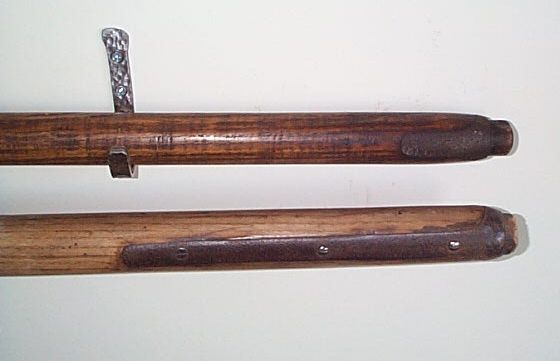

            Another interesting design feature is found at the other end of the boarding pike shaft. Around 1800 the Royal Navy was issued with a standardized design of pike. Having been designed by experienced Soldiers it featured a metal spike on the butt. On board ship it was soon found this spike damaged the deck and would become embedded in the wood when the pike was grounded. Boarding Pikes generally have a wooden butt. Some have a metal collar or fitting near the butt through which a wooden section of butt projects, and blunt brass fittings are sometimes found too.
         If you have enjoyed this article or it has been helpful to you please feel free to show your appreciation. Thank you.
The Books

http://www.angelfire.com/art/enchanter/epsdbook.html
http://www.lulu.com/shop/http://www.lulu.com/shop/phil-west/survival-weapons-optimizing-your-arsenal/paperback/product-21488758.html
http://www.lulu.com/shop/phil-west/crash-combat/paperback/product-22603842.html
https://www.amazon.com/Anatopismo-Underrealm-Novella-Phil-West-ebook/dp/B077G7MMFM

Thursday, 31 October 2013

Halloween!!


            Following the success of last year’s “How to Survive a Slasher Movie” and the sequel I need to post something memorable for this year’s Halloween.
 
           Will it be something scary? Something funny? Or will it salute the connection between Halloween and confectionary? I have found something that does all of these and more!

            Be warned!

This is Not Suitable For Work.

You may find it disturbing.

It may not be suitable for those of faint heart or weak stomach.
 
Yes, I am serious!

Having been so warned, click the link if you dare,

Wednesday, 30 October 2013

Fighting with Spears

It seems my cold has not done with me yet so I will not be writing a lot today. Instead I am posting some interested spear related-videos. The first few are for the Dagohir LARP events but have some interesting points.


Some interesting information on the one-handed use of spears.


A nice video on the use of Wing Chun pole, since a spear is more than simply a point. Shafts can both parry and strike too.


         If you have enjoyed this article or it has been helpful to you please feel free to show your appreciation. Thank you.
The Books

http://www.angelfire.com/art/enchanter/epsdbook.html
http://www.lulu.com/shop/http://www.lulu.com/shop/phil-west/survival-weapons-optimizing-your-arsenal/paperback/product-21488758.html
http://www.lulu.com/shop/phil-west/crash-combat/paperback/product-22603842.html
https://www.amazon.com/Anatopismo-Underrealm-Novella-Phil-West-ebook/dp/B077G7MMFM

Tuesday, 29 October 2013

Military Fork

            Given the subject matter of the last few blog posts it seems logical that today I feature a polearm with poliorcetic connection.

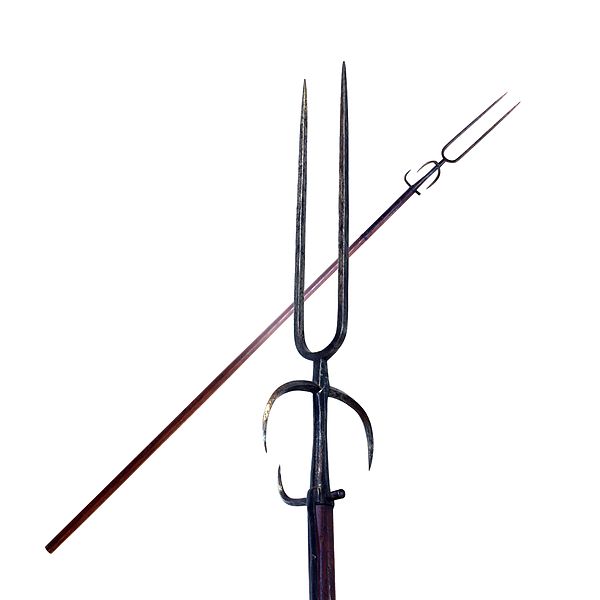
            The military fork is obviously a weapon derived from the agricultural pitchfork. What is interesting is that one reference book I have mentions that it is a particularly useful weapon to have around during a siege. The fork can be used to hold up ladders, or conversely, push them away from walls. It can also be used to raise supplies up to the battlements. The backward facing hooks might have seen application in fighting fires, pulling ignited thatch down from roofs. Given this is essentially a pitchfork, the tines themselves might be used to relocate burning thatch.

            As a weapon, the fork part could be used to catch weapons or limbs, perhaps pushing the victim’s guard to one side for the vital seconds needed for a comrade to make an attack. The backward facing hooks could be used to pull an enemy off balance or from his horse. Like many multi-tined weapons penetration depth would be limited, preventing the weapon burying itself too deep in a target so that it became difficult to withdraw.

            A not widely known fact is that the tines of a gladiator’s trident were so spaced that they prevented the likelihood of a point entering the eyehole of a gladiator’s helmet. Blinded gladiators were a poor investment so trident-armed retarius were therefore always paired with opponents with closed helmets. The military fork seems to have the opposite design strategy. Those two very slender but deadly points would doubtless sometimes menace the eyehole’s of an enemy’s visor.

         If you have enjoyed this article or it has been helpful to you please feel free to show your appreciation. Thank you.
The Books

http://www.angelfire.com/art/enchanter/epsdbook.html
http://www.lulu.com/shop/http://www.lulu.com/shop/phil-west/survival-weapons-optimizing-your-arsenal/paperback/product-21488758.html
http://www.lulu.com/shop/phil-west/crash-combat/paperback/product-22603842.html
https://www.amazon.com/Anatopismo-Underrealm-Novella-Phil-West-ebook/dp/B077G7MMFM