Sunday, 3 May 2015

Utopia and Competition.

            Recently I have been rereading Masamune Shirow's Appleseed books. Shirow’s writing style can be intricate. Often the reader encounters events that appear to have no connection to the storyline. The motivation or consequence of certain actions and threads are often not clear. The true loyalties of certain characters can be unclear too. In some instances this may reflect the subjective viewpoints of the main characters. They are involved in actions and conflicts but the movements of the greater political wheels and gears that drive them are invisible to them. Certain parts of a thread evidently happen “off camera”. For example, the character “Doric” is introduced as an infiltrator in book 3 but does little except engage the protagonists in light dialogue. The next time Doric appears her allegiance to a foreign power seems to be well know and the relationship seems to be guarded but not overtly hostile.
            The reason I felt inclined to reread this work is a philosophical thread running through the first two books. The nation of Olympus is portrayed as being as near to a utopian state as mankind has been able to achieve so far. This, however, brings its own problems. Other nations resent Olympus’s influence and attempt to compete, undermine and subvert the nation in various ways. The rulers of Olympus identify a far greater problem with the potential to not only destroy Olympus but to plunge humanity ultimately into extinction.

            As one elder explains “The core problem is that you can’t have a perfect society without perfect people.”.... “The society creates the people, and when the people come together, they create the society........use ordinary people and all you get is an ordinary society”. In Olympus they have attempted to address this problem by making a significant proportion of the population, including its administration, of bioroids. Bioroids are a type of clone designed to be more rational and less emotionally extreme than “original” humans. Their duty and motivations are towards the welfare of the human species as a whole rather than towards themselves as individuals.
            Not being as ruled by extremes of emotion as humans, the bioroids find themselves at a disadvantage grasping the potential extremes that human behaviour can reach. Once they see the problem they debate it with the nation’s government computer, “Gaia”. The bioroid council are supposed to be the “emotional interpreters” for the computer. Unfortunately the Gaia computer concludes the best prospect for the human race is the destruction of the Olympus utopia. Humans in a utopia will either stagnate or human nature will cause its self-destruction and a conflict that will destroy the rest of humanity. One human character describes Olympus: “I thought it was good here too...at first. But it’s not dreamland. It’s..it’s a zoo. A zoo for those weird animals that build their own cages and hide inside them.”  How mankind would survive the likely word-wide conflict the power vacuum the destruction of Olympus would create is not explained.
            If we ignore the science fiction elements in the above scenario we still have some important concepts to consider.
            A utopian society implies that its members are immune to many of the harsher aspects of mother nature. Food, shelter and water are abundant. Children can be raised safely. Members are free from predation, both from their own species and other species. In some modern societies we can see some of these traits evident to a lesser degree. What we often see is that such advantages are not generally appreciated for the value they have. In many cases they are so much taken for granted that they are mislabelled as “rights”.  People become soft and complacent.
            One of Shirow’s characters briefly mentions a “domestication effect” and that members of a society would “channel stress into aggressive behavior”. “Stress” may not be the best translation here but I think we can understand what is being said.
            If we look at a creature such as a lion, it seems happy to spend much of its time sleeping and raising cubs. It hunts when it needs to. It defends its territory and competes for a mate when it must. If we consider a human living a similar bare subsistence existence we see a much greater inclination to competition. Despite the struggle of keeping the family fed, the human will still find numerous ways to compete with their fellows. Some of these competitions have obvious prizes such as status to win mates or the expansion of territory. Many, however, are games or pastimes where the reward is pride or some other abstract of no real value.
            The Romans summed things up neatly with “Bread and Circuses”. As well as food, shelter and other necessities humans also needed entertainment and distraction. “Bread and Circuses” is still a mainstay of government, the only difference being that it has now been realized the great unwashed can be made to pay money for such things. Many of our diversions are competitive in nature. When we do not have obvious tribal differences we create them. People invest their emotions into the fortunes of a particular sports team. They may not be from the region the team nominally represents, possibly not even from the same nation. I have met loyal Manchester United fans from as far away as China and Japan. The majority of a professional sports team are often not even from the same country, let alone the town they represent. When we lack actual competitors we will often create them. Sometimes this is simply following the fortunes of a particular team. Other times it can be based on divisions along social, economic, racial, religious, ideological and national groupings.
            Competition is necessary and unavoidable. Humans seem to have a need for it. A working utopian society would probably need to provide some form of healthy outlet for such inclinations. Ideally these would take the form of self-improvement activities whereby the individual challenges themselves and reaps some benefit in fitness or knowledge. Most likely for the majority this will be the easier route of following the exploits of some team of theirs against others.
            A key phrase in the above passage was “healthy outlet”. The human need for competition can be met by conflict and warfare. Historian Niall Ferguson has made the observation that many human conflicts, whatever the apparent economic or ideological motivations can be boiled down to a conflict between different ethnic groups. While some people will choose to interpret that as justification for racial conflict I believe it is simply division along the lowest common denominator of social grouping. In many village societies sports such as wrestling or singlestick were often important. It allowed the young men of the village to compete against each other or neighbouring villages without too much likelihood of bloodshed or permanent injury. Perhaps the correct solution to football hooliganism would have been to provide areas where “firms” of consenting hooligans could have fought away from innocent bystanders and property.
            Competition that disrupts a society is obviously unhealthy. So too is competition for disproportionate rewards. In the novel Starmaker” by Olaf Stapledon the narrator observes of the civilizations he views:-
                “We were inclined to think of the psychological crisis of the waking worlds as being the difficult passage from adolescence to maturity; for in essence it was an outgrowing of juvenile interests, a discarding of toys and childish games, and a discovery of the interests of adult life. Tribal prestige, individual dominance, military glory, industrial triumphs lost their obsessive glamour, and instead the happy creatures delighted in civilized social intercourse, in cultural activities, and in the common enterprise of world-building.”

            We are persuaded to buy new cars and other products we do not need supposedly to impress friends, neighbours and strangers. Often the opinions of people that do not matter or should not matter to us. Nations and societies are just as guilty. Despite economic problems the UK spent thousands of millions to host the recent Olympic games, even though few Olympics have ever produced a profit for the hosting nation. The medals won have little real value. The army, health service and police services have all undergone funding cuts and downsizing due to the money wasted. Brazil has hosted the World Cup and will soon host the Olympics. Not only will the nation lose thousands of millions but the events are being used to steal property from some of the poorest elements of that society.
            The philosophical concepts Appleseed raises are though provoking and I wish Shirow had pursued these threads further. But, as he says himself, he is just an artist and does not have all the answers.
            Certain educators have tried to teach kindergarten children not to be competitive. Competitiveness is apparently an inherent and strong trait of the human psyche. Attempts to eliminate it are doubtless doomed to failure. What is needed is for our competitiveness to be educated along more rational rather than emotional imperatives. We need to learn to view competition and realize sometimes the result or prize does not actually matter! Warfare for defence is necessary. Warfare for national prestige/ patriotism/ religious dogma is seductive but false. Pride in your society/ nation/ self is a state of mind and should not require a vast expenditure of money that cannot be afforded.
            Fights are not the only conflicts that we need to pick wisely!
         If you have enjoyed this article or it has been helpful to you please feel free to show your appreciation. Thank you.
The Books

http://www.angelfire.com/art/enchanter/epsdbook.html
http://www.lulu.com/shop/http://www.lulu.com/shop/phil-west/survival-weapons-optimizing-your-arsenal/paperback/product-21488758.html
http://www.lulu.com/shop/phil-west/crash-combat/paperback/product-22603842.html
https://www.amazon.com/Anatopismo-Underrealm-Novella-Phil-West-ebook/dp/B077G7MMFM

Tuesday, 28 April 2015

Grand Theft Autocracy


            This weekend I was reading a short story and came across this passage:

"Society," mused Jadiver. "I always did think it was better to rob the rich ... like Robin Hood."

"Sure," Burlingame said.

Jadiver tilted the glass. "Especially since the poor don't have much money."

"That has something to do with it," Burlingame cheerfully agreed.


Cobber broke in. He was a little gnarled man, older than the others. "A point, Jadiver. The poor don't have much money, but there's so many more of them. You can actually be more successful robbing them. But you have to keep at it every day in the year, and then you don't call it robbery; you say you're governing them."


            Yesterday, a friend sent me this interesting article which nicely echoes the above sentiment.


The Books
http://www.angelfire.com/art/enchanter/epsdbook.html
 

Saturday, 18 April 2015

The War Arrow and The Deserter

            Some of the articles posted on this blog are written just a few minutes before they are posted. Others are started some time in advance and may undergo several rewrites or modifications. Inevitably for me, some of the latter get delayed while other topics take precedence.
            Around Christmastime I was drafting a couple of articles on cavalry swords. This lead me to some examination of cavalry tactics being used in the late 19th  and mid 20th centuries. The widespread use of repeating weapons had a considerable effect on cavalry tactics. They did not, however, render the cavalry “immediately obsolete” as so many uninformed “experts” will tell you. Cavalry remained a useful asset until at least the 1940s, well into the age of repeating weapons and machine guns. I will discuss this in later blogs.
            A side branch of this train of thought had me recalling an unusual western called “The War Arrow”(1953). In this movie a cavalry officer recruits some displaced Seminole Indians to help fight an aggressive faction of  Kiowa. The officer trains his force in some unconventional (although appropriate) tactics. At one point in the movie another officer exclaims in scorn “...digging holes! Firing dismounted! Charging with just four men at a time!” The last part in particular is unusual and I wonder what source the script writer was using.

            The unconventional training in this movie reminded me of another movie seen in my childhood. The officer recruits some of his force from the guardhouse and has them wearing buckskins rather than uniforms. The only bit I could really remember was that during training there was a duel with tomahawks. It has taken me several months to identify this second movie. My recollection was that one of the combatants was an imposing figure, someone like Woody Strode. Yesterday I successfully identified the movie as “The Deserter”(1971). As it turns out, the tomahawk duel in the movie is not actually that good. Just lots of muscle against muscle. If you want some information on how to use a tomahawk more effectively, check out my earlier blog and invest in my book.
            The Deserter is, however, an entertaining movie and some of the other ideas in it are more informative. Give it a watch.


If you have enjoyed this article or it has been helpful to you please feel free to show your appreciation. Thank you.
http://www.angelfire.com/art/enchanter/epsdbook.html
http://www.lulu.com/shop/http://www.lulu.com/shop/phil-west/survival-weapons-optimizing-your-arsenal/paperback/product-21488758.html
http://www.lulu.com/shop/phil-west/crash-combat/paperback/product-22603842.html
https://www.amazon.com/Anatopismo-Underrealm-Novella-Phil-West-ebook/dp/B077G7MMFM
https://www.amazon.com/Hell-Ay-non-partisan-sourcebook-role-play-system-ebook/dp/B07FQSHSQC


Tuesday, 17 March 2015

Handcarts and Alternatives.

            The last couple of posts have been on martial arts so today’s will be more survival orientated.

            Recently I saw a comedian who commented:

 “We put men on the moon decades before we thought of putting wheels on suitcases.”

            I have been researching a few other topics that are out of the scope of this blog but a common thread that keeps turning up is that of handcarts.

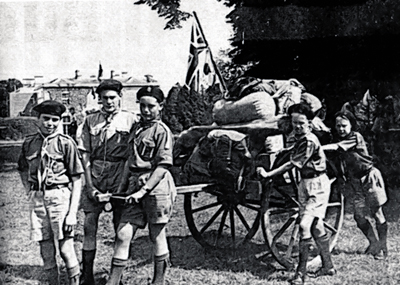
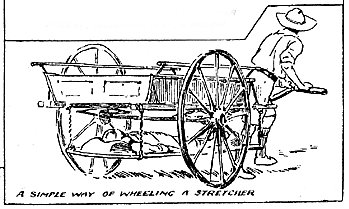
            There was a time when every scout troop had at least one handcart to move their tents and supplies. Many of these would have been made by the troop themselves. Below is a rather nice illustration of a stretcher case suspended below a handcart. Perhaps the Scoutmaster was having a nap.
 

            When 3,000 Mormons chose to migrate to Utah in the 19th century they travelled in companies of handcarts. Some of these families came from as far away as the British Isles and Scandinavia.

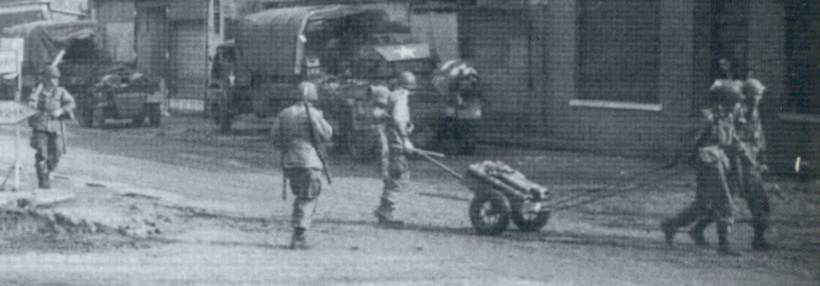
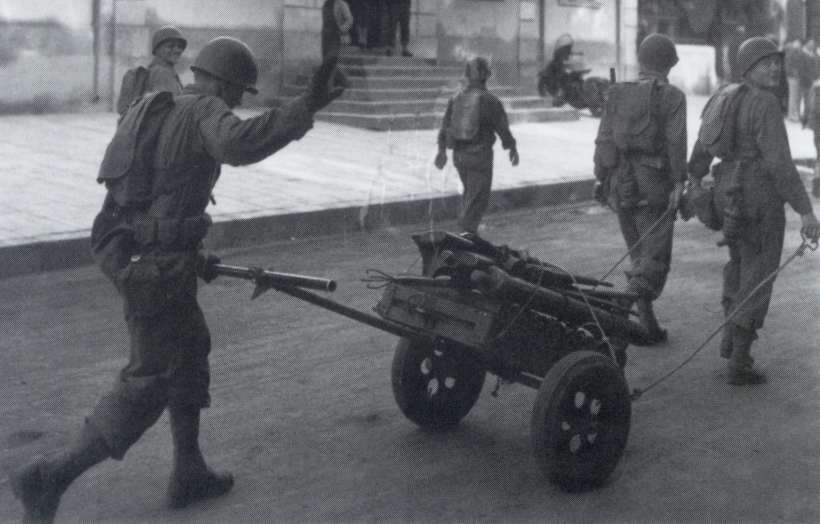
            I have come across many photographs of handcarts in use during the Second World War. This is a nice webpage on the US military handcart. A couple of these could ride on the flatbed of a truck and still leave room for a squad or two of troops seated on the side benches. Handcarts are shown towed behind jeeps or riding in the cargo area of the jeep.
 
 
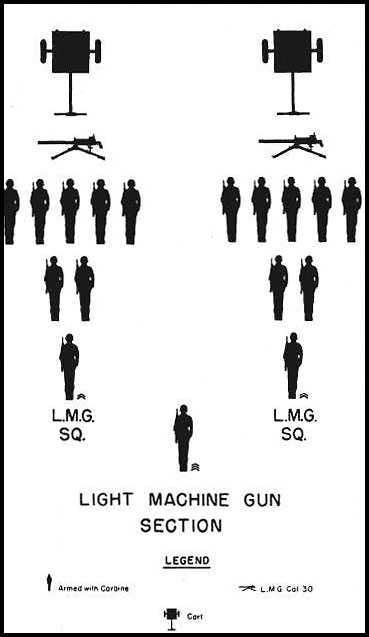
           The picture below depicts a 1944 USMC machine gun section, and you can clearly see they had a handcart as standard equipment for each squad. As an aside, I note the 1944 MG squad had seven men and a handcart to service one M1919 MG. With one leader, a gunner and an assistant gunner that leaves four men to carry ammo and for local defence. An equivalent unit these days has two MGs, seven men and no cart, which implies only one ammo bearer per gun. Modern troops are probably vehicle mounted but that is no comfort if you have to move the MG and ammo more than a few metres.


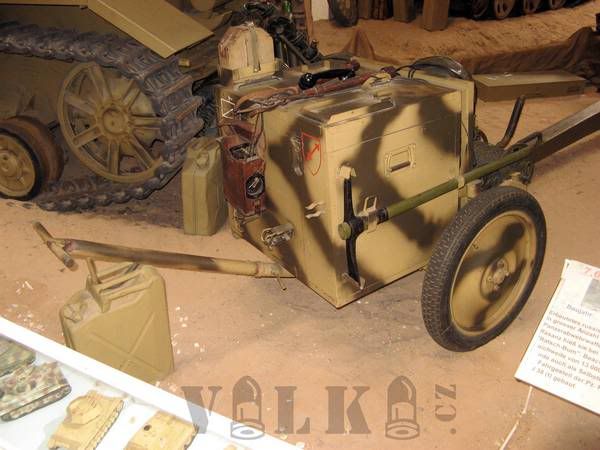
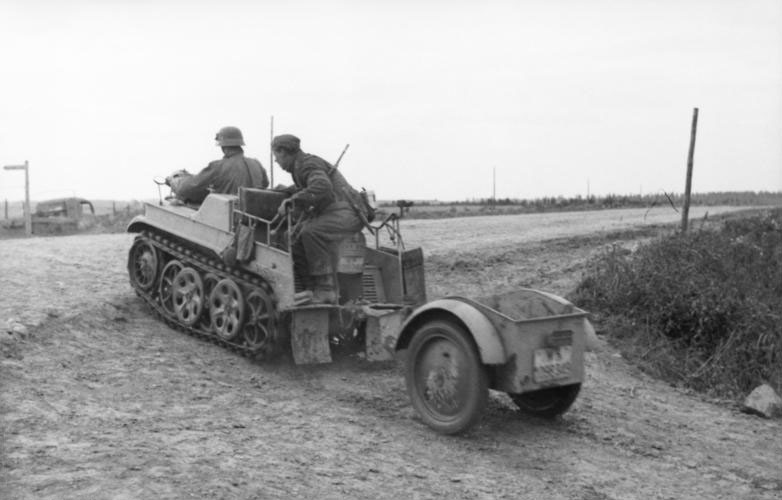
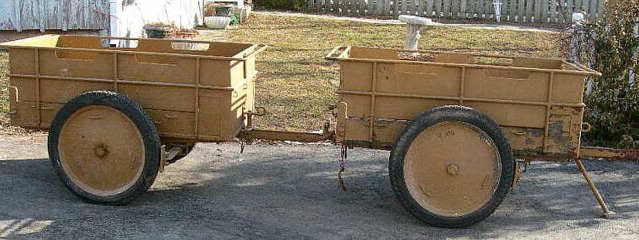
            The German army also made use of handcarts. These were designed so they could be towed by men, horses, mules, dogs or vehicles and even had their own tow hooks so a train of them could be constructed.


            One thing that you notice about the military handcarts is that they are quite narrow. This is logical since the main place you would want them is where you cannot take a vehicle. The handcart must be narrow enough to navigate a jungle trail or mountain path. A “T” shaped shaft seems standard for military handcarts, probably since it can be more easily disengaged from than the “rickshaw” style of two shafts and a crossbar.

            For some reason, modern outdoorsmen and Soldiers overlook the utility of a simple handcart. Some of you reading this blog will have created bug-out bags and perhaps even supply caches. How much better would your chances be if you also had a nearby handcart of additional supplies, water and equipment?

            If you are building or buying a handcart there are obviously a number of features to look for. We have mentioned the T-shaft and that narrowness is a desirable characteristic. Ideally a loaded military handcart should not be so heavy that a couple of men cannot lift it over an obstacle. If you are on your own you may want something lighter. Being able to float the cart across a river is a desirable design feature. Some carts I have seen are narrow but about five feet long, making them suitable for transporting an injured companion in an emergency. It may be useful if you can convert your handcart into a sled or pulk when weather requires. In fact a sled or pulk may be a good starting point for a handcart construction project.


            I’ll end this discourse by looking at a few interesting alternatives to the handcart. Wheelbarrows can be used as emergency handcarts. They have the merit that in some neighbourhoods they are fairly common. An extension of this idea is the Chinese big wheel wheelbarrow. You may need some skill distributing the load in a balanced fashion but it is evident these can handle heavy loads and quite rough terrain.
 

            Another alternative is the Christiania Bike. (I know it is a trike, but they are usually called bikes!). If you have visited Copenhagen you will know these are a common sight in that city. Young Danish mothers use them to transport their children to school and then pick up a heavy load of shopping. After dark you sometimes see drunk couples returning home in a Christiania bike. This culture of cycling everywhere may explain why nearly every second woman in Copenhagen is worth a second look! The Christiania bikes are very nicely designed. In most of them the large box at the front contains a smaller box that serves as both a seat for passengers and a locked storage compartment. The Christiania “as is” is not really designed for rough terrain but the basic idea could be adapted to use mountain bike tires and gearing. Add a few lifting handles. One might even design it so that it can be towed like a handcart when possible.


         If you have enjoyed this article or it has been helpful to you please feel free to show your appreciation. Thank you.
The Books

http://www.angelfire.com/art/enchanter/epsdbook.html
http://www.lulu.com/shop/http://www.lulu.com/shop/phil-west/survival-weapons-optimizing-your-arsenal/paperback/product-21488758.html
http://www.lulu.com/shop/phil-west/crash-combat/paperback/product-22603842.html
https://www.amazon.com/Anatopismo-Underrealm-Novella-Phil-West-ebook/dp/B077G7MMFM