Tuesday, 19 May 2015

Tolerance and the Burke on the Bus.

            Let me give you a hypothetical situation:- You are sitting on a bus. A few seats ahead of you a man pulls out his phone. For ease of reference we will call him “the burke”. The burke begins to talk into his phone, loudly, in some language you cannot understand. His conversation goes on for five minutes, then ten and then fifteen and shows no signs of ending.
            Would you find this irritating? I know I would, but why?
            Permit me to set some background to today’s blog topic. A few days ago my computer at work picked up something nasty by some unknown route. Our computer guy decided that it was simplest to just rebuild the operating system. This will save the few files I had on the machine but will erase the useful programs I had installed. Once again, I am going to remind you all to backup both your files and your program installers. I have been without my work computer for this time so I began to investigate my colleague’s book shelf. I picked a copy of what I thought was “King Solomon’s Mines” and saw it was actually “King Solomon’s Ring”. Not a sequel, as it turned out but a highly entertaining and informative book on animal behaviour by Konrad Lorenz. Finishing the book within a day I noticed another book by him, “On Aggression”. A lot of interesting things in this book, and this gave me some insight on why the “burke on the bus” can evoke such strong emotions.


            What I learnt was that a culture or subculture has a collection of common habits/ rituals/ customs/ mannerisms. These are so omnipresent in our own culture that we will not be aware of many of them until they become notable by their absence in others. On the buses that I was used to when growing up people tended to be silent or talk at a discrete level. In some countries I have visited the inside of a bus sounds like a fishwife riot. It can be argued that mobile phones have created a change in social norms. That may be so, but it is not really relevant since social norms are not necessarily logical or functional but they are powerful. They are habits that will be strongly ingrained. Some of these conventions are very subtle, such as head position and other mannerisms when paying attention to someone. These can differ between different cities or social groups and encountering different mannerisms can cause wires to get crossed. I once watched a film from Africa. As one character explained something the person he was talking to made an “uh-ha” noise every few seconds. If someone I was addressing did this I would be inclined to perceive them as being rather moronic, irritating or possibly mocking me. To the Africans in the movie this was good manners and they would probably perceive my way of listening and paying attention as boredom and rudeness. Customs that are common in one subculture are repugnant in others. Walk the streets of Hong Kong for a day in the right season and you will hear someone hawking and spitting about every five seconds!
            For many people on this bus the burke is violating at least one social norm as they perceive it. It may be in the sub-culture he is from people do talk loudly in buses so he is oblivious that this is not common where he is now. That he is not speaking English and that he assumes his conversation will not be intelligible to his neighbours may have an influence here. Whether he is operating in ignorance or arrogance is irrelevant. To some observers at least he is a social transgressor. A common selection of social norms is said to be a way of social bonding. What is apparent is that violation of these norms causes feelings of tension, discomfort, irritation, anxiety and even aggression.
            There is another reason why the burke on the bus stirs such negative emotions. By talking loudly in public he is effectively announcing that anyone in earshot is irrelevant to him. Now, we do not expect a complete stranger on a bus to have any particular affection or concern for us, but openly rubbing our noses in this fact is another matter. Unintentionally or not, the burke is effectively insulting everyone else present and our subconscious responds accordingly.
            Sometime ago I visited a webpage where the author said something on the lines of “..I know this is about a British game but I am American so I will be spelling it ‘armor’!” It is hard for me to recall that without imagining him finishing with a smug, self-satisfied grin. This statement irritated me and my recent readings have explained why it was actually offensive. That an American should use American spelling is not an issue. What was offensive was his statement was attacking and demeaning English conventions. Before some of my American readers dismiss my reaction as oversensitive consider how you would react if a blog started with the declaration that words would be spelt “properly” in English fashion. Exactly!
            As an aside, the reason why many words are spelt differently by Americans is that Noah Webster deliberately changed the spelling to promote American cultural identity. The cultural norms we are discussing include such factors as accent, lexical register, word choice and so forth. It is a common if somewhat juvenile occurrence for sub-cultures to deliberately change their vocabulary to promote cohesion.
            Returning to the burke on the bus (who is still talking, no doubt!). He is violating at least one social norm and provoking negative emotions in his neighbours. Most social animals also have a collection of rituals/ laws/ social norms. On the rare case that a member of the group violates these rules it usually provokes immediate censure, sometimes by the rest of the flock/ group. The birds/ monkeys/ wolves descend on the miscreant, pecking and biting and it is soon made clear to him or her not to repeat those actions. Sadly, this will not happen to the burke on this bus. A social norm in many cultures is to mind your own business and avoid confrontation with strangers. Our custom of tolerance of different customs in this incidence promotes violence and friction. So the burke keeps on talking and those around him become more irritated and quietly seethe. I have frequently observed that trying to please everyone usually results in more people being dumped on and the inconsiderate individual being rewarded. The burke never learns better and more people suffer. When aggression cannot be applied to its cause it is often redirected in displacement behaviours. Human nature is such that many passengers will leave this bus and instead of feeling irritation at the uncouth burke will redirect these feelings into a more generic routes. It may become a more generic resentment of foreigners or immigrants.
            We are so imbued with our own cultural norms we have difficulty perceiving them yet they are very real factor in human relationships. I am fond of saying “tolerance works both ways”. I once encountered an American whose pet topic was a discourse on the “evils of diversity”. His (dream) world-view failed to understand that there are numerous variations in cultural norms between cities or within a single district. Whether you like it or not, any human society will contain multiple cultures. In a multicultural world all sides must strive to find common ground and adapt their habits and customs as necessary.
         If you have enjoyed this article or it has been helpful to you please feel free to show your appreciation. Thank you.
The Books

http://www.angelfire.com/art/enchanter/epsdbook.html
http://www.lulu.com/shop/http://www.lulu.com/shop/phil-west/survival-weapons-optimizing-your-arsenal/paperback/product-21488758.html
http://www.lulu.com/shop/phil-west/crash-combat/paperback/product-22603842.html
https://www.amazon.com/Anatopismo-Underrealm-Novella-Phil-West-ebook/dp/B077G7MMFM

Monday, 11 May 2015

Baton Thongs

            Did you notice my “deliberate mistake” in the first draft of the previous blog? As I typed “wrist loop” something nagged me to use another term, but “martingale” is rather obscure these days, certain dictionaries no longer acknowledging it.
            For a weapon such as a baton a wrist loop should never be used on the wrist! If it is and the baton is grabbed by an aggressor you will find yourself undesirably under their control.
            The correct way to retain a baton is to use the loop as a thumb loop. Hook it over your thumb, let the thong go around the back of the hand then grasp the grip. If the baton is seized you can just open your hand and let the loop slip off your thumb. Counter attack before the aggressor realizes you have let go.
            Most batons you will encounter will have the thong mounted at the butt of the baton. The FBI Baton Manual (which is well worth a read, btw) recommends the thong is mounted above the grip and is about twice as long as you might expect is needed. Once again, the thumb is used. With this thong you have two options. The first is to let the thong hang down the back of the hand and then grasp the grip. This is effectively the same as the method already mentioned for a base mounted thong. The second method is to first let the thong hand down your palm, then take it up the back of the hand and pass the grip over the top of the hand and into the palm.

 
            All of these methods wrap the thong securely around your hand but allow the weapon to be rapidly released if grasped. Those of you that brought my book on Survival Weapons will be familiar with the illustration below. This shows the same methods being used for a machete. Having a machete fly out of your hand when you hit a resilient piece of wood can make you unpopular so a thong is recommended!

            A long thong on a baton has other applications. Below is an illustration of a restraint. Both of the suspect’s hands are passed through the loop and it is then twisted and rolled around the baton to tighten it. A second way to use the loop is taken from Fairbairn’s “Get Tough”. The suspect does not have multiple arms! This shows the thong being tightened around the wrists of several prisoners so that they may be led.

 
         If you have enjoyed this article or it has been helpful to you please feel free to show your appreciation. Thank you.
The Books

http://www.angelfire.com/art/enchanter/epsdbook.html
http://www.lulu.com/shop/http://www.lulu.com/shop/phil-west/survival-weapons-optimizing-your-arsenal/paperback/product-21488758.html
http://www.lulu.com/shop/phil-west/crash-combat/paperback/product-22603842.html
https://www.amazon.com/Anatopismo-Underrealm-Novella-Phil-West-ebook/dp/B077G7MMFM

Friday, 8 May 2015

Lathis and Police Canes

            For once, I will not describe the convoluted threads of thought that caused to research “Lathi”. Many definitions of Lathi have it as a bamboo stick of about five foot length, often with the ends bound with metal. Lathi actually means “stick” and the examples that seem to have been used by Indian police in more recent years seem to be shorter. Readers of previous blog posts may be recall my post on HG Lang’s book on Walking Stick defence, based on Vigny’s La Canne techniques. Lang’s recommendation was a light walking cane of Malacca or Ash root. It used velocity and fast manipulation by the wrist for effect rather than weight. Lang was an officer in India and mentions that some police forces there had shown interest in the ideas. Possibly the switch to shorter lathis for police use was influenced by this.

            What is of particular interest is that the bamboo Lathi seems to be being phased out. This article here sets the scene.


The upshot of this is that if you google “lathi” you will get a large number of hits offering you the plastic replacement. The suppliers, who are keen to sell these, call them “lathi”. I note that the article above seems to avoid calling the new version a lathi. “Lathi-charge” has similar connotations to terms like “baton round” in some other countries so I can see the Indian police might want to disassociate from the term.

Because so many companies are keen to market “lathi-replacements” gathering some data about the items was much less of a task than much of my research.


The sticks are about a metre long and 25mm external diameter. They are made of polycarbonate. On one end is a 6” handle with a thumb loop ("wrist loop" is a misnomer for batons!). One site describes this as “mock-leather” so it is probably some form of rubber-like polymer. On the other end is a 4” cap, apparently of similar material. Surprisingly, the sticks are actually tubes! Internal diameter is given as 17mm or 19mm, giving wall thicknesses of 3 or 4mm. One site gives the weight as around 350gm/12oz. Sticks/Canes are available in black, khaki and clear.

One question that occurs to me is why such a subdued choice of colours? I think the police are missing a few good tricks here. Suppose we have “cop canes” in a nicely visible light blue? You do not even need to cast them in a new colour of polycarbonate. Pour a cup full of paint down a clear tube, pour it out again and you have your blue cane.

 In “Kill or Get Killed” Rex Applegate talks of the psychological effect on a mob of being confronted with an obviously disciplined force with “white baton, white helmet and white gloves”. Highly visible metre-long blue batons would have the same effect. Blue batons would make officers more visible, useful when operating with police helicopters. Waving a blue cane above your head will alert comrades and civilians to the location of an officer. The highly visible cane has obvious applications for directing traffic or civilians. Held in two hands it can be used as a barrier to keep crowds back. Doubtless we will soon see a vocabulary of signals that can be made with the baton, useful when radio communication is not practical.

What is not apparent in the above article is whether these polycarbonate canes will just be issued for riots or will be carried routinely when on the beat. Personally I think the latter is the better option, at least for cops that walk beats rather than ride in cars. Police actually walking the streets seems to be on the decline in many cities. I think this is a mistake. Patrol cars are good for responding to crimes and traffic enforcement. Patrolling on foot detects and deters crime.

A long cane will be a great asset for a cop walking a beat. Firstly, it serves as a walking cane, and is useful if the ground is slippery. A cane will generally be carried in hand rather than worn on a belt or in a pocket. This means it can be rapidly brought into action should a sudden threat arise. The length of a cane gives an advantage against attacks from weapons such as knives or bottles. The officer has a chance to disable an attacker before he can close distance. The length of the cane allows the officer to strike targets such as the legs that would be difficult to reach with a truncheon or shorter baton. A cane is sufficiently light enough that the officer can still carry a PR24, flashlight or other impact weapons in addition to the cane.

 
How to use a “Police cane”? Given the light weight of these canes HG Lang’s book and techniques are the obvious starting point. Lang describes strikes to the head, throat and chin but primary targets for police use will be the limbs, it being understood that in this context this includes the trapezius and clavicle regions. The reach of the cane allows a fast painful strike to be snapped into the leg, arm or hand, as required. For closer ranges some of the techniques in my book such as the bumper method can be used. The rubber-like caps at either end of the cane allow thrusting and striking techniques with the ends with less risk of excessive damage. A variety of locks and restraining moves can be made with a metre long cane. I detail the principles behind these in my book. For a wealth of examples consult “Stick Fighting” by Masaaki Hatsumi. The FBI Baton manual and the baton and long baton sections of “Kill or Get Killed” are also worth a view.


The tubular construction of the cane offers some interesting possibilities. If the canes prove to be too light a second, smaller tube or other material can be inserted inside to increase the weight. A small diameter flashlight, inserted in the handle end would turn the can into a metre long lightstick –which would make it look like the police are armed with lightsabres!.

The police cane has much to recommend it. Having such devices “readily to hand” may mean less recourse to more lethal defensive measures.
         If you have enjoyed this article or it has been helpful to you please feel free to show your appreciation. Thank you.
The Books

http://www.angelfire.com/art/enchanter/epsdbook.html
http://www.lulu.com/shop/http://www.lulu.com/shop/phil-west/survival-weapons-optimizing-your-arsenal/paperback/product-21488758.html
http://www.lulu.com/shop/phil-west/crash-combat/paperback/product-22603842.html
https://www.amazon.com/Anatopismo-Underrealm-Novella-Phil-West-ebook/dp/B077G7MMFM

Monday, 4 May 2015

Of Boxers, Chariots and Fandom...

            Given that I am the author of a comprehensive martial arts and self-defence book you might assume that I have a considerable interest in boxing. Those of you that have invested in a copy of my book will know that I do not underrate the potential potency of a trained boxer in a fight. Professional boxing, however, is of very little interest to me so I have not been paying much attention to the hype surrounding the Pacquiao-Mayweather fight. A considerable number of real life concerns has meant that it was only this morning that I heard about the size of the fees involved for this fight. 


            The purse for this fight was set at $300 million to be split 60/40 in Mayweather’s favour. Additional funds will come from pay-per-view royalties and various other sources. It is an amazing amount of money for a single fight. A mere pinch of this could solve most of those real life concerns I mentioned. Some people will say that it is wrong for sportsmen to be paid this sort of money but it is worth remembering the boxers are only getting a fraction of the actual money involved. The promoters and TV companies must be making many, many times this. Is it really wrong that the fighters who take the blows get a reasonable cut of this fortune? Both fighters have trained and worked hard to get to where they are and a career in professional boxing is not without considerable real risk.

            Yesterday my blog was about competition and I touched on the role sports can play in redirecting certain traits of the human psyche. Professional sports are one of the better value means to do this. The money paid to many professional sportsmen may seem obscene, but it is a fraction of the money the sport actually generates. Most professional sports factions are profit making and therefore self-funding. A team that fails to make money probably lacks a sufficient fanbase and is not that effective in fulfilling its sociological role, it can be argued.

            As I pointed out in the previous blog, not all sporting diversions are desirable. The Olympics is a good example of a very poor investment in time and money. Thousands of millions of dollars spent for just a couple of weeks of sport. Many of these sports generate so little interest tickets are given away for free to try and fill seats. The up and coming Olympics in Brazil is being used as an excuse for a land grab. Thousands of poor people are being forced out of their homes at gunpoint. Across the span of two decades it is estimated that the Olympic games have displaced more than two million people, often the most disadvantaged in communities. So much for peace and brotherhood through sport!

  
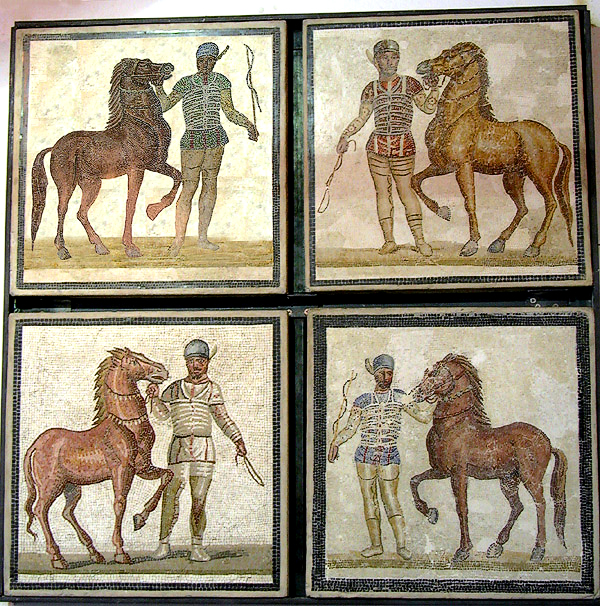
          Following a faction or professional team is nothing new. “Circuses” of “Bread and Circuses” refers to chariot racing, Rome’s most popular sport. The chariot racers were divided into four factions, each with a distinctive colour. Fans would wear these colours and cheer for their chosen side. The emotional investment in their team would be familiar to anyone who has encountered modern day sports fans. Gladiators were also idolised and subject to marketing, souvenirs etc. Gladiators were followed as individuals, more like modern boxers. I have not yet found any references to fans favouring specific ludi. I don’t doubt that both sports had their “stats freaks”.

            I have added a new link to yesterday’s blog. The comments at the start about the social role of the races is interesting:
            “For the people—who once conferred imperium, symbols of office, legions, everything—now hold themselves in check and anxiously desire only two things, the grain dole and chariot races in the Circus” (Satires 10.77-81)...... Juvenal has put his finger on two of the most important aspects of Roman chariot races—their immense popularity and the pleasure they gave the Roman people, and the political role they played during the empire in diverting energies that might otherwise have gone into rioting and other forms of popular unrest.


If you have enjoyed this article or it has been helpful to you please feel free to show your appreciation. Thank you.

http://www.angelfire.com/art/enchanter/epsdbook.html
http://www.lulu.com/shop/phil-west/crash-combat/paperback/product-22603842.html
http://www.lulu.com/shop/http://www.lulu.com/shop/phil-west/survival-weapons-optimizing-your-arsenal/paperback/product-21488758.html
https://www.amazon.com/Anatopismo-Underrealm-Novella-Phil-West-ebook/dp/B077G7MMFM
https://www.amazon.com/Hell-Ay-non-partisan-sourcebook-role-play-system-ebook/dp/B07FQSHSQC