Wednesday, 22 July 2015

Some Thoughts on Money.

            Money has been a recurring theme in this recent holiday. Most obviously we were travelling in Greece, which is undergoing a financial crisis. This required me carrying far more cash than I would usually do since for a while the cash machines were offering a limited service at best. My own finances were also somewhat turgid, our trip being necessitated by my girlfriend’s son’s visa being about to expire. We had to spend a week out of the country even though recent other expenses had made this a bad time for me to be spending. If you have been considering buying any of my books or using the donation button, now would be a good time, thank you.


            One store in town had a counter top covered with a variety of foreign bank notes under glass. Quite an impressive collection. I took my girlfriend and her son there to see a British one pound note (long since discontinued). There was also an American $2 note and another note with a grinning Saddam Hussein.

            Something that came to my attention on this trip was the similarity between certain Euro notes. Both the fives and twenties appear a blue colour, the tens and fifties a red. They look distinctive in the above picture but in practice it was quite easy to confuse these if you were not careful. Given that the Euro is a relatively new banknote design it is a little surprising that more thought did not go into its design.
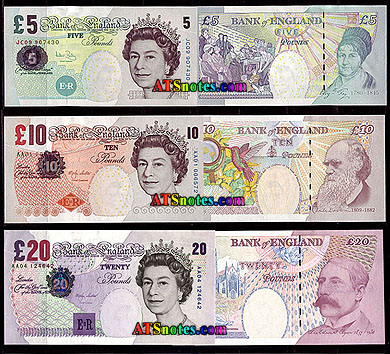
 

            British banknotes, for example, are different colours. £5, £10, £20 and £50s are respectively blue, brown, purple and red. £1 notes were green and the £1 notes still issued by some regional banks are still this colour. Some series of notes also featured a distinctive simple shape in this colour. For example, the £5 a blue circle, £10 had a brown/orange diamond, the £20 a purple square and the £50 a red triangle. (The current £20 seems to have dropped this feature) These shapes were designed to further aide the partially sighted. Different denominations were also different sizes. I have been told that the visually handicapped were provided with a little gauge they could use to measure the length of a note to identify it.
          The now discontinued Dutch Guilder notes took this a step further by providing raised tactile markings to assist the visually impaired (the dots and triangles). One might have hoped the designers of the Euro would have drawn on these sources for inspiration, but apparently not.

            Some Canadian notes have tactile markings for the visually handicapped and it is apparently planned for some US banknotes. It would, however, be more useful if this became a universal feature. Next year the Bank of England plans to issue polymer banknotes. This would be a good opportunity to introduce tactile markings but I expect this will not be exploited.
         If you have enjoyed this article or it has been helpful to you please feel free to show your appreciation. Thank you.
The Books

http://www.angelfire.com/art/enchanter/epsdbook.html
http://www.lulu.com/shop/http://www.lulu.com/shop/phil-west/survival-weapons-optimizing-your-arsenal/paperback/product-21488758.html
http://www.lulu.com/shop/phil-west/crash-combat/paperback/product-22603842.html
https://www.amazon.com/Anatopismo-Underrealm-Novella-Phil-West-ebook/dp/B077G7MMFM

Tuesday, 21 July 2015

Back Blogging

           Back from my trip abroad. In my last post I described how baggage restrictions limited what I could take with me.

           Since we were restricted to cabin baggage only I was unable to take along my Swiss army knife, mini-leatherman or even the little penknife and can opener that usually rides on my keyring. I will admit that there were several times I missed these tools. I doubt a trip of more than a week would be practical without them. For one thing, my nails grow rather fast and need regular trimming.

           One item I did insist on taking was my medical kit, although I removed the haemostats from it just in case there were any objections. Most of my general emergency kit remained at home but I did decide to take my sewing kit from it and stow it with the medical kit.

           I think it is seldom that I have had a trip where the sewing kit was not needed. Something about being far from home seems to increase the likelihood of breakage. For this particular trip its use was more mundane. My girlfriend wished to modify her bikini to reduce the area of tan lines. She was initially dubious about the “invisible” thread in the kit but once she tried it was of the opinion that it was rather clever.

           As an amusing aside: One restaurant we frequented showed videos from a fashion channel, often promoting bikinis and swimsuits. My girlfriend is Brazilian and what many fashion designers regard as “daring” and “sexy” my girlfriend considered “massive” and “suitable for grandmas”.

 
           My little sewing kit fits in a plastic tube of about 1cm diameter. At the bottom are two generic white shirt buttons. It also contains five safety pins, one needle, one sailmaker’s needle, a piece of silk and a length of invisible tread wrapped around half a used matchstick. The sailmaker’s needle is magnetized so can be used as a compass. It is wrapped in the silk to keep it isolated from the other metal items and can be remagnetized by stroking it with the silk. The safety pins can be used as general pins to hold things together while sewing.
           Since my sewing kit saw use this trip I replenished it yesterday. To each needle I added about a foot of doubled invisible thread so they are ready to use in the future without any fiddling about. Sewing is easier if you keep a relatively short thread on your needles and you have less trouble with knots undoing if you simply double the tread and join the ends in an overhand knot. Several metres of extra invisible thread were wrapped around a new used matchstick and added to the kit to replace that used by my lady.
           A repair item that I did not have but would have liked is my little roll of electrical tape. My hand-powered torch from the 99p store got dropped out of the bag and the plastic lens holder broke. Having some tape and/or a small tube of superglue, as found in my larger kit would have been useful.

           The medical kit did see some use. My lady rather misjudged how much sun she got on the final day and was in considerable pain since the nearly empty after-sun lotion got left behind. She had also had something of an allergic reaction to something she had encountered while horse-riding this trip. We had to buy some expensive products at the Duty Free, one of which she informs me contains so much yogurt it is edible. Using yogurt for sun-burn is something one of our new Greek friends had introduced me to that very trip! The painkillers in my kit did provide some relief from her burns and the TCP in the kit had some effect on the allergy. I did suggest she try the Oil of Olbas on her skin too, but she stuck with the TCP.

           More details on my medical kit and other topics in future post.
         If you have enjoyed this article or it has been helpful to you please feel free to show your appreciation. Thank you.
The Books

http://www.angelfire.com/art/enchanter/epsdbook.html
http://www.lulu.com/shop/http://www.lulu.com/shop/phil-west/survival-weapons-optimizing-your-arsenal/paperback/product-21488758.html
http://www.lulu.com/shop/phil-west/crash-combat/paperback/product-22603842.html
https://www.amazon.com/Anatopismo-Underrealm-Novella-Phil-West-ebook/dp/B077G7MMFM

Friday, 10 July 2015

Away for a Week!


            This will be the last post on this blog for a short while. For reasons I will not go into I am obliged to spend a week out of the country so will be taking a short holiday.

            One of the great things about having a partner who is both intelligent and practical is that I can confidently leave important arrangements to her without any worries. She organised the flight leaving me to simply pack my own bag

            My first thought was to locate my holiday rucksack. This is a fine item with six large external pockets covering three sides. It is the sort of rucksack that converts into a suitcase with the harness covered so that it does not catch up in airport luggage conveyers. Clothing packs into it nicely and the pockets allow me to locate items in a moment. For such a short duration trip this bag has ample capacity so I offered to carry stuff for my girlfriend and her son too.

            Things now get interesting. The flight has been booked with a certain budget company and one of their idiosyncrasies is that passengers only get cabin luggage in the price. Hold items require a hefty additional charge. Cabin bags above a certain size also incur an additional charge.

            This has made me think good and hard about what I will actually take with me. Everything must fit in a smaller “cabin legal” bag. Usually I would comply with security restrictions by putting my penknife in my hold bag. No hold bag means I cannot take along this most useful of implements. The haemostats that I keep in my medical kit have also been put aside.

            This is proving to be an interesting exercise. Future blogs will cover what I decided to take, what I decided not to take, and how things worked out.

         If you have enjoyed this article or it has been helpful to you please feel free to show your appreciation. Thank you.
The Books

http://www.angelfire.com/art/enchanter/epsdbook.html
http://www.lulu.com/shop/http://www.lulu.com/shop/phil-west/survival-weapons-optimizing-your-arsenal/paperback/product-21488758.html
http://www.lulu.com/shop/phil-west/crash-combat/paperback/product-22603842.html
https://www.amazon.com/Anatopismo-Underrealm-Novella-Phil-West-ebook/dp/B077G7MMFM

Thursday, 2 July 2015

Cloaks and Plaids

             Yesterday’s post provoked some comments from a Scottish friend of mine. These had the consequence of reminding me I had intended to blog about the Plaid as a logical follow up to my post on cloaks.

             The first obstacle here is one of terminology. “Plaid” essentially means “blanket”. A “belted plaid” was a blanket held in position by a belt. At some time in America’s past tartan patterned woollen shirts made of blanket material became commonly referred to as “Plaid shirts” and the word got redirected to refer to the pattern rather than the material. Americans consider “plaid” and “tartan” to be synonymous but historically it will be seen that this was not the case and this use of “plaid” is inaccurate and confusing. In this article plaid refers to a garment, not a pattern.


             The plaid will be more familiar to many people in two derivative forms. One is the kilt, a relatively modern addition to Scottish costume. The kilt simulates the appearance of wearing a plaid without the rather involved procedure of putting one on. The other derivative is a tartan sash worn as part of some Scottish costumes and uniforms. This simulates the upper part of a plaid. The plaid is sometimes called a “great kilt” but as far as I am aware this is a relatively modern term and likely to be a backronym that came into use after kilt wearing became common.

             So what is a “real plaid”. As the name suggests, it is a woollen garment, effectively a blanket 60” across and 4 to 5 yards in length. A common method for turning this into a garment is to lay an belt on the ground and lay the plaid over it. The plaid is then folded and pleated to the wearer’s satisfaction. He then lies on the plaid, gathers it around him and fastens the belt to secure it.


             As commonly seen, a plaid appears to be of two parts. That below the belt resembles a kilt (or in fact the reverse is truer!). The upper part passes up the back and over one shoulder as a sort of sash, often held by a large broach.

             In actuality the upper part of the plaid can be spread out to cover both shoulders and keep the wearer warm, much in the same manner as any cloak. If it was raining or especially cold a fold of plaid might be passed over the head too.


             This was not the limit of the plaid’s abilities, however. A Scotsman who found himself outdoors at night simply lay down, unbuckled his belt and rearranged his plaid so he was cocooned in a capricious blanket. As many readers will know, wool remains reasonably warm even when wet. The wool used to make plaids had the lanolin left in it so the cloth had a certain degree of water repellence. Next morning the Scot would rearrange his plaid, fasten his belt and stand up and be on his way.

             As you may now appreciate, the plaid was an interesting variation of a cloak. While on the topic of Scottish clothing, a few interesting facts uncovered in my researches. Contrary to the usual Scottish jokes about kilts, it was apparently acceptable to wear a plaid over trews. I have seen contemporary illustrations of this but unfortunately have not located any on-line. For a big chunk of history, however, the Scotsman did not wear much more than his plaid. Socks and other foot coverings took some time to catch on, apparently and the Scots were noted for going bare foot and bare legged. Their main garment, other than their plaid was a shirt dyed with saffron. Apparently the latter had insect repellent qualities.

         If you have enjoyed this article or it has been helpful to you please feel free to show your appreciation. Thank you.
The Books

http://www.angelfire.com/art/enchanter/epsdbook.html
http://www.lulu.com/shop/http://www.lulu.com/shop/phil-west/survival-weapons-optimizing-your-arsenal/paperback/product-21488758.html
http://www.lulu.com/shop/phil-west/crash-combat/paperback/product-22603842.html
https://www.amazon.com/Anatopismo-Underrealm-Novella-Phil-West-ebook/dp/B077G7MMFM