Wednesday, 26 August 2015

US Mess Kit (Updated)

             In yesterday’s post I quoted Horace Kephart’s comments on the suitability of the Boy Scout cook kit for short duration trips. The more observant of you will have noted that I stressed that this quote was taken from the 1921 edition of this book. This reason for this is that in some of the earlier editions of this book Kephart gives a different recommendation.

On page 27 of both the 1910 and 1912 editions :

“Individual Cooking kits...This is not formidable. A frying-pan and a large tin cup, with the sheath-knife, are sufficient; though a quart pail is a useful addition. Instead of a frying-pan, for such trips, I like a U. S. Army mess kit, procured from a dealer in second-hand military equipments for twenty cents. It consists of two oval dishes of tinned steel which fit together and form a meat can 8 inches long, 6½ inches wide, and 1½ inches deep, weighing ¾ of a pound. In this a ration of meat is carried on the march. When the dishes are separated the lower one serves as a plate, and is deep enough for soup. The upper dish has a folding handle which locks the two together, and it makes a fair frying-pan.”

              The US army mess tin is another designs that has changed little since Kephart’s day, the same basic design being widely used for the better part of a century. Those of us of a certain age and background will recognise it as the design of mess kit provided in Action Man’s kitbag!


              The above passage does a pretty good job of describing the basic kit. The frying pan is quite deep, allowing it to be used for cooking duties other than frying. It will probably take at least a pint of liquid (actually 600 mls!). The oval shape makes it long enough to take a reasonable volume of food without becoming excessively bulky. This is not really a kit for a pocket or belt pouch but it will fit easily in the majority of rucksack pouches. 


              The dish part, as already noted, has two compartments, each about 20mm deep. The one on my kit seems to be of slightly thicker material than the pan. It is possible that the two parts are from different issue kits. Some people dislike metal eating plates for being hot to hold and for allowing food to cool more quickly. On the other hand, this dish can also serve as a lid for the pan, conserving fuel, keeping dirt and insects out or just preventing moisture and heat loss when boiling, baking or poaching. The ring on the end of the dish allows you to raise or remove the dish when used as a cooking lid, although this is not the best arrangement and sometimes dips the other end in the pan. 

              The ring on the dish has other functions. Slipped over the handle it allows both parts to be dunked in hot water as a single unit. The accompanying issue knife, fork and spoon set also had cut outs that could be slipped over the frying pan handle so all five parts could be dunked with one action. Cleaning of the mess kits in this fashion is described on this webpage and in this video. 


               In the above site you will also see that the ring and the division down the centre of the dish allowed it to be placed on the handle so that the whole kit can be held as a single item when queuing in a chow line. We have seen this feature used in other mess kit designs. 

              Assembled properly the two components of the kit fit together snuggly and do not rattle. As Kephart notes, the interior of the kit can be used to pack foodstuffs. Placing the knife, fork and spoon inside was an obvious temptation but these had a tendency to rattle if not packed sufficiently. The two photos below also show what I believe to be the Army Arctic Canteen Cup. This appears to be a potentially useful cooking vessel.


              There were several different models of these mess kits, the main difference being in their material of construction. Kephart’s was tinned steel while others were galvanized steel. Models of a later vintage and modern reproductions/copies are claimed to be of stainless steel. The example I brought was supposed to have been stainless steel but seems to be of aluminium. Certainly it is much lighter than I expected, which was a pleasant surprise! The dish seems to be of a thicker material and it is possible that this is stainless steel. Both parts are non-magnetic, which eliminates tinned or galvanized steel. The handle is marked “US. WYOTT” which suggests this part is Vietnam Era. (Correction: An engineer friend of mine tells me mine is indeed thin stainless steel!)

              The metal of the pan is rather thin, which can catch you out if you are used to cooking with heavier pans. Make sure the bottom is completely covered with oil and do not give the pan too long to warm up. If you like your pans to remain nice and blemish free you probably are going to be disappointed.

              In conclusion, if you want a camping frying pan that has a good capacity but it easy to pack this is a design worth looking at.

If you have enjoyed this article or it has been helpful to you please feel free to show your appreciation. Thank you.
The Books

http://www.angelfire.com/art/enchanter/epsdbook.html
http://www.lulu.com/shop/http://www.lulu.com/shop/phil-west/survival-weapons-optimizing-your-arsenal/paperback/product-21488758.html
http://www.lulu.com/shop/phil-west/crash-combat/paperback/product-22603842.html
https://www.amazon.com/Anatopismo-Underrealm-Novella-Phil-West-ebook/dp/B077G7MMFM
https://www.amazon.com/Hell-Ay-non-partisan-sourcebook-role-play-system-ebook/dp/B07FQSHSQC

Tuesday, 25 August 2015

Scout Mess Kit and Aluminium.

        Continuing the discussion of cookware. In the 1921 edition of Horace Kephart’s book he makes the following statement in the second volume:

“It is easy to make up a good lightweight set of utensils for two or more men (see Vol. I. pp. 118-123), but a satisfactory one-man kit is another matter. The Boy Scout sets do fairly well for a short outing when baked bread is carried, but are inadequate for baking on the journey. A reflector is too cumbersome for a lone woods-cruiser. Let him bake his bread and cakes in a frying-pan (see Vol. I, pp. 344-345). This calls for an 8 or 9-inch pan.”
 Camping and Woodcraft Vol.2, p.102

        I do not know for sure the exact form of the Boy Scout set to which Kephart was referring. I suspect it was not that different to the kits in use in the 1950s. Over two million of these were produced so they were in production for a long time. Quite a few of these kits are offered from sources such as ebay. A tip is to try searching for “BSA” (Boy Scouts of America). Also try GSA or “Guide cook/mess kit”. I’ve also come across “non-official” mess kits that are clearly based on or inspired by these kits.
        The kit includes a frying pan and a metal plate which fit together to form a unit that looks rather like the water bottles you see in Westerns. The folding frying pan handle secures the two together and this fits in a canvas bag. More modern versions often have a mesh bag. Inside the package fits a billy, and inside the billy is a drinking cup. In older versions the cup is metal, in more modern renditions it may be plastic. 


        The best feature of this kit is that it has a real billy. It has a handle by which it can be suspended above a fire and a lid to keep the dirt and insects out. On the original versions the lid has a folding ring, allowing the lid to be lifted with a stick while the billy is over a blazing fire. More modern examples have a more conventional (and less desirable) plastic knob. Fitting a ring or loop is recommended. The capacity of the pot is apparently 1¾ quarts, which is a fairly good size for a pot if you only have one. Shape is low and broad, suggesting a more efficient use of heat sources and easy cleaning.
        The billy fits between the plate and frying pan, which means you can potentially contaminate the insides of these vessels with the pot bottom. Keeping the billy in its own bag would be prudent although one would have to ensure the bulk of this does not prevent the parts fitting together. Having the billy in contact with the inside of the pan may also explain why no non-stick version of the frying pan has been offered.
        The plate is metal and I have heard
criticisms that this allows the food to cool too quickly. Personally I have found that an outdoors appetite seldom allows food time to get cold! I can see that the metal plate might be uncomfortable to hold if hot, however. Some clever bunny should offer a plastic replacement for these kits! The frying pan is a little on the small side, hence Kephart’s comment that this is a good kit if you do not have to bake. There are criticisms that the bolt that holds the handle on works loose. Adopt the habit of routinely checking and tightening it whenever you handle it. 


        The scout cook kit is made of aluminium so this might be an opportune moment to discuss this material for cooking purposes. This Canadian Health site gives a nice account of the pros and cons of different materials. The key to cooking safely with aluminium vessels lies in understanding the acidity of the foods you cook. “Naked” aluminium is actually coated with a layer of aluminium oxide. As long as this is intact you should have no worries. Acidic foods or sauces will dissolve this protective coating. So too will rough scrubbing if the vessel is not left long enough for a new protective layer to form. Aluminium will react to form oxide with the oxygen in the air or water. I suspect boiling some water in a vessel will speed this reaction up. Acid foodstuffs to be cautious of include tomatoes, fruit juices and vinegar. Reserve these until your food is cooked or in an non-aluminium vessel. The above refers to “naked aluminium”. Anodised or non-stick coated vessels are not a problem unless the coating is damaged.

        Many more modern versions of camping cookware or mess kits have moved towards the use of stainless steel. This is heavier but more “soldier proof” and needs less care to use safely.


If you have enjoyed this article or it has been helpful to you please feel free to show your appreciation. Thank you.

http://www.angelfire.com/art/enchanter/epsdbook.html
http://www.lulu.com/shop/http://www.lulu.com/shop/phil-west/survival-weapons-optimizing-your-arsenal/paperback/product-21488758.html
http://www.lulu.com/shop/phil-west/crash-combat/paperback/product-22603842.html
https://www.amazon.com/Anatopismo-Underrealm-Novella-Phil-West-ebook/dp/B077G7MMFM
https://www.amazon.com/Hell-Ay-non-partisan-sourcebook-role-play-system-ebook/dp/B07FQSHSQC

Monday, 24 August 2015

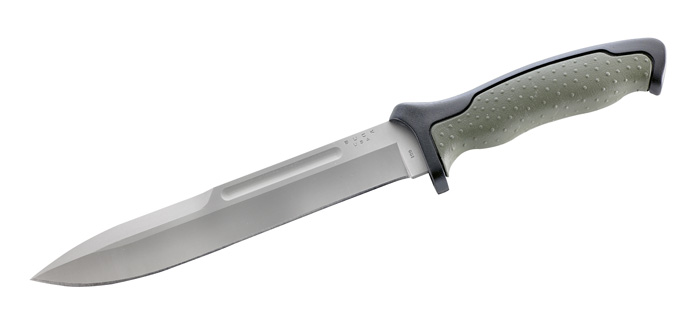
Buck Pigsticker Model 651.

       I plan to make a few more posts on cooking and messware but today we will have a change of subject as an interlude.

       As those of you who have invested in my second book will know, one of my favourite knives is the Buck Special model 119. This is just a really nice knife, and very reasonably priced too! My appreciation of this got me interested in another of Buck’s products, the model 650 Nighthawk.
       Finding an example at a price that I could live with proved more problematic. Examples in the UK had an exorbitant mark-up. Reasonably priced knives in the US came with exorbitantly hiked up shipping costs. Eventually I found a retailer on Ebay that was offering the knife at a reasonable price and postage.
       When the knife arrived I unpacked it and was quite surprised. It was much bigger than I had expected! The blade was grey rather than the black it appeared in photos. Photos on the internet had given the impression that it was a bowie-shaped blade when in fact it was more symmetrical, a spearpoint design rather like an M3 trench knife.
       It was actually several minutes before the penny dropped and I noticed that the little label on the sheath said “Model 651”. I searched the web but there was no mention of a Buck Model 651! I contacted the vendor, a lady in Liverpool. I told her she had sent me the wrong model knife, but I rather liked it so was going to keep it. Could I buy the 650 I had ordered originally? More money changed hands and a few days later another package arrives. It contains another 651! All of the knives she had acquired were 651s and not being particularly familiar with the field she had identified them as Nighthawk 650s.
       I contacted a friend of mine in the US who put me in touch with his step-father. We came to an arrangement whereby he would buy a 650 locally and ship it to me and I would trade him one of my 651s. By this time I had done some further research. Intrigued by the lack of web footprint for the 651 I contacted Buck directly and the mystery of the 651 was revealed.

       The 651 “Pigsticker” was a very limited run of knives intended for the Australian and New Zealand hunting markets. Nearly all of the run went south of the equator, much to the ire of many American collectors.

 As this post on Bladeforums puts it:

“The info we have is that this is Buck Knives largest ever-regular production military knife! Period. With a full 13 inches over all length this is one massive to quote Crocodile Dundee “Now that’s a knife” Tactical knife by Buck!Very fitting as this knife was made and Named the Intruder “Pig Sticker”, these were contracted from Buck by an Australian company. The amount ordered I think 300 or so was sent to them and a few over run were left for replacements. Also it was stated that a New Zealand company has since then bought every last one that was left and they are now ALL down under! ..During the few months between the two delivers it seems that some members of the Buck (knife) Collectors Club {BCCI} got wind of a Huge Military Tactical Knife made for a foreign market and NOT for retail sale in the USA Some few of these Buck Knife Collectors and Buck employees were able to order one or two of these rare ‘extra’ knives for themselves during the short time between the two deliveries! As word spread many of the Buck and military knife collectors are upset at not hearing of this knife sooner as they are now all gone! Rare? Well HECK Yes!!! These huge Pig Stickers are known to be in the hands of less then 40 or so lucky USA collectors! YES - it is estimated there are LESS then three dozen of these knives, snatched by collectors, remaining in the Country at this time. And here are ONE of them for sale. You now have a chance to own one of these rare knives. We do say that YOU will most likely not have another chance for a long time to own one. Most of the collectors we know are hording the extra ones they now have. This knife has one of the the thickest blades we have ever seen on a Buck Knife. It fits our hands very well and has a fantastic tactical grip non slip OD green and black grip. The large Buck 120 black handle knife, Buckmaster 184 all metal knives are not part of this sale, they are for comparison only. The sheath has a built in upper leg tie down adjustable strap for worry free movement during carry … yet it releases and draws from the sheath with ease for use. It is hair popping razor edge sharp.”

       Obviously, on their journey south some of these knives passed through Liverpool docks. As is rather commonplace, some of them happened to fall out of their shipping container and were sold, ending up on Ebay.
       I am probably one of the few people in this country who owns a 651 and knows how rare it is. Likewise, my friend’s step-father is one of the few Americans to possess one! I have seen offers of more than $300 for these.

       The 651 is actually a very nice knife. It was designed as a working knife that would be used against dangerous game and it seems to be well up to the job. The blade is thick and sturdy and has a good edge. My only criticism of the design would be the Nighthawk style handle, which would be improved by a full guard, given its intended use. That is my general criticism of all Nighthawk models, incidentally.

       Buck should consider offering a similar knife for general sale. It would find many happy users.

         If you have enjoyed this article or it has been helpful to you please feel free to show your appreciation. Thank you.
The Books
http://www.angelfire.com/art/enchanter/epsdbook.html
http://www.lulu.com/shop/http://www.lulu.com/shop/phil-west/survival-weapons-optimizing-your-arsenal/paperback/product-21488758.html
http://www.lulu.com/shop/phil-west/crash-combat/paperback/product-22603842.html
https://www.amazon.com/Anatopismo-Underrealm-Novella-Phil-West-ebook/dp/B077G7MMFM

Sunday, 23 August 2015

Army Mess Kits

         In a recent post I mentioned "Camping and Woodcraft" by Horace Kephart. This is a book that has a lot to teach the modern outdoorsman. In one chapter Kephart reflects on the difficulty in designing an acceptable, effective cooking kit for just a single traveller. The kit he suggests has a frying pan and a pair of quart-sized billies. The billies are carried in a bag, bottom to bottom so that no soot and fuel contaminated vessel nests within another. The interior of the billies are filled with bags of food such as flour and rice so effectively they occupy very little space. Each billy has a lid to keep dirt and insects out and to retain heat. Each lid has a folding ring allowing the lid to be lifted with a stick, knife or other implement when they are hung over a fire. The frying pan is a full sized utensil of 8 or 9” diameter. Kephart expects the traveller to bake his own breadstuff and one of the ways to do this is in the frying pan. The pan also needs to be big enough to cook any game or fish that are caught. The handle is either folding or detachable and there is provision to attach an extension piece when cooking over a large bed of coals. A tin cup and a deep plate or bowl for eating from complete the outfit. If you choose wisely the plate can fit in the stowed frying pan and even act as a lid when inverted.
                 Kephart’s suggestions seem logical but actually meeting these specifications proved to be more involved than I expected. Most “camping billies” available on sale are nothing of the sort. A true billy has a bail handle so it can be suspended above a heat source. This also allows it to be used as a bucket to fetch water. The billies that you can find are generally much bigger than the one quart/ two pint/ one litre size suggested. Camping frying pans, on the other hand, tend to be too small. My own efforts to create a similar kit to Kephart's will be the subject of a later post.

                 Many people interested in survival or bushcraft tend to take their cues from the military. When it comes to field cooking the circumstances of the solitary traveller are rather different from those of a soldier. For many armies the mess kit has cooking as only a secondary function. Meals are prepared by a field kitchen or catering unit and the mess kit is only used to receive the finished product. Since World War Two the use of ration packs has become widespread and mess tins are mainly used for warming up the precooked items. Modern soldiers make much less use of mess kits than previous generations. Nowadays MREs are supplied with flameless cooking pouches so many troops in the field do not carry any cooking equipment other than a canteen cup. Larger field catering units often use disposable tableware instead.


                 The most basic military mess kit is probably the rectangular British Army “1937 pattern”. This has two rectangular cooking vessels, one slightly smaller than the other so they can nest. Capacity is approximately 1 litre and 1.3 litres (or 2 and 2 ½ pints). On the plus side, they fit nicely in a pouch or side pocket of a pack. The SAS Survival Guide shows one used as a container for a variety of useful items in a “survival pouch”. On the downside, the basic set has no lid. You can use the larger one as a lid for the smaller. A number of companies make lids/plates for the larger pot. Some versions of lid have a sliding or folding handle, allowing the lid to be used as a small rectangular frying pan. They even offered a variant with a non-stick coating. These mess tins are not by any stretch of the imagination billies. They work well enough on many stoves but if you are cooking using natural fuels you will have to have a good bed of coals or get creative improvising a pot support. The smaller one fits inside the larger so you will need to get the smaller very clean if you want to avoid contaminating your next meal with soot or fuel residue. That is not always possible out in the field. Placing the smaller in a bag to keep the larger clean is prudent. For receiving a dollop of whatever from the field kitchen or heating water to warm ration tins, “boil in the bag” items or make tea they are adequate enough.
                 The British Army mess tins have been around a long time and are widely used. This has spawned useful accessories and variants such as lids and non-stick coated tins. On the downside, there are sub-standard knock-off copies out there. Running out of cooking pots I once used a mess tin to brown some flour on my kitchen stove. Liquid metal resembling solder appeared! I have been told a genuine tin should have a bit of spring to it. If you push on the side with your thumb it should pop-back. 


                 Other armies have taken different approaches to the same requirements.

                 The Germans, Russians and a number of other armies have issued a mess kit that looks a little like a binoculars case. In fact, as a boy I thought these items on my toy soldiers were packed field glasses! The basic item has an oval or kidney-shaped cross section. The bottom part is a deep pot, often provided with a bail handle. The lid is deep enough to also serve as a cooking vessel and provided with a folding side handle. It is neither pot nor frying pan really but makes a reasonable cup. Such mess kits formed a compact package that could be carried in a pack or pouch or attached directly to a belt or the outside of a knapsack. Some versions have other components such as dishes or  bowls that fit inside. The German water canteen fitted inside a pair of aluminium cups of similar design to the mess kit. To put these kits in context, they were often used in conjunction with field kitchens and some soldiers of previous generations had more modest expectations when it came to food. If they got hot soup, coffee and fresh bread they considered themselves well off! A small field kitchen such as the German horse-drawn models widely used in both wars had an oven and two big boiling vessels. One for coffee and the other for a hearty soup, stew or pasta dish. A mess tin bottom full of soup and the lid filled with hot coffee was just what a fighting man wanted. 


                Two variants of this basic pattern are deserve a special mention. The first is the Swedish Army mess kit. This has an oval section billy for the bottom and a lid that also serves as a pan. Lid capacity is about 550mls, the lower section holds 1.3 litres. The handle of the lid has two folding rings of an arch-shape. A stick can be inserted through these if you need a longer handle or one that will not conduct heat. The Swedish mess kit comes with its own stove. This is a sturdy windshield that fits over the outside of the packed mess kit. Inside it at two folding pot supports and the kit also includes a spirit burner of similar design to that used on Trangia stoves. The stove could also be used with other heat sources such as hexamine blocks,  alcohol gel or natural fuel such as woodchips and pinecones. The kit is completed by a plastic bottle marked with the Swedish triple crowns and the legend “RÖDSPRIT ELDFARLIG GIFTIG” (Methylated Spirit Inflammable Toxic). The bottle is of a size that it conveniently fits inside the mess kit but this practice is not recommended since leaks will contaminate your cooking vessels. Keep your fuel bottle elsewhere and fill the interior of the mess kit with a brick of Supernoodles, some Oxo cubes, teabags etc.


                 I have used my Swedish mess kit several times. It is of a size and shape convenient to carry in a daysac. If anything, it could be a little smaller. When you are hiking and the snow is on the ground it is been nice to stop and quickly heat up a quick hot snack of instant noodles.


                 The third kit I will discuss today is usually marketed as a Yugoslavian mess kit or “Eight piece” mess kit. This differs from those of other armies in that the lower metal pot has a side handle rather than a bail. The upper part is made from plastic so is more of a rectangular section bowl than a cooking vessel. The bowl is designed so that it slots onto a hook on the end of the handle, allowing both containers to be held in one hand. Such arrangements are seen in a number of mess kits and are intended to make handling the kit easier when queuing in a mess line. The interior of the mess kit is used to store a plastic water bottle, which comes with its own rectangular beaker that fits over the top. The final components are a carrying pouch and a metal Knife, fork and spoon(KFS) set. The spoon and fork store in the handle of the knife. The knife also has a bottle opener cutout. These Yugoslavian kits can be found at very reasonable prices. You only get one cooking vessel, but it is generously sized. A detachable billy handle could probably be made by drilling holes near the rim at the point of balance. I intend to acquire one of these kits soon so expect a more in depth review. If nothing else the kits seems a good source of components that can be incorporated into a larger kit. Some camping KFS sets or water bottles cost more than this entire kit!

If you have enjoyed this article or it has been helpful to you please feel free to show your appreciation. Thank you.

http://www.angelfire.com/art/enchanter/epsdbook.html
http://www.lulu.com/shop/http://www.lulu.com/shop/phil-west/survival-weapons-optimizing-your-arsenal/paperback/product-21488758.html
http://www.lulu.com/shop/phil-west/crash-combat/paperback/product-22603842.html
https://www.amazon.com/Anatopismo-Underrealm-Novella-Phil-West-ebook/dp/B077G7MMFM
https://www.amazon.com/Hell-Ay-non-partisan-sourcebook-role-play-system-ebook/dp/B07FQSHSQC