Friday, 1 April 2016

What is the sound of one hand clapping?


The following scenario, or something similar may have occurred in your past.

You are out for the night with some friends. One of your male friends, or maybe yourself makes as comment. One of your female friends responds by playfully slapping or punching the male.

Male: “OWWW! That hurt!”

Female: “Oh, don’t be such a wimp! I barely touched you”

Male (muttering) “I DID hurt…”

What has happened in this familiar scene is quite interesting. The lady did not intend to do any real damage so she did not put much muscular effort into the punch/slap. Probably she used no more muscular effort than was needed to raise and move the arm. Because it was very relaxed the hand was moved very fast and thus acquired lots of energy. Paradoxically, she hit harder because she did not intend to hit hard.

A punch or similar strike can be taken to have three phases. There is the cast or throw, where the hand is moved towards the target. There is the impact. And there is the withdrawal.

Momentum is mass x velocity. Kinetic Energy is mass x velocity2. We cannot make our arm and hand heavier so if we wish to increase a strike’s momentum and energy we must move everything faster. Or looked at another way, we need to minimise those factors that may slow the system down.

The arm does not need muscular tension when a punch is being thrown. This would slow the arm down. Likewise we want the withdrawal to be fast too so that our arm is not grabbed or counterattacked in some other fashion.

The only time we need the muscles tensed is just before and during the moment of impact so that the energy goes into the target rather than being used to bounce our strike off. In fact a good punch or blow has something of a snapping action to it. It transmits a portion of its energy and then withdraws before some of this energy can reflect back into the hand. This is what Chinese arts are often talking about when they talk of fa-jing. You are probably more familiar with this effect than you think. If you swing a towel at someone it has very little effect. If, however, you make the towel end snap as it makes contact the effect is quite different.

Getting the correct timing of this relaxed:tense:relaxed cycle for a punch becomes quite labour intensive for some martial arts students. There is also the added complication of ensuring that the bones of the hand and arm are correctly aligned on impact to avoid hand injury.

Things become a lot simpler if you use a palm-heel strike instead of a closed fist. You still need to relax your arm and add a snapping action but tensing and aligning the hand seem to take care of themselves.

Let us consider another familiar action. Clap your hands like there is a big, fat, nasty, blood-sucking mosquito before you. That noise your hands make is energy being converted into sound. There is a lot of energy because you don’t tense up before you clap your hands. You just do it so the action is fast and relaxed and consequently quite powerful. There are a number of combat applications for hand-clap actions in my books . Today I am going to ask you to think of a hand clap as being a model for two palm strikes. If you can bring two hands together with such speed and force why can you not use the same principles to bring just one hand in contact with a target?

“What is the sound of one hand clapping?”  The answer is that of a palm-strike hitting your enemy.
 
The Books
http://www.angelfire.com/art/enchanter/epsdbook.html 

http://www.lulu.com/shop/http://www.lulu.com/shop/phil-west/survival-weapons-optimizing-your-arsenal/paperback/product-21488758.html

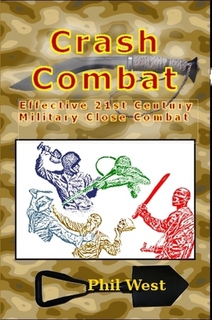
http://www.lulu.com/shop/phil-west/crash-combat/paperback/product-22603842.html


Thursday, 31 March 2016

Dream Martial Art.


I had a very interesting dream the other night. Some of it is still with me.

The inspiration for this train of dreaming was probably that I was reading about Pak Hok Chuan. In its early form it had eight punch techniques, eight kicks, eight finger techniques and so on. Eight was doubtless chosen because of a connection with the I-ching.

In my dream, I was considering a fighting style. It would have numerous offensive techniques and very few defensive ones. Another key point in the dream was a stance with the palm held out. My dreaming mind told me this was in fact four related stances and that they were somehow connected with crescent kicks.

A Great Variety of Attacks.
This part is fairly easy to interpret. Readers of this blog and my books will know I consider the palm-heel and the hammer-fist as primary strikes. Some targets and some techniques work better with other body weapons, however. The knife-hand is ideal for striking the crease of the elbow. Some punches work better with a one-knuckle or phoenix-eye fist than a palm-heel or conventional fist. Likewise, I can think of at least half a dozen families of kicks and each has a particular application or something to teach. A fighting style needs a whole kit of body weapons it can select from.

Few Defensive Techniques.
This bit is also quite logical. It is better to have just a few defensive techniques that can deal with a great variety of situations. This cuts down on decision time, hesitation and makes a defence more reflexive.

If you are holding a quarterstaff there are only really two defensive techniques. If an attack comes from one side you parry it inward, if from the other side parry it outward. Readers of my first book will know that I suggest something similar for unarmed defence using a p’eng hinge/SPBK posture.

I think this is where the bit about the four stances with the palm forward fits in too. Bagua/Pa-kua and some other styles try to do most of the parrying with the forward palm. That palm would have to move to defend four different quadrants –high outside, high inside, low outside and low inside. A crescent kick hits with the inside or outside edge of the foot. A defending palm would make some of its parries with the knife-edge or ridge-hand edge of the hand. That is my best theory so far as to why that bit was considered so important, but it was a dream so logic may not be relevant.

Manoeuver.
Evasion is more important than parrying so the dream had something about ginga, Pa-kua stepping and other movement techniques. Jumping was flagged as an ability. I’d been reading some stuff on how jumping and landing from jumps was a very useful exercise. Jumping can also let you change facing or position or avoid low attacks such as sweeps and kicks.

Clapping.
Clapping, as a method of rapid hand movement, was also present in my garbled thoughts. The martial applications of  this is something I have been meaning to write more on.

This dream is not a Xanadu moment. A new fighting style has not suddenly sprung fully formed from my subconscious. It has, however, drawn my attention down some interesting routes. I hope it does something similar for you.

The Books
http://www.angelfire.com/art/enchanter/epsdbook.html 

http://www.lulu.com/shop/http://www.lulu.com/shop/phil-west/survival-weapons-optimizing-your-arsenal/paperback/product-21488758.html

http://www.lulu.com/shop/phil-west/crash-combat/paperback/product-22603842.html
 

Tuesday, 29 March 2016

Hammer-fist and Single Whip.


Sometimes you search for something only to discover it was close by all along. A case in point:-

In my recent book, Crash Combat, I reflect that the hammer-fist is a somewhat underappreciated weapon in martial arts. I may have made this assertion in my previous book too. Reading Joseph Wayne Smith’s book on Wing chun he makes a similar statement.

Hammer-fist can substitute for the chop, back-fist and even some closed fist punches. It is much less likely to result in self-injury than some of these techniques. It is easy to perform correctly and can deliver powerful blows to both hard and soft targets. Along with the palm-heel it is probably one of the best hand strikes that we have.

Naturally enough, I was experimenting with some hammer-fist attacks the other day. I’d been looking at the rapid 270-360° turn that is possible by using the “closed step” of Pa-kua/Bagua. (See my book for details). This could be used to power a spinning back-fist to strike a foe in the outside gate. But a true back-fist can be fiddly, requiring a terminal flick of the wrist and impact with the first two knuckles. A spinning hammer-fist is more logical and for most fighters more powerful.

I notice that if I bend my wrist inward a fraction my hammer-fist seems a little stronger or more stable at the moment of impact. I also note that this mode favours a sort of “snap”. I can throw the technique with a relaxed arm and hand and snap into a clenched hand just before impact. This, of course, lets the arm and hand acquire more initial speed and produces a more powerful attack with less muscular effort.

From a variety of positions I can just flick my arm and have it land in a hammer-fist. This curve of the wrist seems a technique worth cultivating.

And then it dawns on me! This is the hand form of horse-foot palm from Tai chi’s Single whip. I have written about this as a parrying technique and even as a form of punch. I have probably even written about hammer-fist like strikes with this hand form. But I had not grasped one of the other important things that posture was trying to teach:- that a relaxed, slightly bent wrist gives you a very efficient hammer-fist.

As always, experiment for yourselves. Can you use hammer-fist instead of your other strikes? Can you relax more to make it faster and more powerful?

The Books
http://www.angelfire.com/art/enchanter/epsdbook.html 

http://www.lulu.com/shop/http://www.lulu.com/shop/phil-west/survival-weapons-optimizing-your-arsenal/paperback/product-21488758.html

http://www.lulu.com/shop/phil-west/crash-combat/paperback/product-22603842.html
 

Sunday, 27 March 2016

Cross Stepping Post: Part Two

 
It occurs to me this morning that the previous post on “the Post” needs a little more information. Some of you reading that post will not be familiar with Tai chi, Bagua or have read the relevant parts of my book. If you are only familiar with hard, external interpretations of martial arts you may find the seemingly simple movements of the Cross stepping post surprisingly difficult.

The essence of the Cross stepping post is the cultivation of stability and balance. Your upper body needs to be relaxed and your weight down in your pelvis. Since we are not performing the arm movements at this stage your arms should hang down by your sides, relaxed like hanging vines. If you are used to putting lots of muscular tension into you stances this will probably be one of your first problems in performing the Post.

From Tai chi we have the advice:

1.                   Sinking of shoulders and dropping of elbows.

2.                  Relaxing of chest and rounding of back.

When you attempt the movements of the Post your upper body should be as relaxed as possible, having a slightly hunched shoulders look that comes from a lack of tension.

The other useful thing to remember is that in martial arts movement generally comes from the waist. Don’t attempt those kick-like foot movements just by moving your leg. You will need to rotate your waist/hips to swing them around.

I hope that helps. Persevere and I will post some more information on the exercise soon.
The Books
http://www.angelfire.com/art/enchanter/epsdbook.html 

http://www.lulu.com/shop/http://www.lulu.com/shop/phil-west/survival-weapons-optimizing-your-arsenal/paperback/product-21488758.html

http://www.lulu.com/shop/phil-west/crash-combat/paperback/product-22603842.html