Sunday, 3 April 2016

You Might As Well Jump!


As I mentioned in a recent post, jumping is something that has occupied my mind recently.
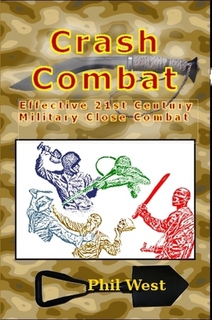
While I was writing the bayonet (or rather, bayonetless!) sections of Crash Combat I came across suggestions that a soldier should jump to change facing, or even to move around. If terrain is uneven jumping has obvious advantages over the shuffle step often suggested for martial arts or bayonet training.
Joseph Wayne Smith’s book on Wing chun notes that jumping up and jumping down from heights is a good exercise for a martial artist. He doesn’t make the logical leap that jumping may be part of the solution to some of the deficiencies in manoeuvre that he identifies.
Other than some rather cinematic techniques such as flying kicks jumping is something that many martial arts overlook.
In Viktor Suvorov’s book “Spetsnaz” he relates how spetsnaz puts great emphasis on a soldier’s legs and jumping ability.

“And there is good reason why the training of a spetsnaz soldier starts with the training of his legs. A man is as strong and young as his legs are strong and young. If a man has a sloppy way of walking and if he drags his feet along the ground, that means he himself is weak. On the other hand, a dancing, springy gait is a sure sign of physical and mental health. Spetsnaz soldiers are often dressed up in the uniform of other branches of the services and stationed in the same military camps as other especially secret units, usually with communications troops. But one doesn't need any special experience to pick out the spetsnaz man from the crowd. You can tell him by the way he walks....I shall never forget one soldier who was known as `The Spring'. He was not very tall, slightly stooping and round-shouldered. But his feet were never still. He kept dancing about the whole time. He gave the impression of being restrained only by some invisible string, and if the string were cut the soldier would go on jumping, running and dancing and never stop. The military commissariat whose job it was to select the young soldiers and sort them out paid no attention to him and he fetched up in an army missile brigade.... The officer commanding the spetsnaz company noticed the soldier in the missile unit who kept dancing about all the time he was standing in the queue for his soup....”
This energetic soldier was there and then immediately recruited into spetsnaz.

“The long jump with no run has been undeservedly forgotten and is no longer included in the programme of official competitions. When it was included in the Olympic Games the record set in 1908, was 3 metres 33 centimetres. As an athletic skill the long jump without a run is the most reliable indication of the strength of a person's legs. And the strength of his legs is a reliable indicator of the whole physical condition of a soldier. Practically half a person's muscles are to be found in his legs. Spetsnaz devotes colossal attention to developing the legs of its men, using many simple but very effective exercises: running upstairs, jumping with ankles tied together up a few steps and down again, running up steep sandy slopes, jumping down from a great height, leaping from moving cars and trains, knee-bending with a barbell on the shoulders, and of course the jump from a spot..... At the end of the 1970s the spetsnaz record in this exercise, which has not been recognised by the official sports authorities, was 3 metres 51 centimetres.”

Where I work is a popular area for parkour training. As well as the more spectacular techniques I also observe apparently more mundane drills such as jumping from post to post.
Parkour itself has been described as a non-contact martial art. As originally conceived it placed considerable emphasis on self-discipline and humility. That is something a number of sportsman and modern martial artists would be advised to emulate. Like many martial arts parkour is in danger of having its core values diluted by pressure to create a sporting, competitive form
Parkour has a number of things that the modern martial artist can learn from.
A fate would have it a movie featuring parkour/freerunning was on the other night. The athleticism and coordination was impressive as always, but I was also struck by the realization that the techniques themselves were relatively simple.
 
I noticed that two landing techniques were often used. One was obviously an adaption of the parachute landing fall. As owners of my first book or Crash Combat will know, I include this technique alongside more traditional breakfall techniques. It use in parkour is logical. The second technique commonly used was the shoulder roll variant of the forward breakfall. Some websites on parkour have some nice sections on how to perform this technique. If the forward breakfall is something you need to improve you could do worse than have a look at how the parkour community learns and practices it. They are making it work for 20 foot jumps down onto concrete, after all!


The Books

http://www.angelfire.com/art/enchanter/epsdbook.html 


http://www.lulu.com/shop/http://www.lulu.com/shop/phil-west/survival-weapons-optimizing-your-arsenal/paperback/product-21488758.html


http://www.lulu.com/shop/phil-west/crash-combat/paperback/product-22603842.html


Saturday, 2 April 2016

Striking with Both Hands


Today I thought I would look at several techniques where both hands apparently strike at the same time.
The targets and techniques given in this article are potentially lethal. They are only to be used in life-or-death situations.
The first technique will be familiar from my book. It is “arn” from Tai chi. “Arn” means “press” but is often translated as “push”. Indeed, it does look like you are trying to push something. One of the maxims of Tai chi is that you should never be “double weighted”. You should never have your weight equally distributed between your feet and your hands should never be equally yin or yang. Arn seems to violate this principle. The common explanation is that arn is in reality two palm-strikes arriving in quick succession. The hands are hitting rather than pressing or pushing, and one strikes just before another.
 
Arn can be a powerful attacking technique. In a frontal attack the hands strike the dim-mak points around the pectoral muscles or use the springiness of the foe’s own ribs to bounce him away. As I have said before, this is a fighting technique that is overlooked by many other styles.
A number of combat styles do not share Tai chi’s aversion to being double weighted and include simultaneous striking techniques
Another thing to remember when interpreting forms is that if two hands are doing the same thing in a form that is not necessarily how they are intended to be used in combat. A form may have, say, double spear hands but in reality one spear-hand would be a feint while the other hand was used to parry or readied for a more powerful follow-up.
 
The second technique we will look at comes from Chuka, Phoenix-eye fist. Both hands are held palm upward in phoenix-eye configuration. The wrists or forearms are crossed, the lead hand being underneath. Both hands punch at once, the hands rotating palm down. The lead hand strikes low, the rear hand high. I regard phoenix-eye and one-knuckle fist as soft-tissue weapons so primary targets will be above the suprasternal notch and below the xiphoid process. The xiphoid/solar plexus region and a palm-width below the navel is another pairing.
A similar simultaneous attack is the double dragon palms, sometimes called butterfly palms. This is a double palm strike with one hand above the other. The upper hand has its fingers up, the lower hand fingers down. This can be used on the same targets as double phoenix-eye punches. Palm strikes are a weapon for both hard or soft body areas so this technique can also be used directly against points on the sternum such as between the nipples or the sternal angle.
 
If you are using both hands to attack it implies that you have less need to parry or control. Such attacks are therefore a more likely option when on the outside gate. So far we have considered frontal attacks. How might the above techniques be targeted if to the side of an enemy?
Double palm strike (po pai and other spelling variations) is used several times in Wing chun’s advanced-level wooden man form. Palm striking is rather common in this form, in contrast to the snap punches used in earlier forms. Wing chun students may like to ponder why this is so.
 
The last technique returns us to Tai chi. It is shown in “How to use Tai chi as a Fighting Art” by Erle Montaigue and is used as a counter to double dragon palms. One hand is held above the other, palms flat and fingers towards the enemy. The hands come in from the side to push the dragon palms off course. The finger tips then thrust forwards to attack the body beyond.
 
The Books
http://www.angelfire.com/art/enchanter/epsdbook.html 

http://www.lulu.com/shop/http://www.lulu.com/shop/phil-west/survival-weapons-optimizing-your-arsenal/paperback/product-21488758.html

http://www.lulu.com/shop/phil-west/crash-combat/paperback/product-22603842.html


Friday, 1 April 2016

What is the sound of one hand clapping?


The following scenario, or something similar may have occurred in your past.

You are out for the night with some friends. One of your male friends, or maybe yourself makes as comment. One of your female friends responds by playfully slapping or punching the male.

Male: “OWWW! That hurt!”

Female: “Oh, don’t be such a wimp! I barely touched you”

Male (muttering) “I DID hurt…”

What has happened in this familiar scene is quite interesting. The lady did not intend to do any real damage so she did not put much muscular effort into the punch/slap. Probably she used no more muscular effort than was needed to raise and move the arm. Because it was very relaxed the hand was moved very fast and thus acquired lots of energy. Paradoxically, she hit harder because she did not intend to hit hard.

A punch or similar strike can be taken to have three phases. There is the cast or throw, where the hand is moved towards the target. There is the impact. And there is the withdrawal.

Momentum is mass x velocity. Kinetic Energy is mass x velocity2. We cannot make our arm and hand heavier so if we wish to increase a strike’s momentum and energy we must move everything faster. Or looked at another way, we need to minimise those factors that may slow the system down.

The arm does not need muscular tension when a punch is being thrown. This would slow the arm down. Likewise we want the withdrawal to be fast too so that our arm is not grabbed or counterattacked in some other fashion.

The only time we need the muscles tensed is just before and during the moment of impact so that the energy goes into the target rather than being used to bounce our strike off. In fact a good punch or blow has something of a snapping action to it. It transmits a portion of its energy and then withdraws before some of this energy can reflect back into the hand. This is what Chinese arts are often talking about when they talk of fa-jing. You are probably more familiar with this effect than you think. If you swing a towel at someone it has very little effect. If, however, you make the towel end snap as it makes contact the effect is quite different.

Getting the correct timing of this relaxed:tense:relaxed cycle for a punch becomes quite labour intensive for some martial arts students. There is also the added complication of ensuring that the bones of the hand and arm are correctly aligned on impact to avoid hand injury.

Things become a lot simpler if you use a palm-heel strike instead of a closed fist. You still need to relax your arm and add a snapping action but tensing and aligning the hand seem to take care of themselves.

Let us consider another familiar action. Clap your hands like there is a big, fat, nasty, blood-sucking mosquito before you. That noise your hands make is energy being converted into sound. There is a lot of energy because you don’t tense up before you clap your hands. You just do it so the action is fast and relaxed and consequently quite powerful. There are a number of combat applications for hand-clap actions in my books . Today I am going to ask you to think of a hand clap as being a model for two palm strikes. If you can bring two hands together with such speed and force why can you not use the same principles to bring just one hand in contact with a target?

“What is the sound of one hand clapping?”  The answer is that of a palm-strike hitting your enemy.
 
The Books
http://www.angelfire.com/art/enchanter/epsdbook.html 

http://www.lulu.com/shop/http://www.lulu.com/shop/phil-west/survival-weapons-optimizing-your-arsenal/paperback/product-21488758.html

http://www.lulu.com/shop/phil-west/crash-combat/paperback/product-22603842.html


Thursday, 31 March 2016

Dream Martial Art.


I had a very interesting dream the other night. Some of it is still with me.

The inspiration for this train of dreaming was probably that I was reading about Pak Hok Chuan. In its early form it had eight punch techniques, eight kicks, eight finger techniques and so on. Eight was doubtless chosen because of a connection with the I-ching.

In my dream, I was considering a fighting style. It would have numerous offensive techniques and very few defensive ones. Another key point in the dream was a stance with the palm held out. My dreaming mind told me this was in fact four related stances and that they were somehow connected with crescent kicks.

A Great Variety of Attacks.
This part is fairly easy to interpret. Readers of this blog and my books will know I consider the palm-heel and the hammer-fist as primary strikes. Some targets and some techniques work better with other body weapons, however. The knife-hand is ideal for striking the crease of the elbow. Some punches work better with a one-knuckle or phoenix-eye fist than a palm-heel or conventional fist. Likewise, I can think of at least half a dozen families of kicks and each has a particular application or something to teach. A fighting style needs a whole kit of body weapons it can select from.

Few Defensive Techniques.
This bit is also quite logical. It is better to have just a few defensive techniques that can deal with a great variety of situations. This cuts down on decision time, hesitation and makes a defence more reflexive.

If you are holding a quarterstaff there are only really two defensive techniques. If an attack comes from one side you parry it inward, if from the other side parry it outward. Readers of my first book will know that I suggest something similar for unarmed defence using a p’eng hinge/SPBK posture.

I think this is where the bit about the four stances with the palm forward fits in too. Bagua/Pa-kua and some other styles try to do most of the parrying with the forward palm. That palm would have to move to defend four different quadrants –high outside, high inside, low outside and low inside. A crescent kick hits with the inside or outside edge of the foot. A defending palm would make some of its parries with the knife-edge or ridge-hand edge of the hand. That is my best theory so far as to why that bit was considered so important, but it was a dream so logic may not be relevant.

Manoeuver.
Evasion is more important than parrying so the dream had something about ginga, Pa-kua stepping and other movement techniques. Jumping was flagged as an ability. I’d been reading some stuff on how jumping and landing from jumps was a very useful exercise. Jumping can also let you change facing or position or avoid low attacks such as sweeps and kicks.

Clapping.
Clapping, as a method of rapid hand movement, was also present in my garbled thoughts. The martial applications of  this is something I have been meaning to write more on.

This dream is not a Xanadu moment. A new fighting style has not suddenly sprung fully formed from my subconscious. It has, however, drawn my attention down some interesting routes. I hope it does something similar for you.

The Books
http://www.angelfire.com/art/enchanter/epsdbook.html 

http://www.lulu.com/shop/http://www.lulu.com/shop/phil-west/survival-weapons-optimizing-your-arsenal/paperback/product-21488758.html

http://www.lulu.com/shop/phil-west/crash-combat/paperback/product-22603842.html