Tuesday, 20 December 2016

Blanket/ Cloak.


Many moons ago I described a method of turning an item such as an all-weather blanket into a hooded rain cape. This was adapted from a method of wearing a plaid associated with the Inverness area. An Inverness cape or cloak is something different and today I will describe a way to use a blanket that forms something not unlike an Inverness cape. We touched on this method with the recent post on Japanese shelter cloths.
 
Take one corner of a blanket in each hand and hold it behind you. Place the middle of the side between your hands over your head.
Release the corners and reach down to waist level and gather the blanket around your lower body. Adjust so the lower edge is about mid-calf level or your preferred length. Tie the blanket in place by encircling it with a belt, piece of string or anything similar you have handy.
Fold the cloth over your head back so it forms a collar. The garment can be improved by using a blanket pin to close the throat area. If you are really improvising you can make a pin by sharpening a small stick.
Your blanket now resembles an improvised cloak. It also resembles the greatcoats worn by US soldiers in westerns. The upper section allows good access to your chest pockets or other gear carried in this area. If necessary it can be drawn up over the head to form a cowl. If your legs need more freedom of movement the lower corners can be brought up and tucked through the belt. Military greatcoats were often designed so the skirts could be buttoned up in similar fashion. This is sometimes called “French fashion” since French troops were noted for fighting in their greatcoats.
You can modify a blanket so that it can more easily be worn in this fashion. Sew a cloth tape by its middle to the middle of the blanket at your preferred waist level. If you refer back to the Japanese shelter cloth article you will see the cloth included this feature. To close off the neck the best option is one or more hook and loop fastenings. Loops should be cord and blunt hooks can be made from suitably bent paperclips or other wire. Hook and loop fastenings are less likely to be uncomfortable should you happen to be lying on them when the blanket if used for sleeping in. Even if you use a sleeping bag for sleeping a blanket is a handy thing to have should it turn unexpectedly cold. Using this technique the blanket is a day garment too. You can wear a rucksac while wearing a blanket like this. The front tends to open more which may or may not be a problem. If you do not need the ventilation when carrying a load a couple of extra blanket pins or a blanket scarf can be used. If your pack is small the cloak can be put on over it.
I have described this as being with a blanket but as the Japanese shelter cloth shows us this can also be used with a rain-resistant material. If you carry a rifle and ammunition across your chest the upper “flaps” provide good protection and easy access. Unlike a poncho this rain garment does not need a hole in the centre for a hood, so is less problematic if rigged as a shelter. A separate hood could perhaps be attached near one edge near the neck fastenings if you are modify a cloth for use in this fashion. If the weather is particularly foul a blanket can be worn within a rain cloth.


         If you have enjoyed this article or it has been helpful to you please feel free to show your appreciation. Thank you.
The Books

http://www.angelfire.com/art/enchanter/epsdbook.html
http://www.lulu.com/shop/http://www.lulu.com/shop/phil-west/survival-weapons-optimizing-your-arsenal/paperback/product-21488758.html
http://www.lulu.com/shop/phil-west/crash-combat/paperback/product-22603842.html
https://www.amazon.com/Anatopismo-Underrealm-Novella-Phil-West-ebook/dp/B077G7MMFM

Monday, 12 December 2016

More on Blanket Rolls


In the last blog I talked about the American Civil War (ACW) horseshoe roll. A point worth stressing is that a horseshoe roll does not need to be constructed from a blanket.

As we saw with the Soviets and ACW horseshoe rolls can be used to carry long greatcoats. A modern sleeping bag, for example, can also be carried as a horseshoe roll. I have a four or five season sleeping bag I brought many years back. It is a great bag but I have seldom used since it is so bulky. I cannot carry it if I have to also carry any other reasonable amount of gear. If I put it in my pack I have very little room for anything else. If I tie it to the top of my pack I’m over seven feet tall, and this is with the thing in its compression sack! Rolling the thing into a horseshoe roll may very well be a better way to carry it. Worn in this way it will also provide some insulation when walking, which may very well be needed in any climate where I actually need such a high-rated bag.

The over the shoulder horseshoe roll is not the only way to carry such items. In many armies of WW2 shelter halves and the like were rolled into a horseshoe that was placed around the pack. A shorter blanket roll that could be carried above or below the pack was also used.

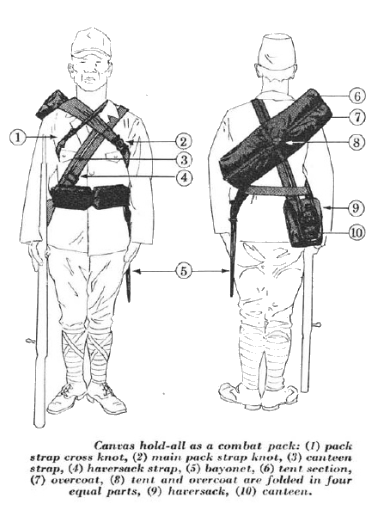
Like the soldiers of the ACW the WW2 Japanese soldier often used a horseshoe roll instead of a backpack. This could be constructed from the shelter cloth. Alternately a canvas “hold-all” was used as described here:

“Instead of the pack a canvas hold-all is sometimes used. This is simply a piece of light canvas with carrying straps at each end, and two long tapes, with shorter tapes to help secure the load. When rolled it can be carried across the back, slanting diagonally upwards from left to right, the straps and long tapes making an X across the chest where they are knotted. The hold-all serves as a combat pack and usually includes overcoat or blanket, shelter half, and tent poles and pins, besides whatever gear is not carried in the haversack. Canteen, ammunition pouches, and gas mask and carrier complete the combat gear normally carried by the Japanese soldier.”


As I discussed in the last blog, many modern waterproofs lack the robustness to make a good blanket roll cover. Something like Japanese hold-all described and illustrated is worth looking into. Such a thing could be combined with the methods for making your own gum-blanket. If the unrolled blanket roll cover was of sufficient dimensions to serve as a groundcloth that would be no bad thing.

Below is another example of a roll being used to carry equipment:
Variations on wearing the web equipment began to evolve while the Canadians trained in England, as Battle Drill put men and gear through increasingly more challenging situations. In Sicily, however, contacts with battle experienced soldiers of the British 8th Army led to quick revisions in how best to carry equipment in action, leading to the adoption of "Fighting Order." The small pack, or haversack, was quickly discarded due to its distinctive outline and the mess tins were instead added to a water-bottle carrier, and worn suspended from the brace-ends, in a spare water bottle carrier, on the left side of the waistbelt, opposite the water bottle. The gas cape was used to wrap spare clothing, rations and kit, then tied to the back of the waistbelt with spare blanket straps.”


Troops of the Loyal Edmonton Regiment at Ortona, December 1943, wearing Fighting Order. LAC Photo.


The Books
http://www.angelfire.com/art/enchanter/epsdbook.html 

http://www.lulu.com/shop/http://www.lulu.com/shop/phil-west/survival-weapons-optimizing-your-arsenal/paperback/product-21488758.html

http://www.lulu.com/shop/phil-west/crash-combat/paperback/product-22603842.html


Saturday, 10 December 2016

Horseshoe Rolls, Blankets and Gum-blankets


While researching the “Soldier’s Load” a conflict that was often mentioned was the American Civil War (ACW). Sherman’s “March to the Sea” was a frequent topic. From the Confederate side we have “Stonewall” Jackson’s Shenandoah Campaign where infantry covered 670 miles in about a month and a half.
 
A distinctive element of these campaigns was the use of the “horseshoe roll”, occasionally called a “croissant”. During the blogs on the WW2 Soviet infantryman I mentioned that what was often described as a blanket roll was in fact a rolled greatcoat, which was also used as bedding. The horseshoe rolls used by ACW soldiers were blankets, but they were not just blankets.
It is a matter of record that many ACW soldiers on both sides discarded their issue knapsacks and carried most of their gear in a blanket roll. There are a number of videos on-line showing you how to construct a horseshoe roll. Key point is that they are rolled LENGHTWISE. A very good article on how the ACW soldier carried his gear can be found here and is worth reading.
 
The horseshoe roll was generally not just blankets. Spare clothes and other suitable items were carried wrapped within it. Often the blanket itself would be protected from damage and weather by wrapping it either in a shelter half or a gum-blanket.
The shelter half of this conflict was a simple square of cloth. Two could be buttoned together and rigged up in various ways to make a very compact two man shelter. Rifle-muskets or local materials provided support.
 
The gum-blanket was a relatively new invention. It was a cloth coated on one side with a waterproof coating such as vulcanized rubber. The gum-blanket served as a ground cloth. Materials such as hay, cut long grass, bracken or similar can be piled under the gum-blanket to serve as a mattress. If a shelter cloth had been lost or been discarded a pair of soldiers might sleep on one gum-blanket and rig another up as cover. A single sleeper might wrap himself in his blanket(s) and sleep within a folded gum-blanket. The gum-blanket also served as a rain cape. Rain ponchos were constructed in the same way as gum-blankets but many soldiers used a single gum-blanket for everything. The shelter half might be discarded in favour of just the gum-blanket.
 
Some comments on sleeping in blankets in the field are relevant here. I cannot do better than quote Horace Kephart:

“To roll up in a blanket in such a way that you will stay snugly wrapped, lie down and draw the blanket over you like a coverlet, lift the legs without bending at the knee, and tuck first one edge smoothly under your legs then the other. Lift your hips and do the same there. Fold the far end under your feet. Then wrap the free edges similarly around your shoulders one under the other. You will learn to do this without bunching, and will find yourself in a sort of cocoon.”
It will be noted that this arrangement tends to place a double thickness of material between the sleeper and the ground, reducing ground chill.
The horseshoe roll was supposed to be carried from the weak-side shoulder, allowing the rifle-musket to be more easily fired from the strong-side. If your activities are less bellicose the roll can be alternated from one side to the other to rest one shoulder. The end parts of the roll needn’t be at the lowest point. Such a configuration apparently hindered access to the cartridge box when worn from the left shoulder so the ends were often shunted back.
After the civil war the American army issued a set of leather straps designed for constructing a blanket roll. This seems excessive both in weight and complication of maintenance. Use some cordage and a parcel wrap of half-hitches. For some suitable knots see my free book on the subject.
 
The shoulder roll can be easily discarded if needed. On the negative side it is not a very good way to carry items that you might want while on the move. Accessing the any item within it requires stopping and unrolling the roll and then reconstructing it. It is better used to carry “end of day” items. Using a gum-blanket or rain poncho as the outer cover of the roll has the disadvantage that if it starts raining you will have disassemble and reassemble the entire roll. This article describes several ways to carry a gum-blanket or similar item separately.
Rain ponchos and similar items made from modern materials may be too light and fragile to form the outer layer of a horseshoe roll. Using them in this fashion may increase the likelihood of them becoming damaged or punctured. A heavier duty item such as a canvas shelter half or a groundcloth may be more suitable. There are a number of websites that explain how to make your own gum-blanket/ groundcloth by painting one side of a cloth with black latex paint.

         If you have enjoyed this article or it has been helpful to you please feel free to show your appreciation. Thank you.
The Books
http://www.angelfire.com/art/enchanter/epsdbook.html
http://www.lulu.com/shop/http://www.lulu.com/shop/phil-west/survival-weapons-optimizing-your-arsenal/paperback/product-21488758.html
http://www.lulu.com/shop/phil-west/crash-combat/paperback/product-22603842.html
https://www.amazon.com/Anatopismo-Underrealm-Novella-Phil-West-ebook/dp/B077G7MMFM

Wednesday, 7 December 2016

Japanese Shelter Cloth.


While I was researching aspects of reducing the soldier’s load the WW2 Japanese Army often came up. Of particular interest was this in-depth article on the evolution of the Japanese soldier’s shelter cloth. I have taken the liberty of reproducing some of the illustrations from that article below.
 

According to the 1944 Handbook on Japanese Military Forces (TM-E 30-480): “Cotton raincoats with hoods are issued to Japanese troops, but in most theaters they prefer to use the shelter half as rain protection.” and “As a raincape it provides excellent protection against wetness and is preferred by many Japanese soldiers to the issue raincoat. A cord is attached to the middle of one end so that the shelter half can be suspended from the shoulders and tied under the chin. Loops through the eyelets on one of the sides then may be slipped through the eyelets on the opposite side to close it securely in front. Two of the corners rest approximately elbow high, allowing the arms freedom of movement. The shelter half also is used as a ground sheet, or to roll up in for protection in a foxhole. It can be pitched as a tent, either alone or in combination with varying numbers of others.”
 

The method of joining the cloths together with the cord loops is rather elegant and ingenious. Apparently this was also used when the cloth was worn as a garment. Below is an illustration I have in another book. Interesting here is that the cloth appears to be a 3:4 rectangle rather than a square.


The Books
http://www.angelfire.com/art/enchanter/epsdbook.html 

http://www.lulu.com/shop/http://www.lulu.com/shop/phil-west/survival-weapons-optimizing-your-arsenal/paperback/product-21488758.html

http://www.lulu.com/shop/phil-west/crash-combat/paperback/product-22603842.html