Monday, 20 February 2017

Levy's Filibuster Formation

During the age of pike and shot it became common for commanders to study arithmetic and geometry. Considerable care was given to calculating the size and shape of formations that could be created with the available manpower. The formation kept the infantry safe from the cavalry and if selected correctly maximised the formation’s fighting power.
Modern warfare uses smaller units of men but the formation they are in can still have an influence on their fighting power. Accordingly, my book “Survival Weapons: Optimizing Your Arsenal” includes a section on small unit formations. The sections on teamwork in “Crash Combat” might also be considered to include some aspects of formation.
Someone once told me “The blob and the line are the only formations a squad needs. The lads can work it out from there.” He may have in fact said “blob and file” but “line” seems more logical. We are taught to stand and walk in files in nursery school. Learning the line is more logical for a soldier since the line formation maximises applied firepower. The echelon formation is just a slanted line and the arrowhead is two echelons. To my surprise I have found “blob” using in official WW2 British Infantry manuals. It was used to designate two or three men moving together.

This weekend I read “Yank” Bert Levy’s book “Guerrilla Warfare”. Beginning on page 66 he describes a reconnaissance formation I have not encountered in other works. He calls this the “Filibuster System” or “Staggered Triangle”.
“Filibuster” as a word apparently derives from a Dutch/ Spanish word for “pirate” or “freebooter”. Webster also defines it as an irregular military adventurer” and “an American engaged in fomenting insurrections in Latin America in the mid-19th century”. The latter is very apt given that Levy’s military career included work in South America.
Below is the illustration from Levy’s book. Levy does not specify the distance between soldiers. He gives the usual advice that distances can be increased in open terrain and reduced where visibility is poorer. My personal impression is that the Filibuster is a more open formation than conventional squad formations. Which man is the point man varies with which direction the triangle is moving. “A” would be the point-man when heading north. “B” would take over the duty if the formation changed course to the east. Each man watches the back of the man or men ahead of him.
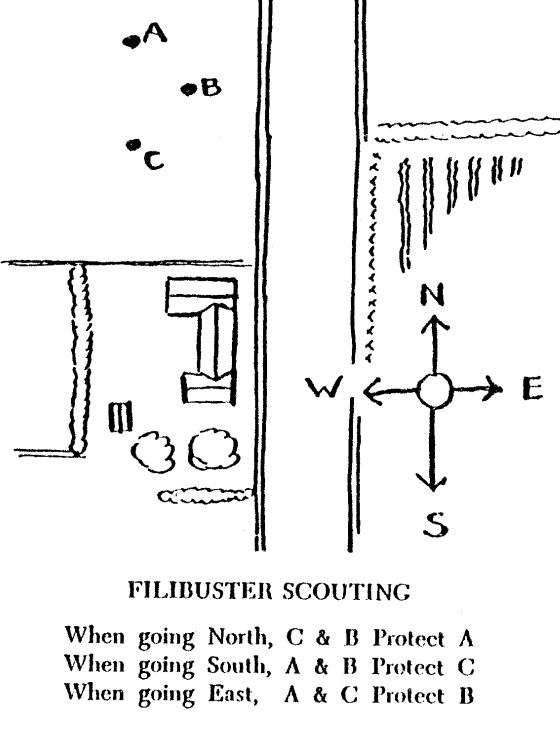
If an enemy is encountered the two “corners” nearest him can engage him in a crossfire. In a reconnaissance mission this would allow the “far corner” to escape with any information gathered. Alternately he can fire between his team mates or manoeuvre to execute a flanking attack or diversion.
Levy’s illustration shows an equilateral triangle with “C” directly behind “A”. Shown below is an alternative configuration. In actuality these formations are unlikely to be perfect geometrical shapes. The most that can really be said for them is that they will have three (or four) corners and are unlikely to contain any right angles.

Levy remarks that the Filibuster triangle can also be used for larger fighting patrols with two or three men at each corner. For a four-man formation he suggests a “staggered square” variant of the Filibuster. Unfortunately that term does not tell us much and Levy does not provide an illustration. Below are two conjectures on what this formation might look like. Distances between members are not to scale.


The first illustration resembles a parallelogram. Everyone other than the point man follows the rule that they should be slightly behind the man on their right and to the left of the man ahead. This formation can be thought of as four echelon formations joined together.


The second illustration can be thought of as a modified rhomboid or diamond formation. Each man ensures that he is never level with the man to his side. Each man watches the back of the man or men ahead. This illustration also hints at how easily the Filibuster can change to other formations. It can narrow to form a staggered file or file. It can easily form a line, echelon or arrowhead formation, as needed.

Levy suggests that a five-man unit should use a four-cornered Filibuster. The fifth man should be the unit leader and somewhat behind the point man and to his flank. For formations of more than three men it may be more useful to form a modified arrowhead, the fourth man positioning himself to the outside of the second or third. Changing direction is as described above.
A six-man unit has the option of forming a pair of Filibuster triangles. These will probably move in echelon, each positioned to support the other. Alternately, the “five-man, four-cornered” formation might be used, the sixth man placed with the unit leader. This is a logical position for the unit’s machine-gun. RPG or mortar. Possibly the corner men will take turns in the centre position, giving them a rest from the concentration and vigilance the corner positions require.

The three-corner Filibuster seems to be a useful starting point for teaching small unit formations.

A more detailed article can be found here.

The Books

http://www.angelfire.com/art/enchanter/epsdbook.html 

http://www.lulu.com/shop/http://www.lulu.com/shop/phil-west/survival-weapons-optimizing-your-arsenal/paperback/product-21488758.html

http://www.lulu.com/shop/phil-west/crash-combat/paperback/product-22603842.html

Friday, 17 February 2017

Camouflage Overvisor.


I have been thinking about some posts on camouflaging the head area. These will have to wait until I scan a relevant image. As an offshoot of this research I have been thinking about the issue of camouflaging the eye area.

Below we have an image of the popular conception of a ninja. In reality the items used to cover the face and hair might not be black. The “letterbox” for the eyes is very noticeable. Wearing a ski-mask type hood is not much better since this creates a pair of circles and the brain is wired to look for eyes.
One solution is to camouflage the area around the eyes with facepaint. The disadvantage of this is makeup is not as easily removed as clothing. That is a problem if the operative wants to disappear back into the local population.

Modern fighters often wear goggles. Some of us wear spectacles. These are reflective and thus difficult to camouflage. Some tactical googles are made with black frames rather than more useful colours such as tan.

Part of the solution is to wear a hat with a brim. This casts a shadow over the eye region and reduces the change of reflections. A headnet or mosquito net that covers the face can also be used.

A third solution is to construct an overvisor. Acquire a rectangle of mesh material of either metal or plastic. It should be lightweight but capable of holding a shape. Bend it into an arc so that it covers the “letterbox”. The brain is attuned to picking out eye-like objects, particularly when they are in pairs. The rectangular shape of the overvisor hides the familiar shapes of eyes or glasses. Two of the photos below show snow goggles improvised with a similar method.

 
Buy a can of cheap black acrylic spraypaint from the hardware store and use it to undercoat both sides of the mesh. Leave the undercoat to dry. For the next step you will take a pot of acrylic model paint. Tamiya “Dark Yellow” or “Desert Yellow” are good shades. Take a piece of tissue or foam, dip it in the paint and wipe off the excess so the sponge is just damp. Wipe the paint onto the outside surface of the mesh. If you have some experience with drybrushing you can use this technique instead.

You now have a rectangular visor that is black on the inside and sand-coloured on the outside. If any of the “outside” colour is visible on the inside brush over it with black. The inner side of the visor needs to be black since this lets you see through it more easily. It should work rather like a fencing mask or mosquito headnet. This, incidentally, is why headnets are always dark, despite mosquitos being supposedly attracted to dark colours. A net of a more reflective colour will be difficult to see through. The goggles shown below have the right idea but the wrong colour.

You will probably want to further camouflage the outside of your overvisor. The trick here is not to overdo it. The main objective is to break up the regular rectangular shape. You probably only need one additional colour as long as it contrasts with the sand colour. Olive drab, darkish grey or a middle/dark brown are good choices. Make the blobs one to two inches across and at least half an inch between them. A winter version might be all white or use white with grey or dull green.

A fringe of suitably coloured frayed cloth can be fastened to the lower edge of the overvisor to help conceal the nose and mouth.


How you wear the overvisor will depend on how you wear it. If you wear it on its own you may simply cut a notch for your nose and add some elastic. Parts of cheap sunglasses may be utilised but some form of retaining band is recommended. If you wear the overvisor over googles or spectacles you may want some mechanism to attach them directly, or attach it to your headgear. Whatever option you choose make sure that the overvisor is easily removable. The overvisor acts a bit like a sunshade so at night or in low light conditions you may have insufficient visibility.

         If you have enjoyed this article or it has been helpful to you please feel free to show your appreciation. Thank you.
The Books

http://www.angelfire.com/art/enchanter/epsdbook.html
http://www.lulu.com/shop/http://www.lulu.com/shop/phil-west/survival-weapons-optimizing-your-arsenal/paperback/product-21488758.html
http://www.lulu.com/shop/phil-west/crash-combat/paperback/product-22603842.html
https://www.amazon.com/Anatopismo-Underrealm-Novella-Phil-West-ebook/dp/B077G7MMFM

Thursday, 2 February 2017

Ammunition Conservation.


Writing yesterday’s blog I was reminded of a paragraph in the introduction of the English language version of “Total Resistance”, the Swiss military manual:

“In my command in the Philippines, I found that the only way to break out of an ambush action was to provide indigenous personnel with limited ammunition. A guerrilla with an empty rifle will retreat readily, while one with an adequate supply of ammunition will stay too long and risk capture.”

Che Guevara’s Guerrilla Warfare manual is often dismissed as being a rehash of Mao Tse-Tung’s work. This is an unfair and inaccurate statement. Che’s work has a lot of original content and insight. Che has a lot to say about ammunition. A good guerrilla should value his ammunition like gold or treasure and never fire one shot more than necessary.

“The veteran infantry soldier, though equipped with automatic weapons, will know the value of ammunition. He will guard it with loving care.”

Amusingly, of the 8-shot semi-automatic Garand he cautions “only people with some experience should use this, since it has the disadvantage of expending too much ammunition.”

If dismounted troops are not to become overburdened with excessive ammunition loads they are going to need to change some of the ways that they conduct operations. This is particularly true of riflemen.


In terrain or conditions where armoured personnel carriers cannot be used the infantry must be supported by smaller tracked vehicles that can carry ammunition and stores. This might be something like a tracked quadbike or modification of a snowmobile with quieter hybrid electric propulsion.

The defence orientated civilian or prepper does not have the luxury of an extensive military resupply system. They too need to adopt tactics and practices that reduce the weight they carry and use ammunition more effectively.


         If you have enjoyed this article or it has been helpful to you please feel free to show your appreciation. Thank you.
The Books

http://www.angelfire.com/art/enchanter/epsdbook.html
http://www.lulu.com/shop/http://www.lulu.com/shop/phil-west/survival-weapons-optimizing-your-arsenal/paperback/product-21488758.html
http://www.lulu.com/shop/phil-west/crash-combat/paperback/product-22603842.html
https://www.amazon.com/Anatopismo-Underrealm-Novella-Phil-West-ebook/dp/B077G7MMFM

Wednesday, 1 February 2017

Soldier's Load: How Much Ammo to Carry.

Continuing our look at the soldier’s/ survivor’s load I will return to the subject of ammunition.

Regular readers will know that I am not ashamed to draw inspiration from unusual sources. They will also know I am partial to the occasional video game.

I was playing a western-themed game and came to a point where I was offered a chance to buy some ammunition. I looked at how much ammo I had collected for the weapons I used the most and decided I did not need to buy any. What was interesting was that I had something like 80+ rounds for the repeater carbine, my primary weapon. Granted that in the game there is a mechanism to make you a deadeye shot and slain enemies generally drop useful ammunition, but if it was in real life 80-100 rounds for a Winchester would seem an ample amount.

The typical soldier in the American Civil War carried a cartridge box with 40 rounds ready for immediate use.

Yesterday I was reading about World War One trench raiding. Troops did not wear “equipment” (webbing) for these raids but the men carrying a rifle and bayonet carried 50 rounds. Other men carried ten grenades instead. “Marching load” for British soldiers was 90 to 110 rounds.

An account of a World War Two British platoon had each rifleman with 50 rounds and two to four magazines for the Bren gun. How much ammunition was carried in practice may have been more.

German soldiers of the same period are noted for being frugal with their rifle ammunition and letting the machine-guns handle the bulk of the offensive and defensive fire. I’ve encountered 90 rounds as the ammunition allocation for a Mauser rifle. The issue belt pouches only hold 60 rounds as twelve 5-round chargers so the remainder may have been in the pack if 90 rounds were carried.

The Japanese soldier carried 120 rounds. Twelve 5-round chargers were distributed between two frontal belt pouches and a further 60 rounds was in a “reserve” pouch at the back.

The American soldier in World War Two was issued with an ammunition belt with ten pouches, each for an 8-round Garand clip. In his famous study of the soldier’s load SLA Marshall claims that soldiers generally carry more ammunition than is needed and suggests six clips (48 rounds) be carried instead.


If we look a little later in history the American soldier in Vietnam was instructed to carry 330 rounds for his M16. Other sources say 14 magazines. Bear in mind a loaded 30 round magazine weighs around a pound each. 880 rounds was allocated for each M60 so the riflemen probably helped carry some of this too.

The British soldier with a 7.62mm SLR was expected to carry five 20-round magazines and a 50 round bandolier or belt for the MG. With the switch to 5.56mm weapons and a rifle capable of automatic fire came a suggested load of 330 rounds: six 30-round magazines and 150 rounds in a bandolier.

In a previous post I have discussed appropriate and inappropriate use for fully automatic fire with rifles. If you have a semi-automatic or manual action weapon this is obviously not a concern.


How ammunition is carried may have an influence on the quantity a shooter carries. Give a soldier two belt pouches that each hold three magazines and he will probably carry at least seven magazines. Three in each pouch and one ready in his rifle. Give him a single pouch that holds four magazines and he will probably carry five. Give him a claymore mine bag instead and he may fill one pocket with magazines and use the other for other useful items.


A few posts back we looked at the Viet Cong chest rigs. If a wearer decides to carry six AK magazines he has around 180 rounds. An AKM 30-round magazine weighs about 1.8lbs so six loaded magazines weighs 10.8lbs. The equivalent load for an SKS would be eighteen 10-round chargers. Each of these weighs 0.4lb loaded so 180 rounds would weigh only 7.2lbs.

Several of the examples given earlier carried their ammunition in chargers (aka stripper clips). The Garand took ammunition in true clips. Contrary to what TV shows, video games and some supposedly expert gun writers will tell you, a clip is not a magazine, it is a device that fits inside a magazine. A charger/ stripper-clip remains outside a magazine and unloads its rounds into the magazine.


Carrying ammunition in chargers rather than magazines constitutes a considerable saving in weight. Unfortunately there are not that many modern semi-automatic rifles that can be loaded directly with chargers. The SKS and M14 are probably the only ones you are ever likely to encounter. Canadian FALs could have their magazines topped up with chargers while the magazine was in place. When Canada switched to the AR-15 this capability was not continued, probably because of the carrying handle. Many modern AR-15 weapons no longer have the carrying handle and a replacement receiver top that can take chargers may be possible.

The SKS has an integral 10-round magazine but this can be replaced with a 20 or 30 round capacity part. Since the chargers hold 10-rounds it is possible to top up such a magazine when it is only partially empty. The capability to use chargers is just one of the advantages an SKS has over a semi-automatic AK-type weapon.


While most semi-automatic rifles cannot be loaded directly with chargers, chargers can be used to quickly reload magazines when they are not fitted to a weapon. For some designs of magazine a device to facilitate this may be needed. Carry a couple. It is practical to have just a couple of magazines and carry additional ammo as lighter chargers.  


So how much ammunition is a realistic load? We are talking personal load here. If you are mechanized carry additional ammunition in your vehicle. If you operate in a given area establish a number of caches with additional ammunition and other useful items.

As a rough guide aim for 80-100 rounds and two or three magazines, including the one in your rifle. You can probably find pocket room for two magazines without needing a belt pouch. A pouch for a single magazine on your rifle-stock is not a bad idea, given that ammo is of only limited use if you are separated from your rifle. If you load 27 rounds to a 30 round magazine then three magazines gives you 81 rounds. This will probably be ample for a semi-automatic weapon. Additional ammo can be carried as chargers.


If you have enjoyed this article or it has been helpful to you please feel free to show your appreciation. Thank you.

http://www.angelfire.com/art/enchanter/epsdbook.html
http://www.lulu.com/shop/phil-west/crash-combat/paperback/product-22603842.html
http://www.lulu.com/shop/http://www.lulu.com/shop/phil-west/survival-weapons-optimizing-your-arsenal/paperback/product-21488758.html
https://www.amazon.com/Anatopismo-Underrealm-Novella-Phil-West-ebook/dp/B077G7MMFM
https://www.amazon.com/Hell-Ay-non-partisan-sourcebook-role-play-system-ebook/dp/B07FQSHSQC