Friday, 12 January 2018

Luggage Locks and Skeleton Keys

Warded locks are very simple devices. At the far end of the lock is a catch or spring. Rotation of the end of the key releases this. Between this mechanism and the keyhole is a space with a number of cross-walls or “wards”. The key cannot turn unless its cut-out sections coincide with the position of the wards. With a little forethought keys can be designed that will only open certain locks in a house, but not others. The downside is that warded locks only really prevent the use of other keys. If most of the excess metal of a key is removed the result is a key that can open a warded lock irrespective of the pattern of wards. This is the original meaning of “skeleton key”. Items such as screwdrivers might be modified to open some locks.


Warded mechanisms are still used and a set of skeleton keys can be purchased or fabricated with modest effort or expenditure. Such keys are, however, too large for the small warded locks commonly encountered on luggage.
 
While still common, such locks have dubious value. Many can easily be snapped open, sometimes without the need for tools. These, and many other luggage locks, can be bypassed by items such as pens applied to the zipper.

The keys for such small warded locks do not exhibit much variation. Some locks don’t even have any warding inside! I have a key on my bunch from a lock I have not seen for decades. When I encountered a small warded lock recently I tried the key and it opened the lock like they had been made for each other. Below is the lock, the key that opened it and a skeleton key for small warded locks that I made.
Below: A lock with a skeleton key made by filing down a similar key.
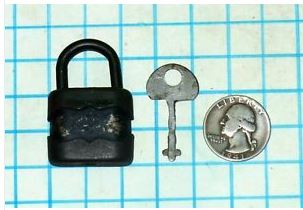
Some of your lock picking tools might open a small warded lock. I have opened such a lock using hooks, half-diamonds, single-hump Bogotas and snowmen. A ball or half-ball would probably work too. Just insert the pick and rotate until you trip the latch or spring.
Conventional lock picks are not really designed to take lateral pressure, so such use should be occasional or for when you do not have a better alternative. If you are a customs officer or someone else who often has a legitimate need to regularly open such locks you can make yourself an opener from some stout wire, tube or rod. Below is a photo of one of my turning tools. The rod section of the handle has been given a slight hook for opening small warded locks.
Alternately, the creation of a small skeleton key should be relatively simple, particularly if you already have a similar key. Keys can also be formed from scrap metal. The skeleton key that I made was created from a section of laboratory spatula. It was produced in under three minutes using just pliers and a needle file. This now rides the same ring as my other skeleton keys.
         If you have enjoyed this article or it has been helpful to you please feel free to show your appreciation. Thank you.
The Books

http://www.angelfire.com/art/enchanter/epsdbook.html
http://www.lulu.com/shop/http://www.lulu.com/shop/phil-west/survival-weapons-optimizing-your-arsenal/paperback/product-21488758.html
http://www.lulu.com/shop/phil-west/crash-combat/paperback/product-22603842.html
https://www.amazon.com/Anatopismo-Underrealm-Novella-Phil-West-ebook/dp/B077G7MMFM

Thursday, 11 January 2018

Zip Tie Escapes

Yesterday I came across a reference to cutting zip ties/ cable ties with “survival cord”. A quick websearch produced a video of a gentleman cutting zip ties with paracord bootlaces.


An important aspect of this to grasp is that it is not necessary to use paracord. The original reference was probably to kevlar line. I had neither paracord or kevlar readily to hand but I did have a soft bootlace that was probably polyester. I tried it and within seconds the zip tie was cut with molten ends. Later I tried some cotton string. I was actually surprised that this worked, but it did! The tie ends looked more broken than melted, but that is still an escape!
Dental floss should work. So might monofilament or braided fishing line. Electrical wires and headphone cables are definitely worth trying when the chips are down. Would belts or strapping work? Failing any of these, rub the tie on a brick edge or stone.

If you secure a prisoner with cable ties and leave them unsupervised there is a real chance they will not be secured when you return. Shoes have laces. Clothing and bags have cords. A compass, ID card or whistle might be on a lanyard. A metre of fishing line can sit in the bottom of a pocket and easily be missed in a search.

Below is an image from the Art of Manliness blog that shows some other techniques you can use against zip ties.


A trick used by magicians and escapologists is to conceal nail clippers on their person. This is often done using a bulldog clip on a safety pin. The clip can be compressed by various body parts to drop its contents into a waiting hand. If you have a lighter or match try and melt the tie. Many military “dog tags” now have rubber bumpers (“silencers”) to stop them rattling. This makes it possible to sharpen or serrate the edge of a metal tag or use the silencer to secure a rectangular blade behind the tag. Such a blade can be made from a tin can lid.

         If you have enjoyed this article or it has been helpful to you please feel free to show your appreciation. Thank you.
The Books
http://www.angelfire.com/art/enchanter/epsdbook.html
http://www.lulu.com/shop/http://www.lulu.com/shop/phil-west/survival-weapons-optimizing-your-arsenal/paperback/product-21488758.html
http://www.lulu.com/shop/phil-west/crash-combat/paperback/product-22603842.html
https://www.amazon.com/Anatopismo-Underrealm-Novella-Phil-West-ebook/dp/B077G7MMFM

Saturday, 6 January 2018

Goso Hook Set.

Regular readers will recall that when I became interested in lock sport I brought myself a cheap Chinese set of tools. This let me experiment with various different styles of tools. It also provided me with a plastic see-through practice padlock.

Today’s post is about another set of Chinese-made tools that I own. Like my other kit, these are made by Goso. A very similar kit is marketed under the name “KLOM”. These have different handles, without “GOSO” on them, and I have seen different handle colour options offered. Some of these KLOM sets seem to have an additional turning tool and/or a turning tool different from the Goso model. My other Goso set seems to be a copy of the Majestic brand. I would have assumed this kit is a copy of the KLOM, but the Goso website sells the KLOM set! Comments on quality and finish only apply to the Goso set. I do not know if the KLOM set is the same.


I brought the nine-piece Goso set of since I wanted to develop my SPP (single pin picking) skills and wanted a selection of hooks.

These are not, by any stretch of the imagination, quality tools. They are punched out from thin steel with no attempt to remove any burrs or turned edges. Many of the plastic handles show seams and flash and vary as to which side the handle curves in relation to the tool head. The flaws with the handle are admittedly aesthetic and the handle orientation makes very little effect on the use of the tools. Burrs can be removed with a file and abrasive paper.

When I first examined the hooks I noticed subtle variations in shape and curve and some duplications. I’m no longer sure how much of this is deliberate and how much poor quality control! There are three, possibly four distinct hook forms. On the positive side, I have a fondness for these since I achieve my first ever SPP with one of these! By that criteria the kit has done what I brought it for. One of these hooks sits by my chair so I can fiddle with a lock during the advert breaks.

You get three other tools:

One tool is the most obtuse half-diamond I have ever seen. I have successfully picked locks with this but its general utility seems low. I cannot even think of anything useful to turn this into.

Another tool is a “dimple rake”, an odd inclusion in a kit mainly of tools for conventional cylinders. Oddly, most of the dimple pick kits offered by the same company don’t appear to have this rake included. I have no experience of how effective this rake is, not having any dimple locks available. In BosnianBill’s review of this kit he accidental snaps this while trying to demonstrate how soft the steel in this set is. (Ironically, one of the few tools from Goso kits he considered useful) The hooks all seem relatively soft and bendy. Not necessarily a bad thing when picking a narrow keyway.

The final pick resembles a giant version of a single-hump Bogota. Apparently this works well on wafer locks and some people buy the set just to get this. To my surprise this works well on some of my (non-wafer) locks both as a lifter or as a rocker. Later I noticed the hump is very similar to that of the Princess rake.

The final part of the kit is a turning tool. This resembles a stout bit of wire with flattened ends. This is actually a nice tool. The ends are a bit asymmetrical but it works fine. A little bit of file work could shape and size the ends to the user’s particular requirements so it is ideal for customisation.
 

Incidentally, I have seen a set of these picks without the handles offered at a higher price as a compact mini-lock pick set. This illustrates the plastic handles could easily be cut down, reshaped or removed. The selection of tool types for this application is a bit limited, however. I would want an half-diamond and some cylinder rakes too, so will stick to my pair of Bogotas.

How useful this kit is very much depends on your expectations and the price you pay. It is not a high quality premium kit and the standard of finish is poor. I brought mine from Withoutakey and consider the price of £2.99 to be reasonable for what you get, being less than that of many quality single picks. Note that many other sources are offering the same kit for several times the price, however. If you get one or two useful tools from the set and was not expecting state of the art, you come out ahead. My kit helped me learn SPP, which was what I wanted. I like the turning tool and may add the giant single-hump to my best kit.
         If you have enjoyed this article or it has been helpful to you please feel free to show your appreciation. Thank you.
The Books

http://www.angelfire.com/art/enchanter/epsdbook.html
http://www.lulu.com/shop/http://www.lulu.com/shop/phil-west/survival-weapons-optimizing-your-arsenal/paperback/product-21488758.html
http://www.lulu.com/shop/phil-west/crash-combat/paperback/product-22603842.html
https://www.amazon.com/Anatopismo-Underrealm-Novella-Phil-West-ebook/dp/B077G7MMFM

Monday, 1 January 2018

AMA: Uniform to Zulu and the Numbers.

The final part of the lessons on American manual alphabet (AMA) and NATO phonetic alphabet. You will probably have found learning these systems very easy. I learnt all the AMA signs in less than a day. There are various ways you can practice. If you are waiting somewhere or during an advertisement break on TV you can fingerspell the names of things around you. Or you can “recite” the vowels. Accompany this by saying or thinking the phonetic terms.

Uniform: Two fingers raised, like the old cub scout salute. Scouts should be in Uniform. Practice signing India-Lima-Uniform to your significant other and you will soon memorize this sign.

Victor: V for Victor(y). Uniform with the fingers apart.

Whiskey: Victor with an extra finger to form a “W”. Mindhacker suggests “three fingers of whiskey”.

X-ray: Crook your finger like it is broken. You should get an X-ray for that.

Yankee: Resembles the “hang-loose” gesture so Mindhacker has a memory aid about “Yankee surfers”. In English “y” and “i” are sometimes exchanged so I remember this as being like the India sign. The Yankee or Yankee-Sierra sign can be used to say “yes”, November or November-Oscar, “no”. There are alternate signs to do this.

Zulu: Like Juliet, a symbol you draw in the air, but using your index finger rather than the India sign. Go inward, outward and inward again. Mindhacker likens this to a clock pendulum, the clock set to Zulu time, naturally.

The numbers: You will have already encountered these in my book Survival Weapons: Optimizing Your Arsenal. One to five are simple enough. For six to nine the key thing to remember is that six starts with the little finger. Note the “thumb” wave signal for ten. Use a number and Charlie for “hundreds”. There is an ASL sign for “thousands” but it needs two hands. “Mike” or “Kilo” are not really suitable since these are more logically used for “metres”, “minutes” or “kilometres/ klicks”. Tango or Tango-Hotel could be used for thousands.

         If you have enjoyed this article or it has been helpful to you please feel free to show your appreciation. Thank you.
The Books

http://www.angelfire.com/art/enchanter/epsdbook.html
http://www.lulu.com/shop/http://www.lulu.com/shop/phil-west/survival-weapons-optimizing-your-arsenal/paperback/product-21488758.html
http://www.lulu.com/shop/phil-west/crash-combat/paperback/product-22603842.html
https://www.amazon.com/Anatopismo-Underrealm-Novella-Phil-West-ebook/dp/B077G7MMFM