Friday, 9 March 2018

Mission Impossible Lock Picks

It is Friday so time for a more light-hearted post.

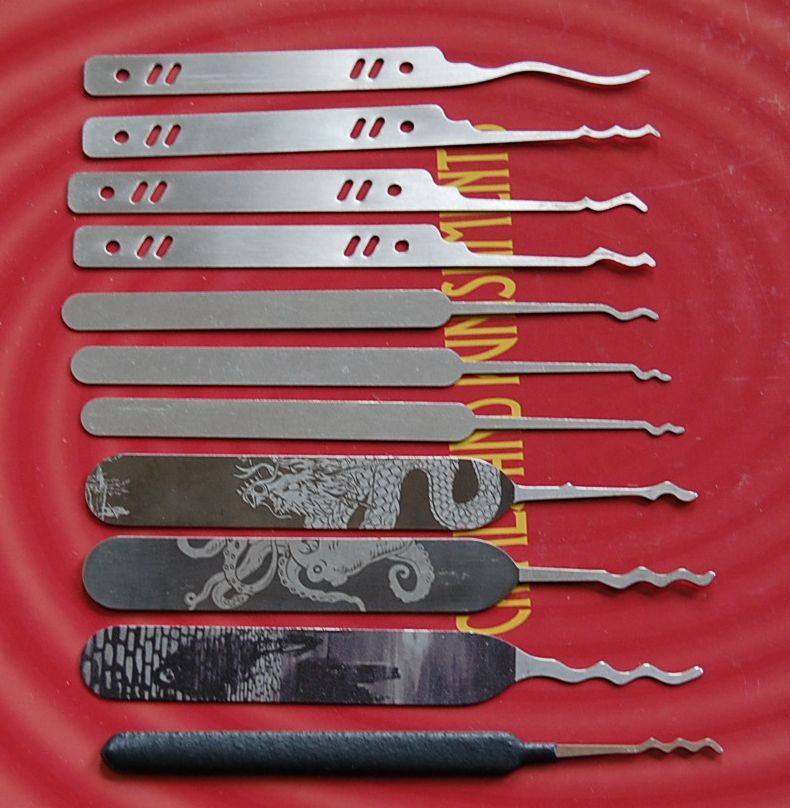
A few weeks back I came across a webpage with the following image. These are props from the film “Mission Impossible 3” and were used in a scene in the Vatican. I cannot say I remember noticing them when I saw the movie.
The original webpage has vanished from the net, so I do not have any of the additional images. The picks were designed so that the handle of each forms a sheath for the other pick so they can be carried as one compact unit. The construction material of the whole picks seems to be plastic, possibly of the same sort used to make credit cards. I have no idea as to whether they will work in real life.

Bizarrely, the writer of the original page referred to the picks as “files”.

Note that this set has no tension/ turning tool. I don’t recall what Tom Cruise did in the movie, but not using a tension tool is the number one movie mistake when it comes to lock picking.

As can be seen, the kit has a half diamond and a two-hump batarang. What amuses me about this is that it looks like it was made by someone who had heard about paired Bogotas but could not be bothered to web-search on what they actually looked like. (Knowing that I would write this article today, I tried picking a lock with my three batarang-style rakes last night. The lock only opened for one. The finger rakes, on the other hand, opened the same lock in a fraction of the time!)
If you have enjoyed this article or it has been helpful to you please feel free to show your appreciation. Thank you.
The Books

http://www.angelfire.com/art/enchanter/epsdbook.html
http://www.lulu.com/shop/http://www.lulu.com/shop/phil-west/survival-weapons-optimizing-your-arsenal/paperback/product-21488758.html
http://www.lulu.com/shop/phil-west/crash-combat/paperback/product-22603842.html
https://www.amazon.com/Anatopismo-Underrealm-Novella-Phil-West-ebook/dp/B077G7MMFM

Wednesday, 7 March 2018

Two Pick Sets, One Review.

Today I am going to look at two different lock pick kits. A seven piece kit and a five piece.
The seven piece kit is one you have already seen in my post on the Serentity plus kit I have built. These are often referred to as “mini-rakes” or “finger rakes”.

Regular readers will know that one of my more reluctant locks I practice on is a little Abus. In my early days of picking I considered the possibility that my Bogota rakes were too big to pick this lock. Hence, I became interested in acquiring a set of rakes more suited to smaller keyways. Experience has shown that it was my skills that were deficient in the case of the Abus. The Bogota is one of the most reliably performing picks for this lock. Ironically one of the best picks for this lock is the much larger Octo rake. I was, however, well aware that in a few months I might have to deal with much smaller padlocks, so the finger rakes remained on my wish list.

Problem was, these rakes are actually part of a much larger kit. Many stockists break the kit into two parts and sell the parts separately. The finger rakes tend to sell well so are usually out of stock. Understandably vendors are reluctant to restock until they have shifted some of the other half of the kit. In short, I have had to wait several months for these. At least once they sold out before I was able to place my order.

The finger rakes appear to be made from what I suspect is music/ piano wire. The actual rake parts have had their sides filed flat to thin them. That is some nice attention to detail. What many websites on making picks from paper clips fail to tell you is that paperclips may be too wide for some keyways. You will need to file down the sides, or in the field, abrade them on a suitable hard surface.

If you look carefully you will see the rakes can be grouped into two styles. One style resembles Soho/ Sabana/ Monserate-type rakes in that a straight section separates the humps. The set has a two-hump and a three-hump example, top and fifth down in the photo. The peak to peak distance (wavelength) of the finger rakes (12mm) is close to that of the equivalent part of a Soho, but not identical (13.5mm).

The remaining rakes might be termed as “continuous wave”, with one to five peaks. Wavelength is close (7mm), but not identical (6.5mm), to that of a triple-hump Bogota.

I brought this set to use on small keyways. A very pleasant surprise has been that this kit works very well on many standard size keyways too. Being constructed of music wire these rakes are very light and springy. They are not suited to techniques such as rocking. The technique that seems to suit them best is scrubbing. Insert them in the keyway and move them back and forth. As always in lock picking, if it does not work, use less force!

I did find a padlock with a tiny key way, only about 4 mm high. Mindboggling thinking about how small the pins must be! The main challenge was finding a suitable turning tool. I ended up using a short length of hairpin, doubtless a product of some of my recent handcuff opening experiments. The finger rakes popped this tiny lock open in a few seconds. They also open small warded luggage locks. Even the multiple-peaked examples fitted down the lockway.

People who make lock pick kits are well aware of the “socket set mentality” many men have, also known as “more is better”. The three-hump “Sabana” can do anything the two-hump can. In small locks only the first hump and a half of either is likely to contact the pins. Likewise, the five-hump wave can do anything its less endowed sisters can. I am uncertain as to if the single-hump has potential as an SPP half-diamond. The locks I have successfully opened with it also open for the Sabanas and multi-waves. This implies that you could potentially split the finger rake set into two sets, making sure each has a Sabana and either a four or five wave rake. The three-hump and five-wave might find their way into my main lock kit.

I like the finger rakes a lot. I expected them to be a specialist item but they have proved more useful and versatile than expected. UK Bump Keys have them for under just under £3/ $5, which is great value. A few stockists charge a bit more, but this is often still a good price given how useful they are likely to be. These finger rakes tend to sell out fast, so balance how much you are willing to pay with how long you want to wait.

The larger kit the finger rakes come with is usually termed a “Wave rake” kit. I have seen these attributed to either KLOM, “Honest” or DAINU, with considerable variation in price. These are probably all made in the same place in China, so the possibility of directly importing only the finger rakes should be looked into.
The second set that I am looking at is one that I brought when I first began buying lock picks. It was a fun purchase of what I considered a novelty item.

As you can see, it comes in a box printed as James Bond’s credit card. (Visa? I would have thought Access as better for lock picks!). The design on the box will actually vary, some websites offering a blank fronted box. I am a bit dubious as to the tactical practicality of pick sets apparently designed to fit in a wallet. It seems if you are illegally detained your wallet and jewellery are very likely to be taken off you. This kit seems a little thick to fit in a wallet, but my wallet is one that only holds cards and is a little on the small side, so others may feel differently.
This kit was a surprise. The picks are actually quite nice! Several times on this blog I have mentioned the poor finish and crude production methods of some Chinese-made lock pick sets. The picks in this set are nicely finished with a good polish and smooth edges. The metal seems adequately springy. I have seen one video where the picks showed signs of rusting so watch out for this if you carry them in humid conditions. It seems I was lucky with this example. The second of these kits that I brought was of much cruder finish.

The kit has two Single Pin Picking (SPP) lifters: a hook and a half-diamond. You also get two rakes: a snake and a jag/ city rake. The fifth piece is a turning tool. I have seen one video on youtube where the kit came with two hooks instead of a snake. I have also seen a kit offered for sale with a training lock that apparently has a duplicate snake instead of the jag.

I have heard complaints that the tools are too short but I have not found that to be a case. My Bogotas are probably shorter. The short handles may be an issue if you are using them for prolonged SPP. For the rakes the short handles are perfectly adequate.

I like the snake rake. Last night I even opened my Abus with it. Regular readers know I am not a big fan of jags and ideally I would rather have seen a two or three-hump Bogota in this kit instead. I suspect the kit predates Bogotas, however. That said, this jag works very well. Using it as a rocker it has opened several of my practice locks in well under a minute.

The one piece I do not like is the turning tool. It is too thin for a turning tool of this type and the noses too narrow. Used centre of the cylinder (TOK) it continually pops out. It is not much better edge of the cylinder (BOK). The best use for it may be to grind it into a Bogota!

This kit may be more practical if carried without the box. I have seen suggestions for drilling a hole in each handle so they can be carried on a split ring. Or rivet them to create a fan. There are key carriers that resemble jack-knives and this is potentially another way to carry this set. The short handles could be used as a tang to fit a longer handle.

The reason I think this kit may be of interest is that it can be found at very low prices. I paid just a few pounds for mine and the vendor also sent me a free booklet on lock picking. I have seen these sets at even lower prices. Then again, I have also see the same sets at five or six times this price, so shop around.

If you have enjoyed this article or it has been helpful to you please feel free to show your appreciation. Thank you.
The Books

http://www.angelfire.com/art/enchanter/epsdbook.html
http://www.lulu.com/shop/http://www.lulu.com/shop/phil-west/survival-weapons-optimizing-your-arsenal/paperback/product-21488758.html
http://www.lulu.com/shop/phil-west/crash-combat/paperback/product-22603842.html
https://www.amazon.com/Anatopismo-Underrealm-Novella-Phil-West-ebook/dp/B077G7MMFM

Tuesday, 6 March 2018

Escape: Handcuffs and Double-locks.

Version 1.1
Today’s blog is the second part of our look at handcuffs. Once I have this out the way I can move on to the product reviews and suggestions.
 
I have seen suggestions that the handles of some lock picks can be used as shims. Most lock pick handles are way too wide for such use. Even types like the Bogotas that have handles designed to serve as turning tools are likely to be a millimetre or so too wide for many handcuffs. What can be done, however, is to use the head of a pick. Obviously some designs of head are too wide. Picks I have successfully shimmed with include my half-snowman, the Dangerfield one-hump Bogota and the jag from the “James Bond Credit Card” set. Some of the snakes and hooks should also be suitable.
Another experiment I conducted was to use a handcuff shim on a cable tie. As I suggest in the previous post, I have further slimmed down the single end of the shim I made. With it I have successfully disengaged the locking mechanism of a cable tie. Admittedly the tie I had handy was larger than average but I believe the tool should be effective on standard sized zip ties too.
In the last post on handcuffs I dealt with how to deal with single-locked cuffs. If you are in cuffs for any length of time a trained captor is likely to double-lock them. This is why I am rather dubious about E&E sets that contain a multitude of different shims.

In the diagram above the double-lock mechanism is in red. Whilst the green single-lock pawl moves up and down, the double-lock mechanism slides back and forth (or up and down, with respect to the diagram above). The single-locking pawl is under constant pressure from a spring. The double-lock mechanism, however, clicks from one position to another and back again. When the double-lock is applied the red piece will physically prevent the green part from raising. Hence when a double-lock is applied the cuff cannot be further tightened and cannot be shimmed.

In the diagram above, you can see a channel above the double-lock mechanism. The handcuff key has a post that can be inserted into this hole to push the double-lock into the locked position. A paper clip, pen refill or any object of similar dimensions can be used to apply this lock if a key is not handy. Incidentally, looking for a post on the key is a good way to determining if the handcuffs you are considering buying a “real” or a novelty item. On some designs of handcuff there is a slot cut in the side and the lock is applied by using the post to flick across a “trigger”. A handcuff of this type can be seen in the “Secrets of shimming” video in the previous post.

To disengage the double-lock you normally need a key. The key is turned in the opposite direction to that you would use to open single-locked cuffs. First the double-lock must be released, then the key turned in the opposite direction to release the single-lock. In the diagram above the key would first be turned anti-clockwise, and then clockwise.

The primary means of dealing with double-locked cuffs is a key. You are advised to spend your money on acquiring a few keys before you invest in commercial shims. Later articles will look at some of the E&E keys available. But a word of caution:

Many years ago I watched a movie about undercover cops at a high school. In one scene a youth spots the handcuff key on a policewoman’s key ring. He says something like “I’ve been busted enough times to know a handcuff key when I see one!” The supposed schoolgirl manages to talk her way out of it, making some comment about being kinky or similar. Having a handcuff key in plain sight on your key ring may get you identified or mistaken for a cop, and the results of this may be more serious than in the movie. Some cops will take a dim view of non-police having handcuff keys, regardless of what the actual local laws permit. Likewise, in some localities carrying of a handcuff key(s) may be illegal. Escaping from legitimate custody is certainly illegal. The techniques on this blog are intended for protection against illegal restraint.

If you do not have a key there are a few things you can try to release a double-lock. Some lock picks can be used to push the bolt back to its unlocked position. Probably these will be hooks, but I have done it with the Dangerfield single-hump Bogota too. I’ve used the same tool to then lift the single-lock. The bulldog clip handle and some other improvised means work better for the latter, however.

A better way to disengage a double-lock is to use a hairpin aka bobby pin. Strip the protective bulb from the end and bend the straight part. Contrary to what you may see in many youtube videos I have found that a gentle curve with a radius of about 18mm works best on the cuffs I have tried. If the slot at the bottom of the keyway is “6 o’clock” then you want to insert your piece of pin at about “2 o’clock”. Give it a vertical angle of about 30-45 degrees. The idea is that it curves around the post and the wall of the keyway to push on the bolt until it clicks across. Bend the pin more as necessary. You can use this slightly curved pin to shim the cuffs once the double-lock has released.

Transparent training cuffs, such as those supplied by Shomer-tech are useful in learning this technique, but be aware doing this repeatedly can damage the plastic around the keyhole. Once you have the basics practice on all metal cuffs.

No discussion of the double-lock would be complete without some mention of kinetic unlocking techniques. The idea is to strike the cuff against a hard surface so that conservation of momentum causes the double-lock bolt to bounce up to the unlocked position. I’m told that this trick is more likely to work with older models of modern handcuffs. A related technique is pull on the shackle of the cuff as the body is struck. The theory is that if the double-lock does not fully disengage it will still move enough to allow the pawl to temporarily lift. Pulling on the shackle while striking the cuff seems a rather complicated operation if you are on your own.
 
The Darby-style handcuffs that Houdini was familiar with were vulnerable to being opened by striking. Strike near the hinge and keyhole. Darby-style cuffs are still in use in some parts of the world.

If you have enjoyed this article or it has been helpful to you please feel free to show your appreciation. Thank you.
The Books

http://www.angelfire.com/art/enchanter/epsdbook.html
http://www.lulu.com/shop/http://www.lulu.com/shop/phil-west/survival-weapons-optimizing-your-arsenal/paperback/product-21488758.html
http://www.lulu.com/shop/phil-west/crash-combat/paperback/product-22603842.html
https://www.amazon.com/Anatopismo-Underrealm-Novella-Phil-West-ebook/dp/B077G7MMFM

Sunday, 4 March 2018

Serenity Plus Lock Pick Kit.

Finally acquired the last component for my locksport kit, so it is time for a quick show and tell. I have come to think of this as my “Serenity Plus” kit.
The Dangerfield pouch that was provided with the Serenity kit as a free upgrade. Note that I have added a small Photon II-style light to the zip-pull. Also notice the home-made red filter made from a red drinking straw and electrical tape. I usually watch TV with the lights off. The light lets me select a pick from the case if I feel like picking a lock during the advertisements.
The pouch opened. Note that I have lined the pouch with red painted plastic backing. Appropriately enough these were created from security key cards, painted with red enamel paint. An elastic hair band has been cut and glued in position to hold the turning tools and hybrid picks. Not clear in the photo is that the right side includes a couple of hair pins, useful for making small turning tools, opening handcuffs and similar.
The right side of the pouch contains rakes and the left side lifters. The distinction between these categories is fuzzy, however. Various lifters can be used to rake or rock, and often this should be the first technique attempted with them. Rakes can sometimes be concentrated on a single binding pin. The Princess and Prince inverted are effectively deep hooks.
The contents of the left side. From the top:
  • Swerve rake from Serenity kit.
  • Bogota triple hump from Serenity kit.
  • Princess rake from Serenity kit.
  • Prince rake from Serenity kit.
  • Snake rakes from SouthOrd. Large, small and angled small.
  • Sandman rocker rake from Sparrow.
  • Octo Rake from Sparrow.
  • Warlock rake from Sparrow.
  • Worm rake from Sparrow.
The all important turning tools:
  • Wide tool made from laboratory spatula.
  • Pair of Soho rakes from Dangerfield.
  • Triple hump Bogota from Dangerfield.
  • Single hump Bogota from Dangerfield.
  • Long turning tool from Chinese turning tool kit.
  • Standard width turning tool made from laboratory spatula. Hooked end designed to open small warded locks.
  • Turning tool made from wiper insert. With standard and narrow heads.
  • Serenity kit turning tool modified to have additional narrow head.
  • Prybar-type turning tool from Serenity kit.
Contents of the right side:
  • Razor pick with home-made protective cover. Note fishing line to prevent loss.
  • Curved Reach Ball hook from Serenity kit.
  • High hook from Serenity kit. (Steep/ Postal hook?)
  • Angled Ball hook from Serenity kit.
  • Half-diamond from Serenity kit.
  • Partial hook from SouthOrd.
  • Half-snowman rake from SouthOrd. Made by filing down SouthOrd’s double-ball pick.
And as a bonus, my set of finger rakes, aka mini-rakes. These do not really fit in the kit but are something you are recommended to acquire. Intended to fit very small locks they work very well in standard sized locks too. Because they are springy they are more scrubbers than rockers. They tend to sell out fast when they are in stock. I’d like to thank Marcus of UK Bump Keys for his efforts to get me a set.
I make that as 28 items. Admittedly, there is some duplication with the turning tools but I do not consider that a bad thing. The half-snowman was an indulgence and just a bit of fun. Many of the other rakes will do anything this pick can, and probably in less time. I brought the snakes since I expected some locks would be difficult to use the Bogotas in. They have not seen much use, and I now have the finger rakes. The Sandman has not seen much use and I suspect it is better suited to American locks. Not found much use for the Swerve rake either. The Octo rake and Warlock, on the other hand, are very impressive. I’d put those on my must-have list right after the Bogotas. I have had little SPP success with the high hook. It has got stuck in a lock at least once! I may file the end round to create a Gonzo-style hook. I have not had much use for the razor pick yet. It only works on certain locks and I have yet to encounter any. Those E&E enthusiasts that think they can open any padlock if they have a razor pick are pr0bably in for a shock!
 
If you have enjoyed this article or it has been helpful to you please feel free to show your appreciation. Thank you.
 

http://www.angelfire.com/art/enchanter/epsdbook.html
http://www.lulu.com/shop/http://www.lulu.com/shop/phil-west/survival-weapons-optimizing-your-arsenal/paperback/product-21488758.html
http://www.lulu.com/shop/phil-west/crash-combat/paperback/product-22603842.html
https://www.amazon.com/Anatopismo-Underrealm-Novella-Phil-West-ebook/dp/B077G7MMFM