Sunday, 13 October 2019

Camouflage and Surface.

One of my readers/sponsors has reminded me that it has been a while since I wrote about camouflage. As it turns out, I have a few thoughts to share.
A mnemonic often taught is the “Five S’s of Camouflage”. These are usually Shape, Shine, Shadow, Silhouette and Spacing. There are variations on this, some schemes adding extra factors. These may include Smell, Speed, Sound, Skyline and Smoking. Some even fly in the face of alliteration and suggest “Movement” and “Aircraft”!
Skyline can be considered an element of Silhouette. Smell is something that is sometimes neglected. A human’s sense of smell may be inferior to that of many animals but can still prove useful if the brain interprets to significance of a familiar or out of place odor. Sound is not just obvious things like talking or gunfire. One of the reasons for the ninja covering his face was to muffle the sound of his breathing if he had exerted himself. The noise of chewing gum or tobacco may tip off an attentive enemy or prey. Give up both habits. Smoking is another habit to drop. As well as being an aiming point and location signal at night the smell of the smoke and on your clothes may give you away. Many smokers are litterbugs and a discarded cigarette butt can tell a competent tracker many things.
Shade/Shadow is something I found myself considering the other night while watching a movie . A cowboy rides ahead of a posse to scout a valley. He really should not ride straight down the middle like that, I thought. He could have easily swung into the big patch of shadow cast by the cliff on one side. Shadows in your environment can be very useful. If you have to cross a forest road follow the shadow cast by a tree. You may be under aerial observation. If you are attempting to conceal something the shadows cast may negate your efforts. Remember that the angle and direction of light will vary with time.
Another factor to consider is texture, or in keeping with the theme “Surface”. This is an element that seems to be often neglected these days. You can paint your vehicle in different colours but it will still be an object with many flat, smooth surfaces, most of them vertical or horizontal. Back when camouflage was taken more seriously I can recall Land Rovers covered in nets and hessian, sometimes looking like mobile blocks of heather. They still looked a bit boxy but viewed from the air they could easily be overlooked if they were static and positioned irregularly. You can still see similar examples, although oddly this seems more common on soft-skins than on actual fighting vehicles. Stowing gear under the nets can make the vehicle shape less regular. This is a variation of the old idea of placing balls of grass under a helmet net.
Surface is also the problem with most modern camouflage clothing. As has been discussed elsewhere, many current patterns lack the element size and contrast to disrupt body shape. Even when this is not the case the garments conform to the easily recognized shape of the human body. Smooth surfaces are not that common in nature. A good camouflage pattern is only the foundation upon which personal camouflage is built. Let me provide some illustrations:
These US troops are fairly typical. A patterned cloth cover does not camouflage a helmet, it remains a distinctive shape. No attempt has been made to paint or cover the distinctive black NVG brackets. These could at least be made in brown. Breaking up the shape of the helmet is perhaps moot when you have an uncamouflaged rosy-pink face beneath it. Note that none of these individuals have scarves they could use to veil their faces or make the head and neck area less distinctive. Other clothing has no attempts at shape disruption. If it was looser it would be more comfortable, better ventilated and more irregular in shape. Troops need a smock that fits over body armour and trousers that fit over knee-pads. Also note that there are not even temporary measures to conceal the distinctive shape of their weapons.

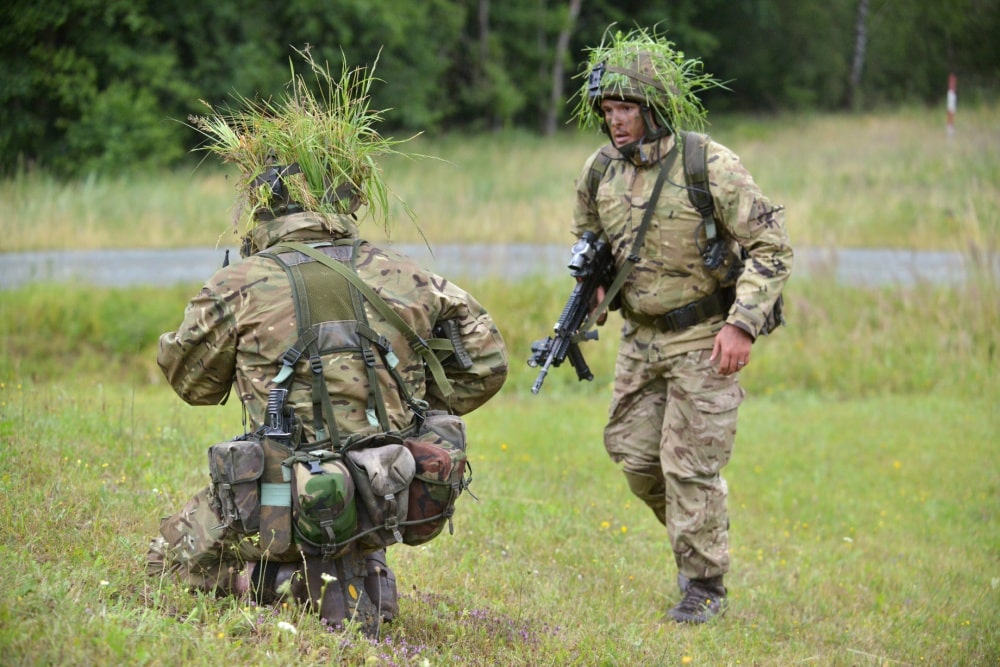
Next are two photos of British troops. These guys have camouflaged their helmets. One pair has used natural materials from their surroundings, the other appear to have used artificial materials (“textilage”). But they have stopped there. No materials added to the webbing, packs or pouches to break up their regular shape. No textilage added to the upper arms and shoulders to break up the shape. This would have also broken up the smooth appearance of their clothing, which takes us back to Surface.


Even if you are in a desert or urban environment with very little apparent vegetation adding some texture to your helmet, clothing and gear can make you harder to see, and harder to target. Personal camouflage is an important defence against snipers and observation. Conventional forces assume they will always enjoy air superiority, but modern technologies such as drones may negate this on a local level.
If you have enjoyed this article or it has been helpful to you please feel free to show your appreciation. Thank you.

http://www.angelfire.com/art/enchanter/epsdbook.html
http://www.lulu.com/shop/http://www.lulu.com/shop/phil-west/survival-weapons-optimizing-your-arsenal/paperback/product-21488758.html
http://www.lulu.com/shop/phil-west/crash-combat/paperback/product-22603842.html
https://www.amazon.com/Anatopismo-Underrealm-Novella-Phil-West-ebook/dp/B077G7MMFM
https://www.amazon.com/Hell-Ay-non-partisan-sourcebook-role-play-system-ebook/dp/B07FQSHSQC


Tuesday, 27 August 2019

Don't Use Your Word Processor!

Yesterday I came across the advice “Don’t use a word processor to write!” This seemed like an odd idea but as I thought about it the wisdom behind it became apparent.
Often I have been using a word processor when the program has “done something weird”. I then spent twenty, perhaps forty or more minutes trying to fix it. At the end of this the creative flow has usually stalled! In addition to this, on my home machine both MS Word and Open Office have a tendency to freeze up when saving new documents.
A lot of what I write ends up as a webpage. Most of the features of a word processor have very little effect on the final appearance. I have written a couple of ebooks, and again, the layout from the word processor has very little effect on the final product. One of the epub creators I used was very fussy. It would not accept Open Office documents and the MS Word version had to be extensively edited and formated before it was accepted. I suspect if I had had a plain text version I might have saved myself considerable time. Often I will draft an email in a word processor and then paste it into the messenger. The only WP feature I am actually using is the spell checker.
Many of us use complex word processors for jobs that actually only needed a simple text editor.
My “weapon of choice” has become Notepad++. I had already been using this program to code my HTML. Rather than pasting text in from a word processor I will now type the text in directly, adding HTML tags as I go. I can do the latter very quickly since Notepad++ gives you an easy system of creating custom macros. My personal experience of Notepad++ is that it is a robust and relieable program. It saves when I click save, opens quickly and so far has not crashed or frozen on me, unlike some WP programs I could mention. I made a few “tweaks” to improve Notepad++ for its new responsibilities. Firstly, make sure you have the Spellcheck and DSpellcheck plug-ins installed and activated. I also recommend that you install the Autosave plug-in. This should be the one from Franco Stellari with the version number 1.6 or higher beside it, not the one labelled “Autosave2”, which is apparently more an auto-copy. Download the .dll files into the plug-in folder, then use the plug-in manager (if your version has one) to tick the boxes and install.
A text editor cannot fully replace a word processor, but you may find using the right tool for the job saves you both time and effort.
An offshoot of this idea got me thinking about how many files I had stored in .doc format. I suspect I can save myself some disc-space if I convert some of these into .txt or simple HTML pages.
Written and edited with Notepad++.


If you have enjoyed this article or it has been helpful to you please feel free to show your appreciation. Thank you.


http://www.angelfire.com/art/enchanter/epsdbook.html
http://www.lulu.com/shop/http://www.lulu.com/shop/phil-west/survival-weapons-optimizing-your-arsenal/paperback/product-21488758.html
http://www.lulu.com/shop/phil-west/crash-combat/paperback/product-22603842.html
https://www.amazon.com/Anatopismo-Underrealm-Novella-Phil-West-ebook/dp/B077G7MMFM
https://www.amazon.com/Hell-Ay-non-partisan-sourcebook-role-play-system-ebook/dp/B07FQSHSQC

Sunday, 11 August 2019

EDC Shopping List.

The other day I had cause to look in one of my boxes of outdoor gear. Various containers that I thought might prove useful. Items brought out of curiosity or sometimes just for their novelty. Gifts from friends. Some are milestones from my path of understanding. Most of it I will never use. Either I have acquired better alternatives or my requirements have changed. So much money spent over the years that I could very much use now. Sadly most of this stuff has very little resale value.
If I knew then what I knew now” I could have saved myself so much time and money. This inspired me to think about the idea of a prepper/survival shopping list. If you have just come into the field, what should you be looking to buy first?
Hopefully my article on “Foundation survival kits” has proved a good start. A fire kit, bottle for carrying water and bag of toilet paper will have been easy to acquire. A poncho and liner or blanket will have cost a bit more but probably did not break the bank. You may be saving up for a good survival knife, but have hopefully bought a machete or hatchet to serve in the meantime. 
 
Most of the items suggested for the foundation are relatively bulky, however. They are “bag” items rather than things you can keep on your person all the time. If you have a good “skin-level survival EDC” what you can find in your environment or in your pack is a bonus.
The good news is that you can build up a good EDC without a great outlay of cash. My article on skin-level gear mainly listed my personal items. I have been asked for a more general list, so this might as well be a shopping list. As before, I will concentrate on the items you carry and save a discussion of clothing for another day.
Pocket Knife: This will probably be the most expensive item on this list. In an emergency this may be the only knife you have available, so it makes sense to get a good one. That said, as a cash-strapped youth I carried a Chinese penknife. It had a really good assortment of tools and the only trouble it ever gave me was a corkscrew straightening out. With my first full-time pay-cheque I brought a genuine Swiss army knife. In my personal list you will note I also have a mini-Swiss army knife (SAK), a Leatherman Squirt and a number of other tools. Some redundancy and backup is always wise. My preference is a Swiss army knife but many of you will be tempted by full-size multi-pliers/ multi-tools. My SAK and Squirt together weigh several ounces less than many full-size multi-pliers, but the choice is yours. Put a loop of cord on your knife so you can secure it to belts or snap-links when necessary.

If you wear glasses and opt for an SAK buy the mini-screwdriver that fits in the corkscrew.
Optional is a small sharpening implement. Mine is a small metal card with diamond dust on one side. Small whetstones and other devices are alternatives.
Knives are not designed for prying, especially folding ones. A pocket prybar is a good addition to your EDC.

Lighter: The most basic fire kit is to carry a lighter. Get the type with a wheel. Even if empty it can still be used to create sparks. Multiple disposable lighters can be brought in budget stores for about a buck.
Bandana: Bandanas can also be found for a modest price. Multiple uses.
Space Blanket: These can be found for very reasonable prices, which is good since they are one of the most important survival items that you can carry.
Flashlight: Flashlights can get really expensive, so it may be sometime before you save up for the one you want, especially if you want a tactical, waterproof kubotan that will survive a nuclear attack. In the meantime, small LED lights such as copies of the Photon II can be found on ebay. Carry one on your keyring.
Whistle: A whistle is another useful addition to your keyring. Budget stores and ebay have these. If you live or travel where temperatures often drop below zero make sure your whistle is non-metallic.
Cordage: Cordage can be put to many uses, but how much for EDC? About two metres/ a fathom/ an armspan of paracord is probably a good start. Or you can carry a spare pair of long bootlaces. Buying a hank of paracord is probably prudent. You will need it for some of the other items.
Dental floss: For lighter cordage I carry a compact container of dental floss. This fits in my pocket pouch of medical items. A hank of braided fishing line or kite string is an alternative.
Pencil with tape: Another “non-medical” addition to my pocket pouch is a short pencil, wrapped in a length of electrical tape. A detachable eraser protects the point.
Chalk: Chalk is useful for marking trails or leaving messages. Half a stick of white or light coloured, half a stick of dark.
Safety Pins: Useful for failed zippers and other wardrobe malfunctions. May be used to drain blisters or possibly as improvised fish-hooks. Mine ride in a little plastic bag with a couple of hair pins and paper clips.
Needle and Thread: At skin-level this is a single needle, already threaded with about a metre of “invisible” thread. Experiment with magnetizing the needle. You will need to select a method for protecting you from the point. Mine rides in a “sheath” made from a drinking straw.

Compass: If starting out, avoid tiny button “survival” compasses. They like to hide in the corners of pockets and pouches. I have to keep my larger clipper compass in a container to avoid this. For about a buck or two you can find budget baseplate compasses on ebay. These are good entry-level items and you can use them to teach yourself some mapwork. They weigh about an ounce and you should be able to find room for one in your EDC. Add a lanyard so you can secure it to your person. A whistle is a good addition to a compass lanyard. I prefer to use non-metallic whistles on compass lanyards.
Condoms: Condoms have a number of survival uses. Keep them away from your needle!

First Aid Kit: Your skin-level medical kit is for immediate treatment of minor injuries, i.e. actual “first aid”. For longer duration problems have a more extensive kit in your bag. When you have the option, use the items in your bag before your EDC. Budget stores and ebay sell little first aid pouches that will fit in a cargo pocket. Often they come with some medical items included. The contents may need a little tweaking but you can create a very useful pocket first aid kit for very little outlay. Many of the items listed above can be fitted in the pouch. I even got my space blanket in mine.
Personal Medication: This will vary with the individual. In some environments this would include a supply of anti-malarials.
Tissues or Toilet Paper: A ziplock bag with a few metres of toilet paper. Obviously, have a larger supply in your pack and use that in preference to your “emergency” EDC supply. If you have a cold or nosebleed this saves your bandana. Paper can be used as tinder and the bag used to carry water. The entire package can be useful padding for other items in a cargo pocket. If, like me, you seem to accumulate lots of paper napkins from takeaways, use these instead. A very useful addition to your kit that costs virtually nothing. For low-level use I carry a small bag with just a few paper napkins. I add a larger bag should I plan to stray from civilization. 
Carabiner: A carabiner makes a very practical keyring and has a number of uses. Several of the items listed above can be conveniently carried on your keyring. If your gear has loops or rings it can be temporarily attached to the carabiner when you need your hands free. I sometimes use mine to carry shopping bags.

That concludes our basic list. A number of items but many of them can be acquired at very reasonable prices from sources such as ebay. Many of the items you may already have around the home.
In my previous article I suggest several EDC items that “up-level” your readiness. Where practical these should be stored in the same small pouch that can easily be added to your pocket contents. Another of the budget first aid pouches can be repurposed for this.
Pouch contents include:
  • Fire Kit: Additional lighter, tinder in container, one or more candles. Fresel lens if you have one.
  • Fishing Kit with Snares.
  • Optional: About two thirds of a metre of cooking foil, ideally the heavier duty “turkey” foil. Carefully folded and rolled.
  • Optional: Additional space blanket.
  • Optional: Larger compass, with spare whistle. Using a firesteel necklace as the lanyard is an option to consider. Add a small snap-link and Photon light.
  • Optional: Elasticated bandage. This came with one of my medical pouches. I don't include it in my daily EDC, but it is a useful addition to the higher readiness inventory.

If you have enjoyed this article or it has been helpful to you please feel free to show your appreciation. Thank you.


http://www.angelfire.com/art/enchanter/epsdbook.html
http://www.lulu.com/shop/http://www.lulu.com/shop/phil-west/survival-weapons-optimizing-your-arsenal/paperback/product-21488758.html
http://www.lulu.com/shop/phil-west/crash-combat/paperback/product-22603842.html
https://www.amazon.com/Anatopismo-Underrealm-Novella-Phil-West-ebook/dp/B077G7MMFM
https://www.amazon.com/Hell-Ay-non-partisan-sourcebook-role-play-system-ebook/dp/B07FQSHSQC

Saturday, 10 August 2019

Survival and Likert Scales.

In my last blog I covered the topic of skin-level survival EDC and described what I carry, and how I could add to that. This prompted a few friends to send me their own suggestions. Some of these were excellent, others...:P For simplicity my blog just covered the items I personally have. There are other alternatives, and some people will have other priorities. I will cover options on another day.
Some friends in particular (you know who you are!) will often send me a link to some survival gadget they have discovered. While I enjoy seeing these, and hope that they continue to send them, my response is often rather neutral. In many cases I often have the same capability in an item that I already have, which is more compact, more reliable, more readily available or cheaper.
The root of this is the need to distinguish between what is essential and what is just “nice to have”. Too many kit lists pile on lots of “may be useful” items without any real consideration of probability of need.
For example, I recently came across a list of suggested items for inclusion in a “survival necklace”. One of the items was “alcohol hand sanitizer”. Unless you work in healthcare, you should not need to carry this. Your average person does not need to clean their hands every twenty minutes. That is not how immune systems work. For actual wounds, alcohol wipes are more compact and more practical. “But you can start fires using sanitizer” you may protest. True, but it is simpler with some tissue, cotton wool, or many other, more versatile, EDC items I already carry. A bottle of sanitizer is also pretty bulky for a necklace!
A friend of mine suggested a “wasp kit” as part of his EDC. Other than your usual first aid items, I would not recommend this. I leave wasps alone and they tend to return the favour. If they hang around too much I can shoo them out the window, cover what is attracting them or trap them under a glass and release them out the window. I don't do the silly dance some people do, nor the statue impression. I have not been stung in well over 40 years. My chances of getting stung are extremely unlikely, so no “wasp kit”. If I was allergic to wasp or bee stings my EDC would include suitable items. The likelihood of being stung remains the same, but its consequences make these items more important.
My EDC includes a trio of lock picks, which have proved useful on certain occasions. Their weight is negligible. I only carry my larger, more capable sets when I know I am going to need them. If you cannot pick locks, however, there is no point in carrying any picks.
What we need is a method to evaluate the usefulness of an item in the light of the probability of need and portability.
I have mentioned the book “Mind Hacks” by Ron Hale-Evans before. Hack #44 has an interesting application for the Likert Scale. In his example he creates two seven-point scales, one for probability, the other for importance. 1 is “very unimportant” or “very improbable”. 2 is “improbable/unimportant”, 3 is “somewhat improbable/unimportant”, 4 is “neither important nor unimportant” or “neither improbable nor probable”. 5, 6 and 7 are correspondingly “somewhat probable/important”, “probable/important” and “very probable/important”. The author arranges these in a 7 x 7 matrix to judge priority.
Using one of our previous examples, I judge the likelihood of my being stung by a wasp as “very improbable” so having a value of “1”. If I was stung, it would be unpleasant, but for me it would not be life-threatening, so would count as unimportant in the greater scheme of things. A 2 or 3 at most, but perhaps a 1. If I multiply my value for probability against that importance I get a value of between 1 and 3. Doubling this for an approximate percentage gives me 2-6%, which confirms my decision not to carry specific items. If I was allergic, however, the importance of being stung would be 6 or 7, 12-14%. If I was someone whose usual reaction to a wasp was to piss it off, probability would be higher. 

 
Use these values as a guide, rather than something that must be strictly adhered to. You will note that the distribution is atypical, “neutral being only 32% and 50% somewhat probable and somewhat important. There is no “set percentage” past which things automatically become essential or redundant. Variables such as environment may change the scores you assign. In most situations not being able to make a hot drink is a minor problem. In sub-zero conditions it is more of a priority. The wasp sting did not score more than 14%, but if allergic it is potentially life-threatening so still something you should plan for.
Obviously our survival equipment should prioritize items that are important and likely to be needed. We can also easily create other Likert scales other than probability and importance. Bulk and weight can be considered. Important/necessary items that are low in bulk/weight go into our skin-level EDC. Bulkier/heavier items that are less important/necessary go into backpacks etc.
Play around with this concept and see if it helps with your planning and kit selection. 
 
If you have enjoyed this article or it has been helpful to you please feel free to show your appreciation. Thank you.


http://www.angelfire.com/art/enchanter/epsdbook.html
http://www.lulu.com/shop/http://www.lulu.com/shop/phil-west/survival-weapons-optimizing-your-arsenal/paperback/product-21488758.html
http://www.lulu.com/shop/phil-west/crash-combat/paperback/product-22603842.html
https://www.amazon.com/Anatopismo-Underrealm-Novella-Phil-West-ebook/dp/B077G7MMFM
https://www.amazon.com/Hell-Ay-non-partisan-sourcebook-role-play-system-ebook/dp/B07FQSHSQC