Friday, 23 January 2015

Spears; One Handed.

            The other week I saw a photo of a model of an ancient warrior holding a spear. A familiar image but this time something about it got me thinking. I don’t have the particular picture but the drawing below shows the same pose in the left figure.


            What occurred to me was this. Why is the warrior holding the spear in the middle? Why carry a spear eight or nine feet long and only use four foot of its reach? Some of you will have said “for balance” and I will deal with that in a moment. Note that when the fighter holds his spear single handed in this way about a metre projects behind him. Ancient warriors often fought in close formations so the length of spear behind a warrior is going to be a hindrance to the rank behind. Often the butt of a spear was fitted with a spike such as the “sauroter “(lizard killer) used on some Greek spears and this would prove a real hazard to the ranks behind.

            My favourite way to use a fighting staff is for my rear hand to grip it about a foot from the butt. This gives me a length of material below my hand to defend or attack with which is not so long that it cannot be moved past my torso in certain movements. Since the staff is a long homogenous cylinder this grip point is nowhere near the balance point. The staff is mainly used two-handed but some moves just use the rear hand. This is practical because when I make such moves the bottom part of the staff presses up against my forearm above, counterbalancing the greater length of the forward part.

            I don’t know any ancient spearman but I do have a friend who was a pikeman in English Civil War re-enactments. I ran some ideas past him. One thing I learnt was the balance point of a Civil War era 16 foot pike was a third of the way up from the butt. Grasping at this point it should be possible to hold the pike single handed at chin level. Given how pikes were used it is logical their balance point should be more towards the user. My friend also observed that my five foot fighting staff was actually heavier than many longer spears. He also observed that pikes and indeed many spears had their shafts tapered towards the head.

            Unless the head fitted was very heavy tapering a spear shaft would shift its balance point rearward. We know that some spears such as those of the Persians were fitted with counterweights at the butt. Fittings such as the sauroter may have had an additional role in adjusting the spear’s balance. There are therefore a number of techniques a spear maker could use to construct a spear that could be wielded while gripped closer to the butt end. In Cowper’s book “The Art of Attack” he mentions spears with a swelling or other arrest near their butt and describes that these were so the spear was not lost when darted through the hand to provide more reach. It is obvious from this that spears were sometimes gripped below their middle.

            Gripping a spear about a cubit from its butt would give more reach and allow comrades behind to fight with less hindrance and hazard. Rearward ranks could also move closer to the forward ranks so be able to offer more support to the forward warriors.

            Here is a video on the single handed use of spears.
         If you have enjoyed this article or it has been helpful to you please feel free to show your appreciation. Thank you.
The Books

http://www.angelfire.com/art/enchanter/epsdbook.html
http://www.lulu.com/shop/http://www.lulu.com/shop/phil-west/survival-weapons-optimizing-your-arsenal/paperback/product-21488758.html
http://www.lulu.com/shop/phil-west/crash-combat/paperback/product-22603842.html
https://www.amazon.com/Anatopismo-Underrealm-Novella-Phil-West-ebook/dp/B077G7MMFM

Wednesday, 21 January 2015

More Applications of Single Whip.

    Today's blog continues on the topic of applications of Tai Chi's Single Whip movement. Be sure to read the previous blog on this subject

    As the left foot steps forward and out there is a moment when there is no weight placed on it. Anytime that your foot is in this state it may be used to kick. Kicks from the Single Whip movement will often be forward or horizontal snap kicks. Since Tai Chi fighting tends to be at relatively short ranges it is prudent to use your opponent for additional support. For example, an opponent swings a club at you with his right hand. You use your left palm to parry his forearm and momentarily take hold. Your left leg springs upward and throws a roundhouse kick, contacting with the shin, instep or toe as appropriate for the range. A likely target is the Liv 13 point on the side of the body where the torso is narrowest. This point allows you to attack the kidneys with a strike to the side of the body. The hold on the opponent’s arm gives you support but also allows you to sense any following movement he makes. If you have the window of opportunity a snap kick to the groin may be possible instead. You can follow this with the hooked palm making a strike to the Liv 14 area as described in the previous blog.

    The next technique is an extension of something I described in my book in the section on the Outward Karate Parry. In that technique you parried across the foe’s chest and a slight turn outward and body movement forward unbalanced them. In our Single Whip example the foe’s right hand is first parried by our right, so we are on their outside gate. You step towards your foe, your left foot advancing behind them. This movement may allow you to make a strike under their arm with your left shoulder. Your left arm swings up under their right arm and extends forwards across their chest. Done correctly this will nudge the opponent off-balance and the placement of your left leg will prevent him stepping back to regain it.

    The next example uses an earlier part of the Single Whip movement. As an enemy punches at you with their right you use your right arm and the hooked palm to parry it outward to your right. The fingers of your left hand point towards your right elbow so your left arm forms a shield across your body. Keeping your arms in the same relative positions you step forward and use your hooked right palm to strike forward and down at the area beneath the foe’s right armpit. This punch with the hooked palm and some of its targets were described in the previous blog on Single Whip. In a variation of the above you again parry with your hooked palm but your right hand finishes in a position where it is not on a direct line to the armpit. In this case you step forward and use your left to palm strike the foe’s body.

I mentioned Single Whip being used to initiate locks in the previous blog. Today I will describe some of the possible techniques in a little more detail. Suppose we are on the outside gate and acting on the foe’s right arm. Your right arm has either hooked over or grabbed his wrist area. One of the simplest moves from here is for the left palm to come up and strike the elbow. Since the other hand is pulling the arm in the opposite direction such an attack to the joint can be very damaging. If the application of force is less acute then a straight arm lock can be applied. Pull his hand back and to your right and apply your weight to his elbow.

If your left palm is applied to the lower side of his elbow you can move the elbow up and pull his hand down to set up a bent arm lock such as a hammerlock. This can be used in various ways including to pull him off balance.

For our third variation of lock the left hand goes under the elbow and makes contact with the inner side of the elbow. Readers of my book will know there are some strike points on the inside of the elbow and the edge of the hand can be applied to these as this lock is made. The intention here is to fold the elbow joint, raising the hand up. You can then use the forearm as a lever to twist the upper arm and shoulder joint. Force the hand up and back and also push the upper arm backwards to unbalance the foe. Sometimes the foe will not unbalance, of at least not enough to fall. If this happens release the hand and use your right to move in a fast semi-circle to hammer-fist him below the pectoral in the area detailed in the previous blog. Bounce you right hand up again and use it to palm strike on the chest or face. Then try something else.
 
You can also apply locks from the inside gate, although this is a bit more dicey since you can be hit by his other hand. In these examples the hooked palm right hand engages his left wrist area. As you step forward your left hand makes an edge of the hand strike on the crease of his elbow. This is the same sort of lock as described in the last paragraph. You fold his elbow joint and take his hand up and back, moving to his outside gate. As you stepped in you probably placed your feet between his so this move can be turned into a thigh or knee strike to the groin.
 
Another technique for the inside gate is the variant of the karate outside parry. Engage the left wrist with your right hand and then step in, passing your left arm under his and extending it across his back. Turn your hips to the left to unbalance him.
 
In the previous blog on Single Whip I mentioned breaking wrist grabs. My book contains a variety of methods for doing this, my favourite being the “underneath and outside” movement. The video below shows a number of applications of Single Whip including a method for breaking wrist grabs. Note that as the hooked palm turns over it effectively passes underneath and to the outside of the grabbing arm. The left hand coming over has a number of applications, one of which is to shield the body should the grab be turned into a strike or should be other hand or head be used to strike.


I hope this brief look at the applications of Single Whip have been of some interest. For much more information on self-defence and the principles upon which some of these applications are based please buy a copy of my book.
 
         If you have enjoyed this article or it has been helpful to you please feel free to show your appreciation. Thank you.
The Books

http://www.angelfire.com/art/enchanter/epsdbook.html
http://www.lulu.com/shop/http://www.lulu.com/shop/phil-west/survival-weapons-optimizing-your-arsenal/paperback/product-21488758.html
http://www.lulu.com/shop/phil-west/crash-combat/paperback/product-22603842.html
https://www.amazon.com/Anatopismo-Underrealm-Novella-Phil-West-ebook/dp/B077G7MMFM

Tuesday, 20 January 2015

Bag Thief Tricks to Watch Out For.


            I got reminded of the following incident in the past the other day when a friend of mine described how a friend of his had recently got a phone call claiming to be from the Police. She phoned the Police station that had been named and established that the call was fraudulent.

            Many years ago I was enjoying a quiet respite at work when there was a knock at the door. A young girl wanted to know where the security desk in the building was. While this building had security guards there was nothing that could really be described as a security desk.

            The young lady explains she had just got a call from her father. Her father had been phoned by her bank to tell her that the bank card she had lost that day had been found and that she could pick it up from the security desk the following morning. I thought about this for a couple of seconds and said “You need to cancel that card now! Use my phone!”

            What was happening was that the person who had stolen her purse had looked through her address book and then phoned her father pretending to be the bank. Being without your bank card for a couple of days while a new one is sent to you can be an inconvenience. Many people, if told that their card was in fact safe and could be picked up the next morning will not bother to cancel the card. This buys the thief an entire night to use your card. You can spend a lot of money in a single night in a big city!

            I think I have mentioned before that I regularly come across bags and other valuables just sitting in the corridors or place on top of lockers. Yesterday as I went for lunch I came across a bag just placed on a chair at the top of the stairs, no one else within sight. I handed it into security. Sometimes I hear the excuse “There isn’t much worth anything in it”. That is not going to prevent a thief from stealing it. You will probably find that many things you had in the bag were much harder to replace than you thought. Modern thieves have many new ways to milk a victim of money. Long term readers of the blog will know my girlfriend had a bag stolen a couple of years back. Using the information on her phone he got into her email account and stole the video game credits she was sending to her son for Christmas, credits that she had worked long and hard to earn the money for.

            Message for today is to be aware of tricks such as the one described above and not to give thieving scum easy scores.
 
 The Books
http://www.angelfire.com/art/enchanter/epsdbook.html


Monday, 19 January 2015

Single Whip and Horse Foot Palm.

            One of the advantages of writing this blog is that I can often cover topics that there was not room for in either of my books. Today I am going to write a little about the “hooked fist” which in turn leads to some discussion of Tai Chi’s Single Whip movement.


            Single Whip has a number of variations and this is worth bearing in mind when you view videos of the movement. Some are variations between different styles of Tai Chi while others are different interpretations. While Tai Chi is a potent martial art many of its practitioners only study it for health or meditative purposes and this should be kept in mind when viewing movements.

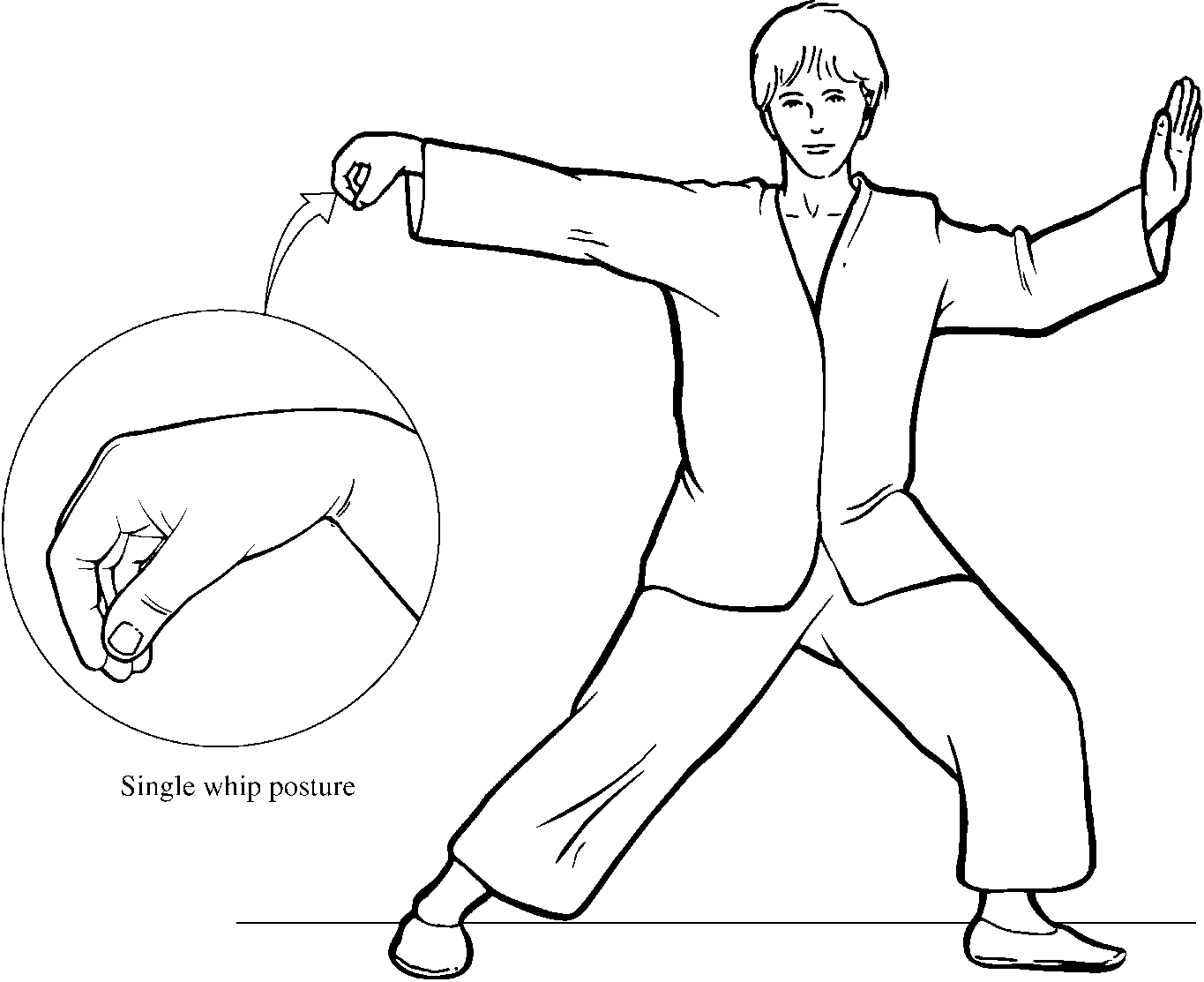
            For purposes of today’s discussion the “whip” part of the movement will be considered to be with the right hand and the movement has three components I will discuss.


            The first “component” is the right hand which comes up to chest level and moves outward, the wrist bending so that the closed hand hangs down. The arm looks a little like you are whipping the rump of a donkey with a riding crop or switch, hence the name of the position. The shape the hand makes has a number of names. It is sometimes called “Hooked Palm” while the name “Turtle Head” is probably the most descriptive. Some instructors liken it to the “Crane Beak” hand form. Given the equestrian aspect of the Single Whip position the “Horse Foot Palm” name is perhaps most apt.

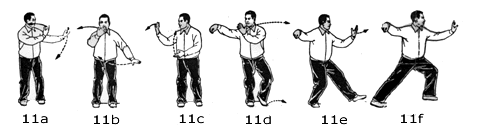
            After the right hand has assumed position the body turns to the left and the left hand comes up in an open palm. On some variants this is a simple semi-circular movement while other variants cause the hand to roll over or spiral.

            At the same time that the left hand moves the left foot steps forward and outward slightly. I used to find the turn and step unusually difficult until Erle Montaigue told me you should keep your left elbow above your left knee when making that part.

            In English we tend to call Single Whip a posture or position but it is actually a sequence of movements. When movements from a Kata or Form are used in combat it is unlikely the whole thing would be used and exactly as you would perform it during a Kata. Elements of a Kata or Form are rather like clay from which you build the thing you need at the moment that you need it. They are not rigid geometric or mathematical constructions, or at least, they are not once your use of them matures. Most Tai Chi moves are multifunctional. One instructor may tell you the combat application is one thing, another that it is something else. In reality there may be many more applications. With that in mind, let us investigate some of the combat applications of the components of Single Whip.

            Single Whip is very much the signature move of Tai Chi. In movies such as the Matrix you will see Single Whip used as an opening posture. In reality it is better reserved until range has been closed with an opponent.

            The left palm’s most obvious application is that it is a palm strike. It is in a good position to hit the chest region or the chin and the accompanying step forward adds power. The open palm can also be used to parry, either with the palm or either edge of the hand. The spiralling motions used for the left hand in some varieties of Single Whip can be used to neutralize a wrist grab.

            The Horse Foot palm is probably most widely understood as a parrying hand form. It can hook over an enemy’s arm and pull it out or down. It can parry to either side or upwards. In his book “Knives, Knife Fighting and Related Hassles: How to Survive a Real Knife Fight” Marc MacYoung describes a Tai Chi inspired “Whip Parry” as a defence against knife attack. Since the arm is semi-relaxed the parry has a very short response time. Marc recommends that you move the wrist and let the hand go along.

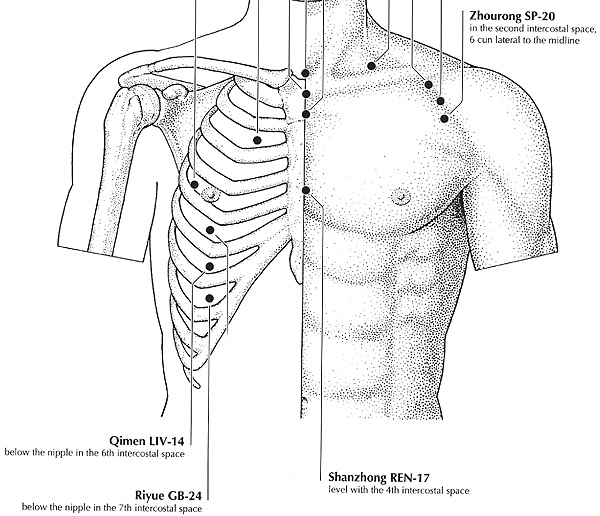
            Horse Foot palm can also be used offensively in a number of ways. The most obvious is to use it as a hammer-fist strike against targets such as under the arm or the temple. The hand can also be used as a reverse hammer-fist, swing inward to hit targets such as the back of the head or the shoulder blade. The hand can also be used to execute a downward glancing punch against certain bony areas of the body. The hand posture is such that the force of hitting a bony area is dissipated along the arm. Targets often used for such attacks include the GB 22 point about 3” under the armpit and the area just below the pectoral muscle. The latter are Liv 14 and GB 24, on the mammary/mid-clavicle line, a couple of ribs down from the muscle in the sixth and seventh intercostal spaces. These are all potent and potentially very harmful targets which can also be attacked by a hammer-fist from a Horse Foot Palm. Horse Foot Palm can also suddenly be flipped over to make a back-fist strike to the enemy’s nose!


            Both hands can of course be used together. Either hand can parry while the other counter-attacks. If one hand grabs the wrist the other can contact the elbow in various ways and apply various varieties of lock. This is another possible application for the spiralling movement of the left hand. Armlocks can be used to unbalance a foe.

            The step forward with the left foot also has martial applications. In high level Tai Chi it is supposed to strike the KD 5 point on the enemy’s foot and drain their Qi. For the less advanced of us it can be positioned to stop an enemy stepping back to regain their balance when the balance is disrupted by hand techniques.
         If you have enjoyed this article or it has been helpful to you please feel free to show your appreciation. Thank you.
The Books

http://www.angelfire.com/art/enchanter/epsdbook.html
http://www.lulu.com/shop/http://www.lulu.com/shop/phil-west/survival-weapons-optimizing-your-arsenal/paperback/product-21488758.html
http://www.lulu.com/shop/phil-west/crash-combat/paperback/product-22603842.html
https://www.amazon.com/Anatopismo-Underrealm-Novella-Phil-West-ebook/dp/B077G7MMFM