Wednesday, 15 June 2016

Items for a Daysac.


Some time back I acquired a new daysac. To my mind, it is prudent if such a bag routinely has certain items stored in it. I had recently been writing about the “six tools of travelling” so I thought that it might be interesting to use these as a guide towards stocking my bag.

The first item of the tools was a hat. Often my old daysac had contained my favourite sun-hat, an advantage-pattern boonie. I decided it would be useful to have something for colder conditions too, so I acquired another headover. Very versatile items are headovers, as I will discuss in a future blog. Treating headgear as a component of the category of protection of extremities I also placed some gloves in the bag. These were cheap acrylic gloves I found in a poundstore. With them I placed some disposable vinyl gloves which could be used with the acrylic gloves to form a vapour barrier system if it was really cold.

The next “tool” would be a towel or cloth. For this I chose a keffiyeh which can serve a variety of purposes. A bandanna or old triangular bandages are good alternatives. I chose a black and red keffiyeh which could also be used for signalling.

For the medicine component I brought a red medical pouch from the 99p store. It came with some items inside but I mainly brought it for the pouch. For a basic medical kit ensure it has a useful number and variety of plasters. Add some painkillers and alcohol wipes and pack it all in waterproof bags within the pouch. I added some diclofenac since I get migraines and a small tin of Vaseline. Suncream and insect repellant often also rides in the daysac.

For cordage I added some hanks of string and paracord.

For the fire component I brought a bundle of disposable lighters from the 99p shop and placed a couple in the pack.

The last traditional tool of travelling would be a writing kit. It is quite common for my daysac to hold a notepad and pen. Possibly the pack should contain a pencil and some paper at least. In fact this last category tends to make me think about documentation and signalling in general and is what inspired me to add some additional items.

Whilst in the 99p store I saw a whistle that also incorporated a compass, a thermometer a magnifier, a microlight and a mirror. I’d not use this as my primary means of navigation, of course but it forms a handy and novel ring pull for one of the daysac zips.

I added my Platypus waterbottle with its drinking tube to the bag. If you do not have something like this add an empty 2litre soda bottle you can use for water. When travelling my daysac usually carries a supply of boiled sweets that can provide a very welcome energy boost.

The contents of my old daysac had included a mini-maglight. I’d been rather impressed by a hand-crank LED flashlight from the 99p store. Not as robust as the maglight, it was true, but something that could sit in the pack until needed without worrying about the state of the batteries. I acquired another example and added it to the daysac contents.

One of the first items I had added to be pack was my All-Weather blanket. This is a more robust version of the emergency mylar “space” blankets. It is provided with grommets at the corners and has a non-reflective side. Mine has been on many adventures with me and several times I have found its warmth and water resistance useful. If you do not have one of these you should at least include one of the smaller emergency space blankets in your pack. My local poundstore has two for a pound at the moment, so it is worth stocking up!

The AW blanket makes a pretty effective raincape but I also added a pacamac to the daysac.

The final item that my daysac carries is a roll of toilet roll in a plastic bag. Should I need to make a fire that is going to be my first source for tinder.

The Books
http://www.angelfire.com/art/enchanter/epsdbook.html 

http://www.lulu.com/shop/http://www.lulu.com/shop/phil-west/survival-weapons-optimizing-your-arsenal/paperback/product-21488758.html

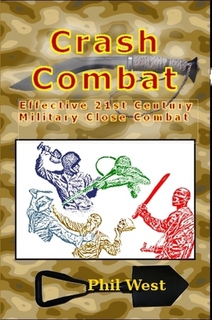
http://www.lulu.com/shop/phil-west/crash-combat/paperback/product-22603842.html

Tuesday, 14 June 2016

Striking the Centaur


After seven years of failed attempts I finally got my girlfriend to visit the British Museum. One particular piece in the Greek section caught my interest.


Of particular note is the posture of the man fighting the centaur. First of all, note how his leg is hooked around the foreleg of the centaur. You will see this particular leg action in many contexts, one of the most familiar perhaps being in Highland dancing. This is one of those examples of a dance move that is also used as training for a combat move. In combat this swift leg raise can be used to avoid a low strike. The leg action is also used in Highland wrestling and other martial arts as a tripping action. This is what the sculptor has portrayed here, although its effectiveness against a quadruped is doubtful! As well as pulling a leg aside this leg position can be used another way. The toe touches the ground for additional stability and the straightening of the leg used to displace the foe’s leg and shift their balance.

The position of the man’s right hand is also notable. His fist is inverted and he appears to be striking the centaur’s temple. Recently I had watched a Hong Kong movie called “Dragon”. A major plot point was that one character made use of a distinctive strike to the temple. He struck with his fist inverted, using the tip of his thumb, the thumb clamped across the top of his fist.
The technique portrayed by the sculptor is also reminiscent of the punch Jack Dempsey calls the “corkscrew hook”. Readers who had read my book will know that the corkscrew is a technique for coming outside and over an opponent’s guard. This use is consistent with the position of the centaur’s left arm. The man has been grabbed by the throat so counters with a punch to the temple from the outside gate. One of Erle Montaigue’s books has effectively the same technique executed from the “White Crane Spreads Wings” posture. Erle describes it as one of the most powerful punches of any martial art since it is entirely circular in its execution. The fist finishes in an inverted position since this is the most energy efficient and relaxed way to make this punch. No muscular tension is created keeping the palm in an orientation that it does not need to be.

Erle’s example of an application was as follows. An attack with the left hand is deflected to the left with the right hand. The left hand takes over control, taking the defender to the outside gate. The right hand drops down and circles up and in to hit over the arm at the temple. My personal recommendation would be to make this as a palm-strike.

The Books
http://www.angelfire.com/art/enchanter/epsdbook.html 

http://www.lulu.com/shop/http://www.lulu.com/shop/phil-west/survival-weapons-optimizing-your-arsenal/paperback/product-21488758.html

http://www.lulu.com/shop/phil-west/crash-combat/paperback/product-22603842.html


Monday, 13 June 2016

Real Action, Not Scapegoats


More than 30,000 people will be killed this year in the USA alone. They will be killed by automobiles. When someone is killed by a negligent driver no one asks what make of car was he driving? No one asks what was the model of phone he found more important than paying attention to the road. It is the driver who was guilty, not the automobile.

And yet, if there is a shooting incident such as that recently in Florida the media are fascinated by what model of gun the shooter used. It is not the gun that is the problem! Gun control laws are not the solution! Gun control laws victimize the law-abiding and create an illusion of a solution when nothing has actually been achieved.

The gun did not cause the man to murder. Religious intolerance and institutionalized homophobia did. Poor security let him take these actions with little real opposition. Mass shootings occur because their targets are undefended and irrelevant and unnecessary laws are accepted as action rather than addressing this.

What model of gun he used or whether it had a pistol grip is not relevant. By concentrating on such irrelevancies you are only perpetuating the problem and preventing a real solution.
 

The Books
http://www.angelfire.com/art/enchanter/epsdbook.html 

http://www.lulu.com/shop/http://www.lulu.com/shop/phil-west/survival-weapons-optimizing-your-arsenal/paperback/product-21488758.html

http://www.lulu.com/shop/phil-west/crash-combat/paperback/product-22603842.html

Rubber Saps


 Recently I was doing some research on the SOE and the Home Guard Auxiliary Units. The Auxiliary units were a uniformed force that in the event of an invasion were to conceal themselves in occupied territory and conduct a campaign of sabotage. The equipment list of the auxiliary units made for interesting reading. One list I came across included a number of “knobkerries”. This probably refers to World War One vintage trench clubs that have been discussed in another blog. Such weapons would be an obvious compliment to the commando knives and other stealthy combat systems the Auxiliaries were issued with. Another list contained an entry for “rubber truncheons” instead. There are times when an enemy may need to be subdued without excessive bloodspill or fatal results.


“Rubber truncheon” is quite an evocative phrase nowadays. In the first half of the 20th century a number of police forces issued hard rubber batons. This was probably the source of the Auxiliary unit weapons. Such batons seem to have fallen from favour and as is often the case the reason may be more political than practical.

Many years back I wrote an article on blackjacks and saps. These can be a useful defensive tool for a police officer but have become controversial. Blackjacks have been used as scapegoats, with the weapon conveniently blamed for the misconduct of some users.

Blackjacks and saps effectively divide into two types. One type is circular in section and often has a coil spring in its shank. The other type is a flattened “beavertail-shape”. If there is a spring incorporated in this second type it will be a flat leaf spring.

The round-type have a noticeable snap to them since the spring allows the head to accelerate faster than the head of a rigid weapon of similar short length. The spring of the flat-type does not seem to contribute as noticeably to the force as the coil spring model. The beavertail-shape does allow the force to be spread over a wider area, reducing the chance of serious injury. The flat-type also gives you the option of striking with the edge when necessary, which is useful on some bulkier target areas such as large muscle groups.

I concluded that the ideal sap/blackjack would have a coil spring combined with a flattened head. As far as I know, no one has attempted to make such a model, or if they have they have not bothered to credit or contact me!

Encountering the idea of truncheons made from rubber or rubber-like materials got me thinking about blackjacks once again. Why not a modified beavertail-shape moulded from hard rubber or a synthetic modern equivalent? Much easier to manufacture than a leather, lead and spring weapon. If the stem was made in a square or circular cross section the weapon would gain the benefits of acceleration whether striking with the edge or the flat.

Police officers need more less-lethal options. The blackjack can be concealed discretely in the hand and brought into action when there is insufficient time to draw a nightstick or handgun. Used correctly it can end aggression with minimal damage.


It occurred to me last night that the resulting rubber sap might actually resemble a dog's bone-shaped toy!


The Books
http://www.angelfire.com/art/enchanter/epsdbook.html 

http://www.lulu.com/shop/http://www.lulu.com/shop/phil-west/survival-weapons-optimizing-your-arsenal/paperback/product-21488758.html

http://www.lulu.com/shop/phil-west/crash-combat/paperback/product-22603842.html