Wednesday, 11 January 2017

The Generation That Never Hears "No"

This weekend I was enjoying the company of a friend who teaches guitar. At one point he mentioned the necessity of “self-discipline” and that if a student lacks this all of his teaching was worthless.
This sticks in my mind because it echoes some conclusions I had reached about another body of students. Said students are lazy, self-indulgent, self-centred, sloppy, unfocused, negligent, selfish… basically, think of a negative character trait and you will find it well represented in this group. A single individual like this is tiresome, you can imagine what forty plus in a group are like!
Colleagues and myself have wondered why students have been so bad in recent years. An idea occurred to me the other day. The current generation had been born after corporal punishment had become illegal. (At this point I fully expect certain readers to have thrown their hands in the air and wailed that I am advocating flogging babies with a cat-o-nine tails. Respectfully, I say get over yourselves, this is not about your pet cause. Try to understand what I am saying.)

The current generation are used to getting their own way. The only sanctions they have ever known is being made to sit on the “naughty step” or being told they cannot go to Macdonalds. In the latter instance they probably just screamed their heads off until their parents gave in. Spoilt, selfish children become spoilt, selfish adults.

A friend of mine often passes on articles about narcissistic personalities. I don’t know if a childhood environment can create such personalities but certainly it could nurture and encourage such traits where they already exist. The current culture in this institution undoubtedly encourages the selfish and self-centred further.

This blog is about self-defence and survival. A generation with a high proportion of narcissistic individuals is relevant to both. To groups such as these students each one thinks they are the only person that matters. They are the people who cannot be bothered to dispose of dangerous items safely. The motorists that use their phones while driving. They are the cyclists that run the lights and injure pedestrians (My girlfriend's aunt was killed by just such a cyclist). The only rationale they need is “I want to”. These people are the reason you need to learn to protect yourself.

If you have enjoyed this article or it has been helpful to you please feel free to show your appreciation. Thank you.
The Books

http://www.angelfire.com/art/enchanter/epsdbook.html
http://www.lulu.com/shop/http://www.lulu.com/shop/phil-west/survival-weapons-optimizing-your-arsenal/paperback/product-21488758.html
http://www.lulu.com/shop/phil-west/crash-combat/paperback/product-22603842.html
https://www.amazon.com/Anatopismo-Underrealm-Novella-Phil-West-ebook/dp/B077G7MMFM
https://www.amazon.com/Hell-Ay-non-partisan-sourcebook-role-play-system-ebook/dp/B07FQSHSQC

Wednesday, 21 December 2016

Chinese Blanket Pack


Do you ever think about why the word “pack” is used in terms such as “backpack”? I had not, until I came across a chapter of Horace Kephart’s “Camping and Woodcraft”. As can be seen from the image reproduced below, some packs are literally packages, wrapped in waterproof material and held together by a harness.

The reason I was reminded of this was because I have come across yet another variant of blanket roll. I was reading about China in the first half of the twentieth century. This is a very interesting period of history and I am rather surprised more movies and games are not set in this period and location. The various Chinese factions had to equip millions of fighting men with only limited resources. How they achieved this is relevant to recent topics on this blog.
In the photos below you can see that a pack was created by placing the cargo within a blanket and then rolling each end inwards until they met. In the last photo you can see that a shelter cloth/ rainproof is carried in a horseshoe around the pack so that it is easily accessible.


The Books
http://www.angelfire.com/art/enchanter/epsdbook.html 

http://www.lulu.com/shop/http://www.lulu.com/shop/phil-west/survival-weapons-optimizing-your-arsenal/paperback/product-21488758.html

http://www.lulu.com/shop/phil-west/crash-combat/paperback/product-22603842.html


Tuesday, 20 December 2016

Blanket/ Cloak.


Many moons ago I described a method of turning an item such as an all-weather blanket into a hooded rain cape. This was adapted from a method of wearing a plaid associated with the Inverness area. An Inverness cape or cloak is something different and today I will describe a way to use a blanket that forms something not unlike an Inverness cape. We touched on this method with the recent post on Japanese shelter cloths.
 
Take one corner of a blanket in each hand and hold it behind you. Place the middle of the side between your hands over your head.
Release the corners and reach down to waist level and gather the blanket around your lower body. Adjust so the lower edge is about mid-calf level or your preferred length. Tie the blanket in place by encircling it with a belt, piece of string or anything similar you have handy.
Fold the cloth over your head back so it forms a collar. The garment can be improved by using a blanket pin to close the throat area. If you are really improvising you can make a pin by sharpening a small stick.
Your blanket now resembles an improvised cloak. It also resembles the greatcoats worn by US soldiers in westerns. The upper section allows good access to your chest pockets or other gear carried in this area. If necessary it can be drawn up over the head to form a cowl. If your legs need more freedom of movement the lower corners can be brought up and tucked through the belt. Military greatcoats were often designed so the skirts could be buttoned up in similar fashion. This is sometimes called “French fashion” since French troops were noted for fighting in their greatcoats.
You can modify a blanket so that it can more easily be worn in this fashion. Sew a cloth tape by its middle to the middle of the blanket at your preferred waist level. If you refer back to the Japanese shelter cloth article you will see the cloth included this feature. To close off the neck the best option is one or more hook and loop fastenings. Loops should be cord and blunt hooks can be made from suitably bent paperclips or other wire. Hook and loop fastenings are less likely to be uncomfortable should you happen to be lying on them when the blanket if used for sleeping in. Even if you use a sleeping bag for sleeping a blanket is a handy thing to have should it turn unexpectedly cold. Using this technique the blanket is a day garment too. You can wear a rucksac while wearing a blanket like this. The front tends to open more which may or may not be a problem. If you do not need the ventilation when carrying a load a couple of extra blanket pins or a blanket scarf can be used. If your pack is small the cloak can be put on over it.
I have described this as being with a blanket but as the Japanese shelter cloth shows us this can also be used with a rain-resistant material. If you carry a rifle and ammunition across your chest the upper “flaps” provide good protection and easy access. Unlike a poncho this rain garment does not need a hole in the centre for a hood, so is less problematic if rigged as a shelter. A separate hood could perhaps be attached near one edge near the neck fastenings if you are modify a cloth for use in this fashion. If the weather is particularly foul a blanket can be worn within a rain cloth.


         If you have enjoyed this article or it has been helpful to you please feel free to show your appreciation. Thank you.
The Books
http://www.angelfire.com/art/enchanter/epsdbook.html
http://www.lulu.com/shop/http://www.lulu.com/shop/phil-west/survival-weapons-optimizing-your-arsenal/paperback/product-21488758.html
http://www.lulu.com/shop/phil-west/crash-combat/paperback/product-22603842.html
https://www.amazon.com/Anatopismo-Underrealm-Novella-Phil-West-ebook/dp/B077G7MMFM

Monday, 12 December 2016

More on Blanket Rolls


In the last blog I talked about the American Civil War (ACW) horseshoe roll. A point worth stressing is that a horseshoe roll does not need to be constructed from a blanket.

As we saw with the Soviets and ACW horseshoe rolls can be used to carry long greatcoats. A modern sleeping bag, for example, can also be carried as a horseshoe roll. I have a four or five season sleeping bag I brought many years back. It is a great bag but I have seldom used since it is so bulky. I cannot carry it if I have to also carry any other reasonable amount of gear. If I put it in my pack I have very little room for anything else. If I tie it to the top of my pack I’m over seven feet tall, and this is with the thing in its compression sack! Rolling the thing into a horseshoe roll may very well be a better way to carry it. Worn in this way it will also provide some insulation when walking, which may very well be needed in any climate where I actually need such a high-rated bag.

The over the shoulder horseshoe roll is not the only way to carry such items. In many armies of WW2 shelter halves and the like were rolled into a horseshoe that was placed around the pack. A shorter blanket roll that could be carried above or below the pack was also used.

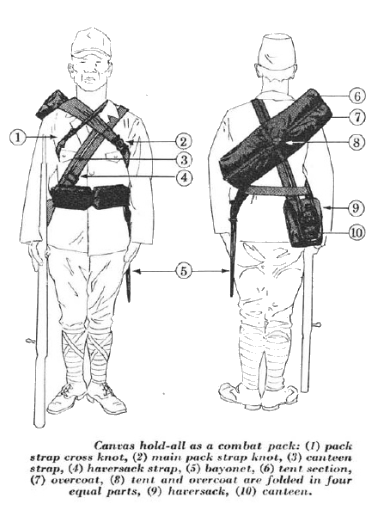
Like the soldiers of the ACW the WW2 Japanese soldier often used a horseshoe roll instead of a backpack. This could be constructed from the shelter cloth. Alternately a canvas “hold-all” was used as described here:

“Instead of the pack a canvas hold-all is sometimes used. This is simply a piece of light canvas with carrying straps at each end, and two long tapes, with shorter tapes to help secure the load. When rolled it can be carried across the back, slanting diagonally upwards from left to right, the straps and long tapes making an X across the chest where they are knotted. The hold-all serves as a combat pack and usually includes overcoat or blanket, shelter half, and tent poles and pins, besides whatever gear is not carried in the haversack. Canteen, ammunition pouches, and gas mask and carrier complete the combat gear normally carried by the Japanese soldier.”


As I discussed in the last blog, many modern waterproofs lack the robustness to make a good blanket roll cover. Something like Japanese hold-all described and illustrated is worth looking into. Such a thing could be combined with the methods for making your own gum-blanket. If the unrolled blanket roll cover was of sufficient dimensions to serve as a groundcloth that would be no bad thing.

Below is another example of a roll being used to carry equipment:
Variations on wearing the web equipment began to evolve while the Canadians trained in England, as Battle Drill put men and gear through increasingly more challenging situations. In Sicily, however, contacts with battle experienced soldiers of the British 8th Army led to quick revisions in how best to carry equipment in action, leading to the adoption of "Fighting Order." The small pack, or haversack, was quickly discarded due to its distinctive outline and the mess tins were instead added to a water-bottle carrier, and worn suspended from the brace-ends, in a spare water bottle carrier, on the left side of the waistbelt, opposite the water bottle. The gas cape was used to wrap spare clothing, rations and kit, then tied to the back of the waistbelt with spare blanket straps.”


Troops of the Loyal Edmonton Regiment at Ortona, December 1943, wearing Fighting Order. LAC Photo.


The Books
http://www.angelfire.com/art/enchanter/epsdbook.html 

http://www.lulu.com/shop/http://www.lulu.com/shop/phil-west/survival-weapons-optimizing-your-arsenal/paperback/product-21488758.html

http://www.lulu.com/shop/phil-west/crash-combat/paperback/product-22603842.html