Sunday, 4 March 2018

Serenity Plus Lock Pick Kit.

Finally acquired the last component for my locksport kit, so it is time for a quick show and tell. I have come to think of this as my “Serenity Plus” kit.
The Dangerfield pouch that was provided with the Serenity kit as a free upgrade. Note that I have added a small Photon II-style light to the zip-pull. Also notice the home-made red filter made from a red drinking straw and electrical tape. I usually watch TV with the lights off. The light lets me select a pick from the case if I feel like picking a lock during the advertisements.
The pouch opened. Note that I have lined the pouch with red painted plastic backing. Appropriately enough these were created from security key cards, painted with red enamel paint. An elastic hair band has been cut and glued in position to hold the turning tools and hybrid picks. Not clear in the photo is that the right side includes a couple of hair pins, useful for making small turning tools, opening handcuffs and similar.
The right side of the pouch contains rakes and the left side lifters. The distinction between these categories is fuzzy, however. Various lifters can be used to rake or rock, and often this should be the first technique attempted with them. Rakes can sometimes be concentrated on a single binding pin. The Princess and Prince inverted are effectively deep hooks.
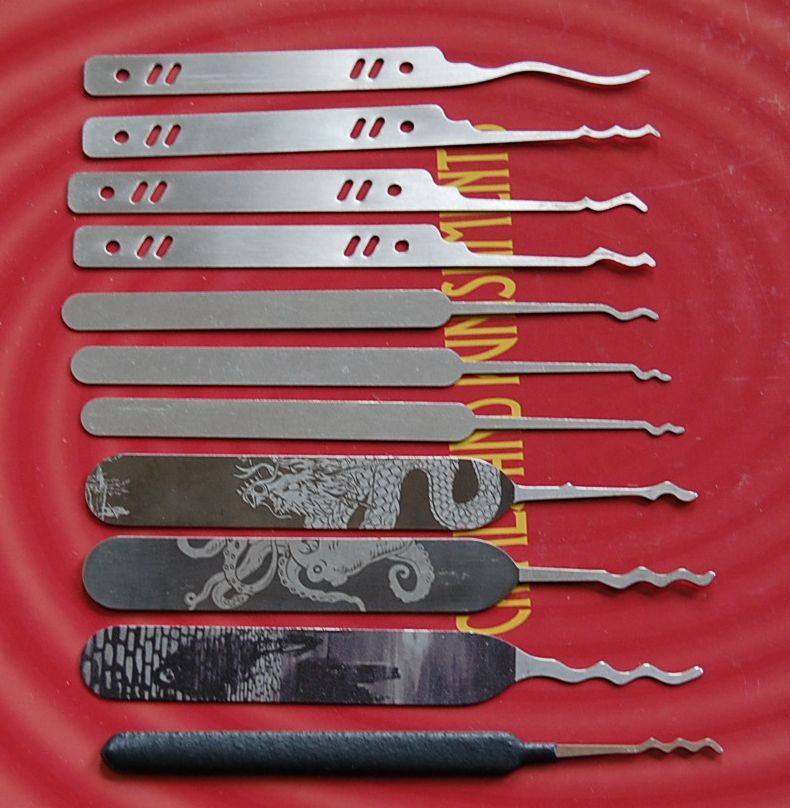
The contents of the left side. From the top:
  • Swerve rake from Serenity kit.
  • Bogota triple hump from Serenity kit.
  • Princess rake from Serenity kit.
  • Prince rake from Serenity kit.
  • Snake rakes from SouthOrd. Large, small and angled small.
  • Sandman rocker rake from Sparrow.
  • Octo Rake from Sparrow.
  • Warlock rake from Sparrow.
  • Worm rake from Sparrow.
The all important turning tools:
  • Wide tool made from laboratory spatula.
  • Pair of Soho rakes from Dangerfield.
  • Triple hump Bogota from Dangerfield.
  • Single hump Bogota from Dangerfield.
  • Long turning tool from Chinese turning tool kit.
  • Standard width turning tool made from laboratory spatula. Hooked end designed to open small warded locks.
  • Turning tool made from wiper insert. With standard and narrow heads.
  • Serenity kit turning tool modified to have additional narrow head.
  • Prybar-type turning tool from Serenity kit.
Contents of the right side:
  • Razor pick with home-made protective cover. Note fishing line to prevent loss.
  • Curved Reach Ball hook from Serenity kit.
  • High hook from Serenity kit. (Steep/ Postal hook?)
  • Angled Ball hook from Serenity kit.
  • Half-diamond from Serenity kit.
  • Partial hook from SouthOrd.
  • Half-snowman rake from SouthOrd. Made by filing down SouthOrd’s double-ball pick.
And as a bonus, my set of finger rakes, aka mini-rakes. These do not really fit in the kit but are something you are recommended to acquire. Intended to fit very small locks they work very well in standard sized locks too. Because they are springy they are more scrubbers than rockers. They tend to sell out fast when they are in stock. I’d like to thank Marcus of UK Bump Keys for his efforts to get me a set.
I make that as 28 items. Admittedly, there is some duplication with the turning tools but I do not consider that a bad thing. The half-snowman was an indulgence and just a bit of fun. Many of the other rakes will do anything this pick can, and probably in less time. I brought the snakes since I expected some locks would be difficult to use the Bogotas in. They have not seen much use, and I now have the finger rakes. The Sandman has not seen much use and I suspect it is better suited to American locks. Not found much use for the Swerve rake either. The Octo rake and Warlock, on the other hand, are very impressive. I’d put those on my must-have list right after the Bogotas. I have had little SPP success with the high hook. It has got stuck in a lock at least once! I may file the end round to create a Gonzo-style hook. I have not had much use for the razor pick yet. It only works on certain locks and I have yet to encounter any. Those E&E enthusiasts that think they can open any padlock if they have a razor pick are pr0bably in for a shock!
 
If you have enjoyed this article or it has been helpful to you please feel free to show your appreciation. Thank you.
 

http://www.angelfire.com/art/enchanter/epsdbook.html
http://www.lulu.com/shop/http://www.lulu.com/shop/phil-west/survival-weapons-optimizing-your-arsenal/paperback/product-21488758.html
http://www.lulu.com/shop/phil-west/crash-combat/paperback/product-22603842.html
https://www.amazon.com/Anatopismo-Underrealm-Novella-Phil-West-ebook/dp/B077G7MMFM

Tuesday, 20 February 2018

Escape: Handcuffs and Shimming

Today I am going to look at ways to bypass the single lock of handcuffs. To do this it will be necessary to briefly describe the mechanism we will be dealing with.
A typical pair of modern handcuffs uses a very simple mechanism. As you can see, the shackle/ strand (the moving part) has ratchet teeth. The teeth are engaged by the teeth on the pawl  (green part) within the mechanism. The pawl allows the shackle to move in but not be pulled out. In “single-lock” mode the handcuff can be tightened but not loosened. The handcuff key engages the pawl directly and lifts it up, disengaging the teeth and allowing the shackle to be opened. Note that the pawl is under spring tension so will drop if the pressure from the key is removed.
Above the pawl is a second mechanism (red). When this mechanism is engaged the handcuff is termed to be “double-locked” or “transport-locked”. When double-locked the pawl cannot rise, even if the correct key is used on it. The shackle of a double-locked handcuff can be neither tightened nor loosened. I will deal with double-locked cuffs in more detail in a future post. Today it is sufficient to understand that the techniques I will describe only work on single-locked cuffs, not those where the transport-lock is still engaged.
One way to unlock single-locked cuffs is to raise the pawl, mimicking the action of a standard key. For most cuffs this is relatively easy since the key has a simple flag without any cut-outs or other distinctive features. A variety of items can be used instead of a key. Bulldog clips, of the type that are triangular in section and have separate wire handles are very good for this. Obviously, these can be found in office environments or in desks. A desk can provide a prisoner with a variety of items that can be used for escape! Remove one handle and use the hooked end in the keyway of the cuff. Transparent training cuffs are very useful to have available when learning these techniques. Be careful of putting too much pressure on the plastic face of a training cuff and damaging the keyway.

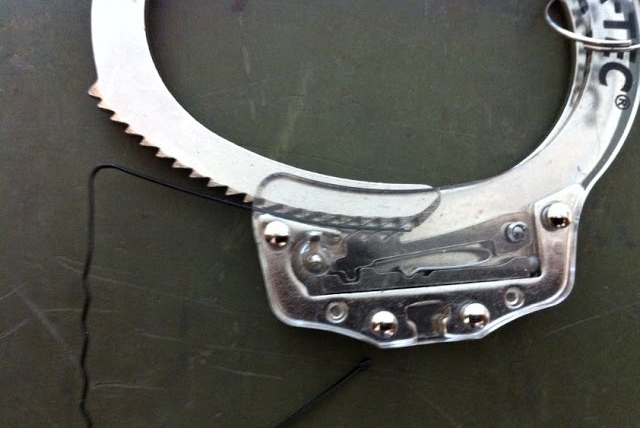
The second technique for single-locked cuffs is shimming. This may be attempted when you do not have something to use as a key or when the keyhole is difficult to reach. Probably the best way to learn shimming is with a hair pin, aka bobby pin. Transparent training cuffs are very useful here.

Take a bobby pin and pull the protective blob from the end of the straight side. Open the pin out and give the straight side a slight curve. Slide the straight end of the pin along the top of the ratchet teeth on the shackle and into the housing. The pin can go no further when it is up against the pawl. You now need to push the shackle inward while also applying gentle pressure to the shim. This will obviously tighten the cuff but human wrists can take a measure of compression. If you do this correctly the pawl will raise and the shim will slide between it and the shackle before the pawl can descend again. If your shim is sufficiently inserted the teeth of the pawl and the shackle will be separated by the shim and cannot engage. Keep moderate pressure on the shim and you should be able to pull out the shackle.

The chief merit of shimming is that a variety of items you may have on your person or in your surroundings can be turned into shims. If you do not have a bobby pin then a paperclip or various bits of wire can be used in the same fashion. Shims do not need to be metallic. Strips of card or plastic may be suitable. Strips of aluminium soda can seem too flexible but this might be solved by folding them. The material used for the can ends is thicker. One way to use a piece of can as a shim is to fold it into an inverted U-section shape. This may not be practical if the shackle is a tight fit within the housing. It may not be possible to slip the material between the side of the shackle and the inner wall of the housing. A large plastic drinking straw may be used as a shim in the same fashion. Be careful when handling strips of soda can. You can easily cut your fingers and the blood may make your escape attempt more problematic.

If you carry an escape kit then including some purpose-built shims is prudent. Some users carry quite a variety but in reality you need two types at most, with perhaps a bobby pin or wire for very narrow cuffs.

Commercially available shims tend to come in two forms. There are standard shims and “split” shims that have a notch in one end. Some handcuffs have obstructions intended to prevent shimming and the notched shim is supposed to counter this. The commercial notched shims I have seen only have a notch of a few millimetres depth. Some high security cuffs have obstructions that seem to be deeper than this.

Most commercial shims are made of steel. Some websites specify stainless steel but very few also provide the information as whether the stainless steel used is also non-magnetic. For an item such as a shim that you may want to conceal a low magnetic signature is an attractive feature.
While I was pondering this problem I discovered the turning tools I had made from laboratory spatulas were not magnetic!
Like many items of scientific equipment, lab spatulas are often subject to massive mark-ups. Price may vary fiftyfold so shop around.
The spatula is slightly over 3.5mm width so needs to be narrowed down a little for use as a shim. Round the corners and bevel the ends a little while you are working on it. I chose to slot one end. I used the cut-off wheel of a Dremel for this, which is probably not the best (nor the safest!) tool for the job. Not the neatest job I have ever done but sufficient for illustrative purposes. Use abrasive paper on the shim to polish it and remove any rough edges. The shim should have a slight curve. Passing it through a handcuff’s mechanism a few times creates this.
 
I don’t currently have any cuffs with anti-shimming features to test this shim against. It works very well on the training cuff and both the bifurcated and non-bifurcated ends can be used with this. The length of this shim lets me insert it across the full width of the cuff. This results in the handcuffs looking like they are secure but capable of being pulled open when desired.
Some cuffs use a narrower shackle as an anti-shimming measure so perhaps the non-bifurcated end should be narrowed even further. This would result in a tool that has an elongated Y-shape or that resembles a very slim tuning fork!

Many thanks to Shomer-tech for providing me with the transparent training cuff.

If you have enjoyed this article or it has been helpful to you please feel free to show your appreciation. Thank you.

http://www.angelfire.com/art/enchanter/epsdbook.html
http://www.lulu.com/shop/http://www.lulu.com/shop/phil-west/survival-weapons-optimizing-your-arsenal/paperback/product-21488758.html
http://www.lulu.com/shop/phil-west/crash-combat/paperback/product-22603842.html
https://www.amazon.com/Anatopismo-Underrealm-Novella-Phil-West-ebook/dp/B077G7MMFM

Sunday, 18 February 2018

Escape Introduction

In a certain adventure series I watch one or both of certain events are likely to happen every few episodes.

The first is that the protagonists are likely to find themselves deep in dark woods with no phone reception.

The second is that one or both of them will be knocked out and wake up tied up somewhere, usually with a gloating adversary.

You’d think that they might consider investing in a pair of satphones, or some other alternate communication options. Investing in some counter custody equipment would also be logical.

Escape and Evasion (E&E) is not just something for action heroes and spies. Many of us are more at risk than we realize. I can think of at least two people that I know who have been victims of illegal abduction. Neither were wealthy. In one case the motive was rape. Fortunately both incidences ended happily, except for the would be rapist, and I have no problem with that result.

Today’s blog is an introduction to a series of forthcoming posts on the topic of escape.

An abductee may face confinement and/or restraint. I have already addressed confinement to some degree with the articles on lock picking. Lock picking is a non-destructive technique and if you are illegally confined you should have no qualms about damaging property if it allows you to escape.

This blog has also looked at some methods against physical restraint, most recently with an article on escaping zip-ties. For convenience let us divide physical restraint into four broad categories.

The first of these is restraint using cordage. This may be rope, leather thongs, string, wire or a variety of similar items. Here your main options are cutting the cord or undoing the knots. The practicality of each very much depends on the materials used and how you have been tied. Your teeth can be used to chew cord or manipulate the knots. If you cannot reach your own bindings you may be able reach those of a companion. Hands may be restrained before or behind you so any escape gear you carry should be accessible from either posture. Look for edges that you can abrade the cordage against. Look for objects in the locality you can break to create cutting edges. Items such as lighters can be used to burn through bindings.

Once you are free do not neglect the potential of the remaining cordage as a tool or weapon to further aid your escape.

The second class of restrain is that using chains and manacles. In the modern world the most commonly encountered of this category are handcuffs. Such restraints are much harder to break or cut. There are ways to bypass or damage the mechanisms, however. Ways to deal with handcuff restraint will be detailed in forthcoming posts. I’ll be assessing the merits of some of the commercial products offered.

A more recent category of restraint is the use of adhesive tape such as duct tape. I have looked at ways to break such restraints in a previous post. Many of the techniques suggested for use against cordage can also be applied to tape, with the obvious exception that there are no knots to attack. Your location may include organic solvents that can be used to weaken the adhesive. Possible sources include petrol, brush cleaner, paint thinner, stove fuel, nail polish remover, alcohols and similar.

The last category is that of zip-ties and similar devices. A variety of techniques against these have been covered in previous posts. Future blogs will look at some of the tools you may use to apply such techniques.
 
If you have enjoyed this article or it has been helpful to you please feel free to show your appreciation. Thank you.
The Books

http://www.angelfire.com/art/enchanter/epsdbook.html
http://www.lulu.com/shop/http://www.lulu.com/shop/phil-west/survival-weapons-optimizing-your-arsenal/paperback/product-21488758.html
http://www.lulu.com/shop/phil-west/crash-combat/paperback/product-22603842.html
https://www.amazon.com/Anatopismo-Underrealm-Novella-Phil-West-ebook/dp/B077G7MMFM


Wednesday, 7 February 2018

POW Manual Alphabet

I found this while I was researching the tap code. In addition to the tap code the advice to potential prisoners had another form of manual alphabet.

If you have enjoyed this article or it has been helpful to you please feel free to show your appreciation. Thank you.
The Books

http://www.angelfire.com/art/enchanter/epsdbook.html
http://www.lulu.com/shop/http://www.lulu.com/shop/phil-west/survival-weapons-optimizing-your-arsenal/paperback/product-21488758.html
http://www.lulu.com/shop/phil-west/crash-combat/paperback/product-22603842.html
https://www.amazon.com/Anatopismo-Underrealm-Novella-Phil-West-ebook/dp/B077G7MMFM