Friday, 29 May 2020

Hori-Hori for Survival.

One of the many things that became apparent after the American Civil War was that the infantryman needed a means to quickly construct earthworks.“Hardtack and Coffee” informs us that the quartermaster of the army had wagons of intrenching tools [sic] that were supposed to be supplied to units that needed them. In practice, there was seldom time to send for these tools, and infantrymen resorted to digging with their tin plates ormuckets. As you can see, there were attempts to modify spike bayonets for the role.


One of the solutions offered after the war was the Rice trowel bayonet, which began to see trials in the late 1860s. Available on-line is a document detailing the findings of the trails. While a few officers expressed reservations, the opinion of the enlisted men and many other officers was overwhelmingly positive. The document describes “rifle-proof” parapets being constructed in as little as nine minutes.This would be impressive, even with larger modern tools. The trowel bayonet was clearly superior to the improvised means the troops had been using before. It also had sufficient size, heft and edge that it could be used to cut saplings and branches, something beyond the current spike bayonet. Many believed the large, spear-like blade would make a better bayonet than the spike bayonet. Breech-loading rifles were coming into service, and many were of the opinion that the bayonet might be becoming obsolete. If it wasn’t quite as good a bayonet as the weapon it replaced, this was tolerable and its greater utility made up for this. The main objection to the trowel bayonet was that troops might be tempted to dig with it while it was mounted on the rifle. This was likely to bend the barrel, damage the muzzle or block the bore. Shortly after the introduction of the trowel bayonet it was replaced with a trowel knife. This probably had a better grip than the trowel bayonet, but its rounded tip gives it a less war-like appearance and possibly it was of less utility as a hand weapon. 

Bayonets continued to evolve, but along different lines. The next step was the sword-bayonet, intended to serve as bayonet or hanger. Some infantry had carried both bayonets and hangers. Napoleon’s guard around 1815 spring to mind as an example. By the 1880s most infantry had long since discarded the hanger, so effectively the sword bayonet was replacing an implement that was no longer carried. Nonetheless, many armies entered the 20th century with sword bayonets, and would be using them until the 1940s at least.
The idea of letting the infantry have their very own entrenching tools had taken root, however. Infantry entrenching tools got bigger and more sophisticated until they reached the form we know today.
As has been discussed before on this blog, some of these tools are overkill for the non-military user. It is a hygienic cathole, rather than atomic-proof foxhole, that we generally need. There are little plastic trowels, of course, but these are not much use for anything else. The trowel bayonet suggests a relatively small digging tool can be a useful survival aid. Is there a modern equivalent?


Seeking to answer this took me to discover the hori-hori. In another blog I described how I had seen machetes used as jack of all trades by gardeners in Jamaica. The hori-hori is a similar device, but more compact. Not surprisingly, these are Japanese. The ninja put a similar digging tool, the kunai, to various uses. The hori-hori were originally used for gathering wild foods, so technically are already survival tools. A variety of models of hori-hori are available, but the one I have has a 7.5 inch blade, so more compact than the 10 by 4inch blade of the original trowel bayonets. One edge is serrated, the other can be used to chop or cut, or will be once I sharpen it. (The packaging says it comes “razor sharp”, which apparently means “unsharpened”.) The blade is a broad spearpoint, with one side slightly concave, as suits its digging role. Mine came with a nice condura sheath. Unlike many survival knives, this is a tool the makers recommend that you can pry with. Price is a bit more than a normal trowel, but this can be offset against the fact that many gardeners think they do not need many tools other than their hori-hori. On the other hand, compared to many survival knives, the price is very reasonable.
The hori-hori seems a pretty useful tool to have along on a trip or stored in an emergency kit. A useful backup or replacement for a survival knife.


If you have enjoyed this article or it has been helpful to you please feel free to show your appreciation. Thank you.

http://www.angelfire.com/art/enchanter/epsdbook.html
http://www.lulu.com/shop/phil-west/crash-combat/paperback/product-22603842.html
http://www.lulu.com/shop/http://www.lulu.com/shop/phil-west/survival-weapons-optimizing-your-arsenal/paperback/product-21488758.html
https://www.amazon.com/Anatopismo-Underrealm-Novella-Phil-West-ebook/dp/B077G7MMFM
https://www.amazon.com/Hell-Ay-non-partisan-sourcebook-role-play-system-ebook/dp/B07FQSHSQC

Tuesday, 26 May 2020

LBE, M-1956.

My friend Ralph Zumbro had often referenced “the Pentomic division”, so recently I read “The Pentomic Era” by A. C. Bacevich. This provides an interesting insight into the politics and mindset that was behind this phase of Army history. What the book does not provide is much detail on the actual organization of the Pentomic divisions. Thus, a few nights ago I could be found wading through an on-line copy of “Infantry”, 1957-1958.


One thing I came across was an article (p.34, April-June 1958) on the new “universal, individual load-carrying system.”. Although the designation is not used, this is the M-1956 system that served in Vietnam and was replaced by what was essentially a nylon version. What caught my eye was the author divided the soldier’s load into three groupings: Battle load, existence load and protection and comfort load. “Combat load” was the battle and existence loads, “Full field load” was all three. Before entering “close combat” the soldier could jettison the existence load “except bayonet or fighting knife, first-aid pouch and other essential items”.
What were these loads?
The battle load was defined as the individual’s weapon and ammunition and weighed 25lb. This was still the era of the M1 Garand, although the M14 was just coming into service.
The existence load included emergency rations, medical items, canteen and canteen cup, toilet articles, one pair of socks, poncho and bayonet or fighting knife, and weighed 20lbs.
The comfort load included a sleeping bag, extra clothing and “personal gear” and weighed 10lbs.
The existence load was carried in the combat pack. Presumably the protection and comfort items could be stored in the sleeping bag carrier. An illustration in the article declares that clothing and other personal items can be carried inside the sleeping bag roll. Oddly, it shows a shaving kit, which you would think was a toiletry. Thus either load could be removed by just releasing a few clips. Full field load was therefore 55lbs. Compare this to the 1877 load in a previous article.
The idea of dividing and packaging the gear as several categories is interesting, although some of the details can be challenged. Why is the bayonet/ knife and first-aid pouch not part of the battle load? These would probably be carried on the webbing anyway, so would not be jettisoned with the combat pack/ existence load. One of the canteens on the webbing and part of the battle load makes sense, but the canteen cup is less vital and should be a pack item. 


Essentially this approach has the soldier carrying two packs, the contents of each having different functions and different priorities. You can create a similar system by having a large pack and one or more smaller packs that clips onto or fits in the larger. It is a set of ideas to play around with.

If you have enjoyed this article or it has been helpful to you please feel free to show your appreciation. Thank you.

http://www.angelfire.com/art/enchanter/epsdbook.html
http://www.lulu.com/shop/phil-west/crash-combat/paperback/product-22603842.html
http://www.lulu.com/shop/http://www.lulu.com/shop/phil-west/survival-weapons-optimizing-your-arsenal/paperback/product-21488758.html
https://www.amazon.com/Anatopismo-Underrealm-Novella-Phil-West-ebook/dp/B077G7MMFM
https://www.amazon.com/Hell-Ay-non-partisan-sourcebook-role-play-system-ebook/dp/B07FQSHSQC

Friday, 22 May 2020

Kephart: Dressing for Cold Weather

Following the description on Kephart’s Autumn Outfit, I will add his recommendations for dressing for cold weather:


Cold Weather Clothing.— The main fault of most cold weather rigs is that, paradoxically, they -re too hot. You go out into '“twenty-some-odd” below zero, all muffled up in thick underwear, overshirt, heavy trousers, and a 32-ounce (to the yard) Mackinaw coat. Very nice, until you get your stride. In half an hour the sweat will be streaming from you enough to turn a mill. By and by you may have to stand still for quite a while. Then the moisture begins to freeze, and a buffalo robe wouldn’t keep you warm. Conditions vary ; but for average winter work put on two suits of medium weight all-wool underwear, instead of one heavy one, moleskin trousers (heavy Mackinaws chafe), wool overshirt, Mackinaw shirt worn with tail outside, so it can easily be removed and worn behind you when not needed, the rubber “overs” and socks mentioned above, a Mackinaw cap with visor and ear flaps, large, old kid gloves, and thick, woolen mittens held by a cord around the neck. In buying Mackinaws get none but the best quality. Cheap Mackinaw is shoddy, or part cotton, and soaks up moisture like a sponge. A good grade sheds rain so long as the nap is not worn off; then it can be waterproofed by the lanolin process. It is noiseless, and stands rough usage. The natural gray color is best, except where the law requires you to wear red for protection against gun-bearing fools. (About this, saith our friend Crossman: “Yes, some fellow might take you for a deer if you wore an inconspicuous color in the woods, but what would you? He’d take you for a zebra if you wore green and yellow, or shoot you for a forest fire it you wore flaming crimson.”)


In the previous section referenced to above Kephart writes:

Rubber Footwear.— I never wear waders for summer trout fishing, but early spring fishing is a different matter. Wading stockings require special hobnailed shoes to go over them. I prefer a pair of light hip boots and separate wading sandals studded with nails. This combination costs less than the other, is more durable, and the boots by themselves are serviceable for general wet weather wear, marsh shooting, and the like. Light rubber boots of first-class quality will last as long as the common heavy ones, and have the advantage that the legs can be turned inside out clear to the ankle for drying. They need not weigh over 3 or 3½ pounds to the pair, and the sandals a pound more — together no more than the high-topped leather boots that I have been objurgating. Have them large enough for both socks and oversocks, then your feet are not likely to get “scalded”. Carry a couple of “eezy-quick” menders, and have a rubber repair kit among your possibles in camp.
For hunting big game In wet snow and slush the best footwear is a pair of rubber shoes with ten-inch leather uppers, weighing a bit over two pounds. They should have heels, if you go into a hilly country, and rough corrugated soles. Dress the feet with soft woolen socks, and over these draw a pair of long, thick “German socks” that strap at the top. The latter are warmer than the loose felt boots worn by lumbermen, lighter, more flexible, fit better, and are easier to dry out. The rubbers should fit properly over the heavy socks, neither too tight nor too loose, but especially not too tight or you risk frostbite! Thus equipped, a still-hunter is “shod with silence.” For cold weather the vital necessity is suppleness of the foot, and here you have it.


If you have enjoyed this article or it has been helpful to you please feel free to show your appreciation. Thank you.

http://www.angelfire.com/art/enchanter/epsdbook.html
http://www.lulu.com/shop/phil-west/crash-combat/paperback/product-22603842.html
http://www.lulu.com/shop/http://www.lulu.com/shop/phil-west/survival-weapons-optimizing-your-arsenal/paperback/product-21488758.html
https://www.amazon.com/Anatopismo-Underrealm-Novella-Phil-West-ebook/dp/B077G7MMFM
https://www.amazon.com/Hell-Ay-non-partisan-sourcebook-role-play-system-ebook/dp/B07FQSHSQC

Monday, 18 May 2020

Walk-A-Heaps

When it comes to the Indian Wars, it is the cavalry that gets the glory and screen-time. In reality, the infantry or “walk-a-heaps” (as Sioux are reported to have called them) played a significant role. Prolonged travel tires horses. Over a period of weeks seasoned infantry can outdistance cavalry or other horse-mounted raiders.
It seems some of the lessons learnt during the War between States were retained. I came across this interesting passage in the Osprey book “Men-at-Arms 063: The American Indian Wars 1860-1890”

Osprey “Men-at-Arms 438: US Infantry in the Indian Wars 1865-91” notes: “Most infantrymen on campaign preferred to leave their packs behind at barracks, and carried personal items rolled in blankets slung around their bodies. When the 5th Infantry were ordered on campaign in July 1876. each soldier took only a blanket, a shelter-half, an extra pair of shoes and one change of underwear, plus weapons and ammunition. Sibley tents, iron stoves and other unit gear were carried in company wagons; more lightly equipped columns used pack mules.”
No information on how many wagons a company had is given, but “Hardtack and Coffee” informs us that each ACW Union Infantry company would have two wagons and five for the Regimental HQ.
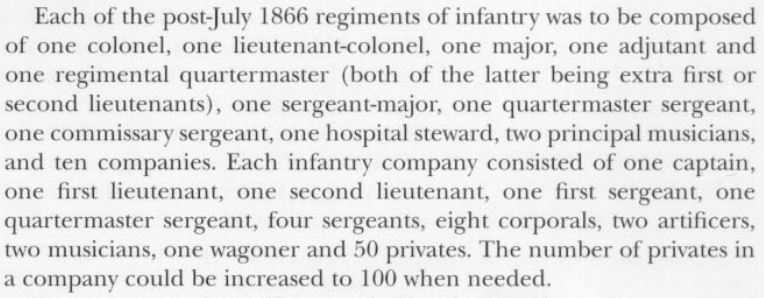
Men at Arms 438 provides the information that companies were small units compared to modern versions:

Note that only one wagoner is listed. Later on in this section it is stated the average size of a company would be 35 men. The company was the key operational unit. If a company was relatively small, the platoon level was omitted. A platoon had two sections, each of two or more squads. Typically a squad would be a corporal and seven privates. Interestingly, military reformer Emory Upton proposed soldiers manoeuvre and skirmish in units of four, so squads might be further divided.


If you have enjoyed this article or it has been helpful to you please feel free to show your appreciation. Thank you.

http://www.angelfire.com/art/enchanter/epsdbook.html
http://www.lulu.com/shop/phil-west/crash-combat/paperback/product-22603842.html
http://www.lulu.com/shop/http://www.lulu.com/shop/phil-west/survival-weapons-optimizing-your-arsenal/paperback/product-21488758.html
https://www.amazon.com/Anatopismo-Underrealm-Novella-Phil-West-ebook/dp/B077G7MMFM
https://www.amazon.com/Hell-Ay-non-partisan-sourcebook-role-play-system-ebook/dp/B07FQSHSQC