Friday, 11 November 2016

On Prejudice.

            “Prejudice” is a word I expect we will be hearing a lot over the next few months, so I would like to share an observation.

             “Prejudice” derives from “pre-judged”. A good definition may be making up your mind before you have all the facts, or in spite of the facts. Many people who claim they oppose prejudice are quite happy to hold prejudiced views about groups they do not like. We see open prejudice against groups such as law-abiding gun owners. This is considered permissible.

             The “logic” is that anyone who owns a weapon is potentially a killer and murderer. If we continue with this train of logic it will also be recognized that all men are potential rapists, all women are potential whores and all parents are potential child abusers.

             If I were to make the statement that “Hilary Clinton is potentially a whore and a child abuser” many people would be offended but I am only applying the same treatment that she and other gun abolitionists apply to others. I hope this gives you pause for thought.

             If you wish to oppose prejudice, make sure you yourself are not really perpetuating it.

         If you have enjoyed this article or it has been helpful to you please feel free to show your appreciation. Thank you.
The Books

http://www.angelfire.com/art/enchanter/epsdbook.html
http://www.lulu.com/shop/http://www.lulu.com/shop/phil-west/survival-weapons-optimizing-your-arsenal/paperback/product-21488758.html
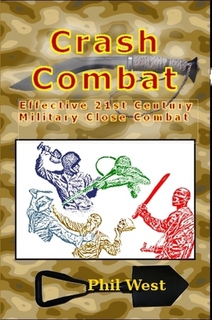
http://www.lulu.com/shop/phil-west/crash-combat/paperback/product-22603842.html
https://www.amazon.com/Anatopismo-Underrealm-Novella-Phil-West-ebook/dp/B077G7MMFM

Thursday, 10 November 2016

Tomahawk Strengths.


Researching tomahawks has led me down some interesting paths. One such path led me to an interesting site on boarding axes:


“Ships carried a large quantity of tools to meet any eventuality. These of course included axes for fire fighting - fire being an ever present hazard on wooden ships - for general repairs, and for tree felling and wood gathering ashore.

The main uses of an axe when fire fighting, whether at sea or on land, were for breaking open doors, smashing windows or knocking holes in walls and roofs to affect a rescue, releasing smoke or creating fire breaks. The thin angle of the blade as well as the spike could also be driven into the gaps around doors and windows to lever them open. At sea during battle this would also include damage control such as clearing fallen rigging and spars by cutting and dragging them clear and to pry out embedded hot cannon balls before they set the wood alight.

Axes were therefore always part of a vessel’s equipment and it is from these that the Boarding Axe evolved to fill a niche created by the art of naval warfare at the time of the great sailing ships.  

As well as being used for damage control they were also used as a combat tool in any boarding action between vessels, and it was this action that generally concluded the fight. The boarding axe was used to cut through anti-boarder nets and lines, to cut through rigging or ropes holding gun ports open, to smash through the doors and windows of cabins to attack the opposing crew who may be defending that as a stronghold. And of course in melee an axe may not be as good as a sword or cutlass but it was still a handy personal weapon.

A boarding party would always include a complement of axe carriers to support the main body of marines and sailors armed with musket and cutlass. As the axes were generally stored in racks near each gun they were also handy for defence against enemy boarders, being quickly available to the gun crews to cut grappling lines or defend themselves.”

This nicely sums up why a tomahawk or similar tool can be so useful. Not only can it create shelter or provide fuel, it can also be used to help create escape routes, particularly in an urban environment. A Falklands veteran I know of insisted his knife should be capable of cutting through the side of a helicopter sinking in the sea, having been in such an unfortunate situation.
A kukri will make short work of a wooden door. So too will a good tomahawk or hatchet. Many other survival knives will not, even though they cost several times more.
As I detail in “Survival Weapons: Optimizing Your Arsenal” a good kukri can be acquired for very reasonable prices. The catch is you have to get them from Nepal, although postage is also quite reasonable. On the other hand, you can find reasonably priced hand axes and hatchets in any hardware or DIY store.

         If you have enjoyed this article or it has been helpful to you please feel free to show your appreciation. Thank you.
The Books

http://www.angelfire.com/art/enchanter/epsdbook.html
http://www.lulu.com/shop/http://www.lulu.com/shop/phil-west/survival-weapons-optimizing-your-arsenal/paperback/product-21488758.html
http://www.lulu.com/shop/phil-west/crash-combat/paperback/product-22603842.html
https://www.amazon.com/Anatopismo-Underrealm-Novella-Phil-West-ebook/dp/B077G7MMFM

Wednesday, 9 November 2016

Tomahawk Fast Draw.

 
           As regular readers may know, I am a big advocate of the kukri. I am also, however, a big fan of Horace Kephart’s writings so am interested in tomahawks too.

           Last year I acquired a copy of “The Fighting Kukri” by Dwight C. McLemore. There is nothing wrong with this work but I personally found his techniques “over-systemized”. I can understand the reasons for his approach and recognize the influences, but it was not to my personal taste. This may be because I have my own ideas about using a kukri, as readers of Attack, Avoid, Survive or Crash Combat will know.

           One technique I did note was a defensive/ ready posture that had the forearms in a sort of pyramid configuration. If an enemy has his own kukri or a similar weapon I’d not like to leave my forearms as such a tempting static target. If he has an inferior weapon then my arms are going to be moving and letting my kukri bite!

           Yesterday I got to look at a copy of “The Fighting Tomahawk” by the same author. I found this quite informative.

           One advantage a kukri or other knife has over a tomahawk is that it can more rapidly and more smoothly be brought into action. A knife is generally worn so that its handle can be grasped first. A tomahawk is generally worn so that the first part grasped is the head or the shaft just under it. How do you move your hand to the end of the handle in a combat situation?

           You can, of course, flick the tomahawk upwards and catch the end. Or you can let it slide down out of your hand and catch then end. There is a significant chance that you may fumble this and lose your tomahawk! McLemore’s solution to drawing and readying the tomahawk will be the subject of today’s blog. It has applications for other implements such as hammers or entrenching tools.

           I call this technique “Brace and Slide” or “Slip, Brace and Slide”.
  • Grasp the tomahawk just under the head and pull upward to clear it from your belt.
  • Brace the butt of the handle against your hipbone or another convenient body part.
  • Slide your hand down the handle and grip near the end.


           It is possible that an enemy will have rushed your before you have the tomahawk fully drawn and readied. I have often stated, you should defend or avoid an initial attack before attempting to draw a weapon. That said, a tomahawk or hammer gripped just beneath the head can still be used to augment your unarmed techniques.

           Tomahawks and similar small axes usually come with a protective cover. Typically such covers feature belt loops or some other means to attach the cover to your belt. When carried in this way smoothly and rapidly drawing a tomahawk to defend yourself becomes very difficult. A better option is to use the cover just as a cover and rig another means for carrying the tomahawk. A tomahawk or axe with a sheathed head still works pretty well as a club!

           Many photos of WW2 German soldiers show them with entrenching tools slipped through the front of their belts rather than in the belt-mounted carrier, which was worn on the left side. The intention was to make the entrenching tool more readily available as a weapon.

           If used only as a cover many tomahawk sheathes are probably over engineered and have a lot of unnecessary weight and bulk. The photo below shows a rather elegant alternate edge protector. Such a thing could be easily constructed from materials other than leather.


           Cops often carry their nightsticks by a simple belt ring. Workmen carry hammers slung from a cloth loop. These methods can be adapted to carry a tomahawk. A diagonal strap can be added to prevent the tomahawk being lost when climbing or crawling and this provides greater security than simply slipping it through a belt.

The Books
http://www.angelfire.com/art/enchanter/epsdbook.html 

http://www.lulu.com/shop/http://www.lulu.com/shop/phil-west/survival-weapons-optimizing-your-arsenal/paperback/product-21488758.html

http://www.lulu.com/shop/phil-west/crash-combat/paperback/product-22603842.html


Friday, 28 October 2016

Boy Scout Axe


           I fully intend to write some more on the topic of tunics. For today, however, a briefer post.
           I’ve really been enjoying the series “Westworld”. This has inspired me to resume playing “Red Dead Redeption”, which in turn has got me thinking about various topics including that of  tomahawks/ hatchets/ hand axes. There will probably be posts along these lines in the near future.
           For today I will just post this interesting example of an English boy scout axe. Length is apparently about 14”. The head is backed with a point suitable for such tasks as digging latrines/ catholes.
 

The Books
http://www.angelfire.com/art/enchanter/epsdbook.html 

http://www.lulu.com/shop/http://www.lulu.com/shop/phil-west/survival-weapons-optimizing-your-arsenal/paperback/product-21488758.html

http://www.lulu.com/shop/phil-west/crash-combat/paperback/product-22603842.html