Friday, 27 January 2017

Writing and Time


          One consequence of becoming interested in the length of documents is that I have given some attention to the related field of reading speed and time.

          Over the years I have worked with a number of academics who proceed a workshop with a lengthy introduction. Sometimes this can be very long indeed! It is often claimed that the average human has an attention span of about 40 minutes.  My own experience suggests that despite this an introduction should be kept to under 15 to 20 minutes duration. Adding more content serves no purpose if it does not register.

          According to a Wikipedia article reading speed varies with language and writing system. Interestingly many people read much quicker than they are able to listen to spoken text. For English, reading speed is somewhere between 200 and 300 words per minute, bearing in mind that many people who will be reading an article in English may not have English as their first language. This means that a concise webpage of under 2,000 words will take about six to ten minutes of a reader’s time. If you have written a page of 8,000 words you should ask yourself will it interest a reader enough for them to spend 30 to 40 minutes of their time reading it?


          A fellow writer suggested the use of videos to me. Similar criteria apply, although just as a video is more complex than a written page so too are the factors affecting its acceptability. Personally I find myself reluctant to watch videos of more than ten minutes length unless it promises to cover something I am particularly interested in. If a friend sends me a music clip I find I will give it about 30 to 45 secs before I decide to continue or not. If the intro seems to be one that is particularly drawn out I may jump forward to see if the track improves. With non-musical videos I probably will give it a bit longer to develop, but a lot will depend on the presentation. If a webpage is badly presented and/or poorly structured you can sometimes fish through it for the better parts. With videos this is more difficult so poor structure or presentation will often discourage a viewer.
The Books
http://www.angelfire.com/art/enchanter/epsdbook.html 

http://www.lulu.com/shop/http://www.lulu.com/shop/phil-west/survival-weapons-optimizing-your-arsenal/paperback/product-21488758.html

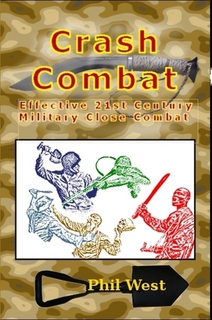
http://www.lulu.com/shop/phil-west/crash-combat/paperback/product-22603842.html


Thursday, 26 January 2017

Rifle Tactics.

             A significant contribution to the soldier’s load is ammunition. One way to reduce this is to modify how ammunition is expended.
             Full-auto fever. An assault rifle is not a machine gun. The effective range of an assault rifle with fully automatic fire is considerably less than that of a true machine gun. Full auto from a rifle can be used to sweep a trench or clear a room. It will only be cost-effective at longer ranges if the enemy is in a big dumb bunch. Some manuals state the effective range of a rifle on full-auto as 50 metres. About half of this distance is probably more realistic. If the enemy is more than 50 metres away keep your rifle on semi-automatic.
            Let the MGs, mortars and snipers do the work. When machine guns, snipers and mortars are available let them do the majority of the work. There is little point blazing away if you know you have little chance of having an effect. Only let the better marksmen make long range shots. Alternately use collective fire and semi-automatic volleys against the same target. Reserve your rifle ammunition for an assault or to repel assaults against the heavier weapons. The less you shoot the harder it is for the enemy to locate you.

           Suppressive fire doesn’t have to be full-auto. There will be times when rifles must provide suppressive fire. Think about the Westerns you have seen where a character gets pinned down in the rocks. The Winchesters and revolvers used did not need to go full-auto to do this! Suppress an enemy position with aimed, semi-automatic fire.
           It’s Fire or Manoeuvre! Running across a street guns blazing is pure Hollywood but you will see it done in real life. Firing like this has very little chance of hitting a target. Most of your rounds will not even be close enough to suppress an enemy. What this does do is waste your ammunition and draw attention to you!

           If you are moving, concentrate on moving. Tactical movement needs your full attention. You need to be thinking about how you use the cover and concealment available and how you are going to traverse gaps and obstacles. Let other elements provide any suppression. Ideally a moving element should never be visible to an enemy.

           If you are shooting, concentrate on shooting. Use any cover and concealment as effectively as you can. Use the most stable firing posture that your surroundings allow. Standing or moving is the least accurate posture to shoot from. Prone is the most stable. If you are surprised, take cover first, then return fire. If in the open drop prone and then roll for cover.
           Many years ago I came across a statement from the SAS when they were reactivated for operations in Malaya:

           “At first we carried too much ammo. We learnt to carry less. We learnt to shoot less and hit more often.”

           To that we can add a statement from the Home Guard Fieldcraft manual by Maj. John Langdon-Davies. He observes that a Home guard solder will never have as much ammo as he might wish for and that twenty rifle rounds at 25 yards will be far more effective that fifty at 250 yards.

           Know when to fire and when not to.
 
         If you have enjoyed this article or it has been helpful to you please feel free to show your appreciation. Thank you.
The Books

http://www.angelfire.com/art/enchanter/epsdbook.html
http://www.lulu.com/shop/http://www.lulu.com/shop/phil-west/survival-weapons-optimizing-your-arsenal/paperback/product-21488758.html
http://www.lulu.com/shop/phil-west/crash-combat/paperback/product-22603842.html
https://www.amazon.com/Anatopismo-Underrealm-Novella-Phil-West-ebook/dp/B077G7MMFM

Tuesday, 24 January 2017

Covert Pegging.

            Recently I posted a blog on lightweight shelter from the perspective of the soldier. This weekend I was reading some suggestions about covert/ tactical bivouacking. Of interest was a passage that said something along the lines of

            “The pegs are not to be hammered in. A hole is made with a bayonet and the pegs driven in with the head” (The head of the peg, presumably, not that of the soldier!)

            An interesting idea, but some readers will now be recalling that recently I posted on how the bayonet should be one of the first things a soldier should get rid of.

            Last night I put my SA-80 bayonet on the scales. The bayonet alone was 15 oz, about the same as my favourite 10” bladed kukri. The bayonet with scabbard was just over 1 lb 7 oz. This is the later pattern of scabbard without the useful wire cutter and woodsaw fittings. The blade is a sort of bowie-like shape so not sure how well it will poke peg holes in hard ground. The author of the about passage was probably talking about sword bayonets. The latter spike bayonet might be even more useful.

            Obviously there is little point carrying a heavy bayonet just to make holes for pegs. The solution is to find yourself a suitably sized screwdriver. Sharpen the end if necessary and pack it with your pegs. The screwdriver can be used to make peg holes. The shank can be placed under the hook of some peg designs and the screwdriver used to pull up these pegs. The screwdriver can also be used as a peg, so you are able to carry one peg less.


         If you have enjoyed this article or it has been helpful to you please feel free to show your appreciation. Thank you.
The Books

http://www.angelfire.com/art/enchanter/epsdbook.html
http://www.lulu.com/shop/http://www.lulu.com/shop/phil-west/survival-weapons-optimizing-your-arsenal/paperback/product-21488758.html
http://www.lulu.com/shop/phil-west/crash-combat/paperback/product-22603842.html
https://www.amazon.com/Anatopismo-Underrealm-Novella-Phil-West-ebook/dp/B077G7MMFM

Friday, 20 January 2017

Easily Digestable Writing.


           Since it is Friday I will continue my tradition of a more off-topic topic!


           Many readers will be familiar with Osprey. They publish a number of series of books on military history such as the “Men at Arms” and “Elite” ranges. I was recommending one of these books to a friend and made an observation that these books were of a convenient length to get through in a lunch break.

           When I write a blog post I usually write it first in a word processor program. I then upload the basic text onto the website and add links and illustrations as required. Recently I have noticed that many of the posts I had made were two pages or less of plain text. This seemed to produce a blog of a relatively convenient size that can deal with a topic but not be overly long.

           I had been reading some GURPS sourcebooks recently too. These can often be a useful source of interesting information since some are very well researched. These tend to be more text intensive than the Osprey books. Third edition sourcebooks can be 128+ pages long, which can be a little long (over 100,000 words). Interestingly many of the more recent fourth edition publications are under 60 pages, with some as short as 17 pages. Some may be shorter.

           I began to ponder these observations. The Osprey books are very informative and detailed but generally have a page count of between 32 and 64 pages. This includes numerous illustrations, eight full colour plates and quite wide margins down one side of the page. How big is an Osprey book in plain text? I found a blog where an author talks about writing his first book for Osprey and the figure of 15,000 words is mentioned. 15,000 words is approximately 30-40 pages of single spaced text. That sounds very credible for a 48-64 page illustrated book of Osprey format.

           Every now and then I come across a webpage where the writer attempts to include absolutely everything on a certain topic. They may also decide to put down everything they know related to the topic. And everything else they may be interested in at the moment they were writing the page. Just to make things even more interesting the page will often lack a logical structure. It is a pity since some such pages often include a lot of interesting information, but this is easy to overlook or miss. If the author is trying to make a particular point this can sometimes be lost in the general tidal wave. If you want to refer the reader to additional information use hyperlinks or, if writing in dead tree format, references!


           Now I have written a few overly long and somewhat rambling webpages myself over the years. A few of the more recent ones, however, I have been pleased with the conciseness of. Out of curiosity I pasted a few examples of these into the word processor for a crude word count. Several of these are under 2,000 words, with the longer ones a couple of hundred under 4,000.

           This seems like a very useful set of guidelines. Two pages or less of plain solid text for a blog post. (Font size 12, Georgia, single spaced). 4,000 words or less for a webpage, with less than half of that attractive. For longer works aim for under 15,000 words. If that is not possible aim for sections or chapters of less than this size. The latter strategy may also help towards the better structuring and presentation of the information.

589 words :P


         If you have enjoyed this article or it has been helpful to you please feel free to show your appreciation. Thank you.
The Books

http://www.angelfire.com/art/enchanter/epsdbook.html
http://www.lulu.com/shop/http://www.lulu.com/shop/phil-west/survival-weapons-optimizing-your-arsenal/paperback/product-21488758.html
http://www.lulu.com/shop/phil-west/crash-combat/paperback/product-22603842.html
https://www.amazon.com/Anatopismo-Underrealm-Novella-Phil-West-ebook/dp/B077G7MMFM