Friday, 5 May 2017

Getting Old.

Recently I have been re-reading Appleseed, trying to pin down the aspects of utopias hinted at in the first two books. I have been using the snipping tool to copy particularly relevant panels for later consideration. The panel below is not relevant to this theme, but is an interesting idea in its own right.


Then, two days ago, facebook publishes a “memory” from several years back. Turns out that I have already written a blog about Appleseed, utopias and competition. I had completely forgotten about this.

So effectively had I forgotten this article that I actually enjoyed re-reading it. It had some insightful points and is probably far better than the article that I was intending to write.

Evidently I am getting old and my memory is failing. On the positive side I guess that will allow me to better enjoy my movie collection once again. Providing I can remember where I live!

<         If you have enjoyed this article or it has been helpful to you please feel free to show your appreciation. Thank you.
The Books

http://www.angelfire.com/art/enchanter/epsdbook.html
http://www.lulu.com/shop/http://www.lulu.com/shop/phil-west/survival-weapons-optimizing-your-arsenal/paperback/product-21488758.html
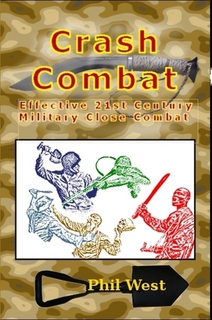
http://www.lulu.com/shop/phil-west/crash-combat/paperback/product-22603842.html
https://www.amazon.com/Anatopismo-Underrealm-Novella-Phil-West-ebook/dp/B077G7MMFM

Thursday, 4 May 2017

Survival Weapons: Optimizing Your Arsenal

When I wrote “Survival Weapons: Optimizing Your Arsenal” I tried to include all the information that I might want from such a book if I were purchasing it. Thus the chapter on shotguns explains choke and there are numerous tables to help the reader understand pellet sizes, pellet counts and what loads are best suited to what game.

There is a whole chapter on exterior ballistics that explains near and far zero and other influence such as wind effects and target speed. I included stuff that is not usually covered such as how canting a weapon or shooting to a higher or lower elevation target will change the point of impact.


The book includes a number of snap-shooting techniques that can be used when there is insufficient time to take careful aim. There is a chapter on a various types of sighting system and how to zero them correctly. There is a chapter on using your sling as a shooting aid and how to make a sling both lighter and quieter. There is information to help you choose firearms for defensive purposed for both two and four-legged threats.

In addition to all the gun-related content I have included several chapters on the selection, use and care of survival knives. There is also a discussion of improvised weapons for defence and food gathering.

Whilst I can obviously be accused of bias, I think this is a very fine little book, packed with useful information and very good value for the price.
The Books

http://www.angelfire.com/art/enchanter/epsdbook.html 


http://www.lulu.com/shop/http://www.lulu.com/shop/phil-west/survival-weapons-optimizing-your-arsenal/paperback/product-21488758.html


http://www.lulu.com/shop/phil-west/crash-combat/paperback/product-22603842.html


Sunday, 30 April 2017

Middle Finger Trigger


Since last week’s post I have had some time to further explore the point shooting website.

It seems the idea of using the middle finger on the trigger dates back to at least the 1800s. It was once considered to be a valid alternative for shooters. One factor for discouraging its use seems to have been the adoption of the Colt M1911. As described on this page, the index finger pressing on the takedown pivot on the frame of a M1911 can cause a malfunction. The US Army pistol manual still encourages the soldier to use his natural pointing ability, then instructs him to use the finger he naturally points with for something else!

The USMC manual on pistol marksmanship wisely tells us “A firm grip is essential for good trigger control.” and that “The pressure applied to the grip must be equal to or more than the pressure required to move the trigger to the rear.”

An interesting feature of using the middle finger on the trigger is that the hand makes four points of contact with the weapon. At the top it is held between thumb and the pointed forefinger. On the grip it is held by the two lower fingers. The pressure on the trigger is applied between these two points. Mechanically, this is quite a stable configuration.

Contrast this with the “traditional” grip using the index finger on the trigger. The bottom part of the grip is held by three fingers and pressure is applied higher up. Mechanically, that is a lever!

US Army manual FM-3-23.35 tells us “Poor shooting is caused by the aim being disturbed before the bullet leaves the barrel of the weapon.” and that “A slight off-center pressure of the trigger finger on the trigger can cause the weapon to move and disturb the firer’s sight alignment… Trigger squeeze is the independent movement of the trigger finger in applying increasing pressure on the trigger straight to the rear, without disturbing the sight alignment until the weapon fires… If pressure from the trigger finger is applied to the right side of the trigger or weapon, the strike of the bullet will be to the left. This is due to the normal hinge action of the fingers… The firer must not apply pressure left or right but should increase finger pressure straight to the rear.”
Applying trigger pressure “straight to the rear” can be problematic if you use the final section of your index finger. To be consistent the same region of the finger section must always make contact with the trigger. Some shooters try to use the crease of the finger if their finger is long enough to allow this. With some guns your index finger has to reach for the trigger at a downward angle too. This may affect moving the trigger straight to the rear.

If you operate the trigger with your middle finger the point of contact will be the middle section of the second finger. This will give a more consistent trigger operation, allowing any inequalities in pressure to be compensated for.

Another advantage of using the middle finger is that the gun sits lower in the hand, reducing the effects of recoil and muzzle climb.

The middle finger is also stronger, which may explain why Ruby used his for a double action revolver.

This page describes how to construct an “aiming aid” or “index guide” from plastic cornering and double-sided tape. On this page are some patents for alternate devices. An important point to grasp, however, is that these are optional. Providing you have a suitable weapon you can try this technique without any modifications or financial outlay. In absence of a firearm you can try it with an airsoft, an airgun, a toy or whatever.
 

The point shooting website concentrates on shooting when there is insufficient time to use the sights. Middle finger triggering can also be used when the sights are being used. My subjective impression is that this grip causes the sights to align with the intended target a fraction quicker. Because the pressure that you are applying to the trigger may be different using this method your mean point of impact (MPI) may change. Judge the groups on their consistency rather than how close they are to the sighted point of aim. If there is an improvement in your performance you can adjust your sights later.

When I first tried this technique I noted a tendency to grasp the trigger when picking up the “weapon”. A simple solution is to adopt the habit of holding your first two fingers in a “V” sign as you reach for your weapon. Just remember “Peace to my piece”!

The Vermont UFC and police academy report on the technique included a useful list of weapons they found to be suitable. Note that this list includes rifles, shotguns and SMGs in addition to pistols. I will confess to being surprised the little Seecamp .32 was found to be suitable! This list is, of course, not comprehensive and only lists the models tried in the Vermont study. There will be other suitable models of weapon.

SIG - P228, P229, P239, P220, P230, P232, P225, P226
S&W - 4506, 3903, 39, 59, 66, 49, 1006, 4006, 622, 3000 Shotgun
Colt - 1911 (Caution), Python Trooper, Detective Special
H&K - P7M13, USP, MP5 Navy, MP5SD
Glock - 17 thru 33
Beretta - 92, 96, Cougar, SMG
Ruger - P89, Blackhawk, GP1000, Security Six
Seacampo - 32 (Seecamp?)
Remington - 870, 1187, 1100, 870 Marine, M-24
Bennelli - Super 90, M1
Ithica (Ithaca)- Model 37
Mossberg - 500 Series
USN-SEAL - 300 Win. Mag. Sniper rifle
US Military:
- M16A1 @ 300 meters
- M14 @ 500 meters
- M21 @ 500 meters
- M1 @ 300 meters
- M24 @ 700 meters

In short, you have nothing to lose in trying this technique. If you do not like it or it does not suit your shooting style then at least you tried it out before you decided, unlike some of its critics. If you find it better/ easier, you have gained! To paraphrase Bruce Lee: “Absorb what is useful, discard what is not”.

It would be nice to see using the middle finger included in firearm course as an option. It would also be nice if more firearms incorporated an index guide into their design. A simple groove or a narrow ledge between the slide or cylinder and the frame would suffice.

The Books

http://www.angelfire.com/art/enchanter/epsdbook.html 


http://www.lulu.com/shop/http://www.lulu.com/shop/phil-west/survival-weapons-optimizing-your-arsenal/paperback/product-21488758.html


http://www.lulu.com/shop/phil-west/crash-combat/paperback/product-22603842.html


Friday, 28 April 2017

Workplace Survival.

As is usual for a Friday the blog will be a little more diverse in its topic than usual. Today’s post still comes very broadly under the topic of survival or even defence!

A few weeks back I was reading some books by David Devereux that a friend had given me. First I read his novels, which are worth checking out. After that I read his more autobiographical “Memoirs of An Exorcist”. This will not be to the tastes of some of my readers I suspect. That is a shame. Devereux is obviously an intelligent and insightful individual. He is also a competent and entertaining writer, which is more that can be said for some other better known writers!

Below is an extract from “Memoirs of An Exorcist” about workplace environments. There are some insights here that are likely to be familiar.


So what do we find in offices? Generally, a matter of dealing with negative energies. Most offices have a stock of that: people hate their job, their boss, their colleagues and their customers. They hate the necessity to work. They hate commuting. Be honest with yourself for a second: do you actually enjoy working? If you do, you’re a rare creature. I generally enjoy what I do, but it leaves me tired, frustrated, angry and occasionally despairing about clients and the world in general. So, if this is someone who likes their job, imagine what kind of emotional roller coaster someone who doesn’t is riding. Now stick them in an open-plan office with thirty so other people. No privacy, no respite from the pressure. In some offices, the length of time you spend in the toilet is monitored to make sure you stay productive. The number of calls you take in an hour, or the number of keystrokes at your computer, or the number of shelves you fill, or whatever it is you do, someone’s watching, making you work harder, keeping the pressure up. For all their much vaunted training, managers are not always good communicators. Self-expression is discouraged - wear the correct dress or be sent home.

 I’m not saying that it is wrong for a company to want to get value for money from its employees. But there are ways of doing it that turn offices into nothing more than battery farms and there are ways that treat employees like people. The former approach is generally the cause of difficulties, poor staff retention and a general air of gloom over the whole workforce. This spreads from employee to employee as each drags the others’ mood down.

I’ve seen entire open-plan offices of fifty to a hundred people where nobody smiled. Sure, the managers were allowed a few personal effects on their desks, but employees sat at a desk with a phone, and a computer and whatever they needed to do their jobs; nothing else was allowed because the company enforced a “Clear Desk” policy. Nothing personal, unless you’re a manager. Side screens divided each employee from their neighbour, and conversation was discouraged. Of course, the managers were expected to enforce an atmosphere of jollity and esprit de corps that just wasn’t there because people couldn’t bond. So the atmosphere of the place was depressing and wasn’t helped because almost all the staff were temps with no job security or feelings of loyalty to the company. People were arbitrarily dismissed with no need for notice, because they had no contract and, while the temp agencies responsible for staffing this battery farm had an office on site, there was a distinct impression from some of the liaison personnel that the staff were just replaceable commodities not worth getting to know.

The other parts of the company employed people properly and treated them far better. These parts were more profitable, had better retention rates and happier people. But the first office seemed to end up going through the entire available workforce of its town and it got to a point where they couldn’t hire enough people to keep up with the losses caused by attrition and the summary justice within. The solution was classic corporate thinking: they opened an office in a new town, and expected some of their more loyal temps to travel two hours each way to teach the new office how to do the job.

The simple fact is that misery loves company. If you take an approach that makes people miserable, then that misery will build upon itself and spread throughout the working environment. This applies in the home as well, but is more likely to happen in an office because many people resent having to go to work at all. I’ve noticed that companies who spend time and trouble to create a decent environment for their employees have less sickness, absenteeism (“throwing a sickie” being different from actually being ill) and attrition than companies who are perceived not to care. Something as simple as taking a genuine interest in your staff can make the difference between people who are happy to work for you and people who would rather gnaw their own leg off than spend one more minute than necessary in the office. This seems the most obvious thing imaginable, but it amazes me how few companies do it.

And here’s a thought: how much oxygen are you actually taking in? For a start, most people breathe very shallowly, using about the top third of their lungs. Lack of oxygen leads to them getting tired and emotional, which again contributes to the problem. Simply sitting quietly at one’s desk and breathing deeply for a few minutes can have a remarkable effect on stress.

But put aside my feelings about the generic corporate culture for a moment and consider those more enlightened companies who feel that happy employees are more productive. Things can get interesting when a company switches its policy from battery farming to free-range. Trying to introduce a sunnier disposition to people trapped in a misery-sink can be something of an uphill battle, since employees may not trust the management and are still working in an environment that has stored their anger. This is why office refurbishment is a good way to start, but may not cure the problem entirely. Something obviously needs to be done to dispel the preceding atmosphere and give people a chance to face the new environment with a more open mind. Far Eastern companies have been doing this for years and have started to introduce the same approach here over the last twenty years or so.

         If you have enjoyed this article or it has been helpful to you please feel free to show your appreciation. Thank you.
The Books

http://www.angelfire.com/art/enchanter/epsdbook.html
http://www.lulu.com/shop/http://www.lulu.com/shop/phil-west/survival-weapons-optimizing-your-arsenal/paperback/product-21488758.html
http://www.lulu.com/shop/phil-west/crash-combat/paperback/product-22603842.html
https://www.amazon.com/Anatopismo-Underrealm-Novella-Phil-West-ebook/dp/B077G7MMFM