Tuesday, 22 April 2014

A Decent Meal in Less Than Ten Minutes.

            Cooking for myself recently has been very efficient.
The other night my cooking proceeded thus:-
 I place a bowl of frozen sweetcorn in the microwave. This will cooked in under three minutes.
At the same time I boiled a cupful of water in the electric kettle. This will be used to make instant gravy. A good selection of ready-made sauces and instant stuff can really add variety to your diet.
 A frying pan heated up on the hob with a squirt of oil added. I keep the oil in a squirt bottle since it makes it easier to add less to a pan. Chopped fresh mushrooms went into the frying pan to brown for a few minutes.
 While this was going on and heated up my new George Foreman grill. I have seen some rubbish written on the internet about these grills drying food out. The George Foreman is basically a culinary trouser press. It cooks food from both sides at once, so it will take approximately half the time to cook something. Adjust you cooking plan accordingly!
On another hob, I boiled a pot of salted water. Following the previous blog post I decided to experiment with pre-soaking dried pasta. It worked even better than I expected so it was obvious I could now cook it like fresh pasta. A couple of minutes of cooking instead of twelve to twenty minutes.
Pork chop, mushrooms, sweetcorn and pasta in gravy, cooked in under ten minutes. Big saving on fuel, time and hassle.
         If you have enjoyed this article or it has been helpful to you please feel free to show your appreciation. Thank you.
The Books

http://www.angelfire.com/art/enchanter/epsdbook.html
http://www.lulu.com/shop/http://www.lulu.com/shop/phil-west/survival-weapons-optimizing-your-arsenal/paperback/product-21488758.html
http://www.lulu.com/shop/phil-west/crash-combat/paperback/product-22603842.html
https://www.amazon.com/Anatopismo-Underrealm-Novella-Phil-West-ebook/dp/B077G7MMFM

Saturday, 19 April 2014

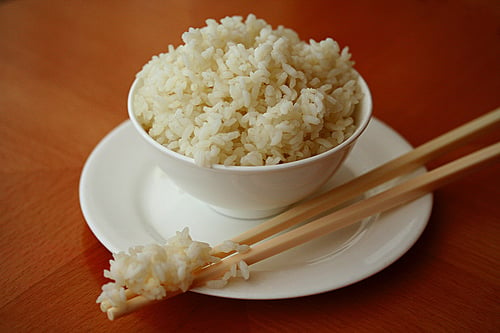
Cooking Rice in Under Ten Minutes. Save fuel and money.

            My gas bill this previous quarter was much higher than I expected. Made even more frightening by the fact that it was a mild winter and I barely used the heating. This got me thinking again about ways to save energy when cooking. 

            A friend of mine once told me that during the rationing of World War Two his mother saved fuel by soaking rice overnight. By doing this she only needed to cook it five minutes. Time to experiment with this method again.


            Here is the method that I have ironed out over the last few days.

            Measure out your rice. 100gms is a generous portion and comes up to the 100ml mark in one of my measuring jugs. Rather than bothering to weight the rice I just fill the jug to the mark. Pour rice into a cup and cover with water.

            Place your cup of rice and water in the fridge. The first time I tried pre-soaking rice I ended up leaving it longer than I intended since I spent the next couple of nights down the pub and eating out. The rice sort of started fermenting so I suggest you keep the soaking rice in the fridge just in case you are delayed.

            Leave the rice to soak a few hours, or better still, overnight.

            When it is time to cook, pour the rice and water into a pot. A broader pot heats up quicker and is less likely to boil over. You may need to add a bit more water to the rice so it is covered by at least a centimetre of water. Add a little salt too. Use a hob of suitable size for your pot.

            If you add too much water you are going to waste fuel heating it up. Too little and your pot may boil dry before you are done. You will have to experiment on getting the optimum for the pot you use. As in so many things, balance is the key.

            Cover your pot, bring to the boil and then turn down the heat to simmer.

            Give the rice about five to seven minutes. If you are new to this cooking method taste a little of the rice to see if it is soft or still a little gritty. Turn off the heat and let the pot stand, preferably over the still hot hob. The residual heat will continue to cook the rice without expending fuel. This gives you time to finish cooking the other components of your meal.

            Drain your rice. Turn out onto a plate and serve with a variety of vegetables and a sensibly sized portion of meat.


           This method will prove pretty useful if you are hiking or camping and have to carry your own fuel. In this case I suggest the in the morning you place your rice and water in a wide-mouthed screw top container and let it sit in your rucksack while you are walking. Such a container is a useful addition to your hiking kit since it can be used to prepare other backpacking foods that need a long soak.
            I have not yet tried this method with brown rice. Is it possible to reduce the cooking time of dried pasta by pre-soaking? I will have to experiment. Have a go yourselves.
         If you have enjoyed this article or it has been helpful to you please feel free to show your appreciation. Thank you.
The Books

http://www.angelfire.com/art/enchanter/epsdbook.html
http://www.lulu.com/shop/http://www.lulu.com/shop/phil-west/survival-weapons-optimizing-your-arsenal/paperback/product-21488758.html
http://www.lulu.com/shop/phil-west/crash-combat/paperback/product-22603842.html
https://www.amazon.com/Anatopismo-Underrealm-Novella-Phil-West-ebook/dp/B077G7MMFM

Friday, 11 April 2014

Cutlasses


            I got diverted reading about cutlasses the other day. According to the book I picked up it is not until the start of the nineteenth century that Royal Navy cutlasses were standardised, or at least records of the standard date to. In 1858 a new model of cutlass based on the 1853 cavalry sword was adopted and the blade length as standardized at 27” (right). I get the impression that most of the earlier patterns of cutlass were of this size. In 1871 weapons with a slightly shorter blade of 25½” were adopted. ’71 saw the adoption of both a new cutlass and a cutlass bayonet for the Martini-Henry rifle (below). Cutlass bayonets had been issued before, such as the 1859 model for the Enfield (above). The two ‘71 pattern weapons seem to have been intended to share many common components between the bayonet and sword and the slight shortening of the blade may have been a concession to the bayonet role. In 1889 a cutlass with a blade of 28” was adopted.
            What interested me about this passage was that the navy considered a blade of about 27” to be ideal for a cutlass. Most British army swords of this period are 32” or more in length. Cavalry swords tend to be longer and in the 33 to 36” range. I have a 1898 Officer’s sword with a 32” blade. It is a very nice weapon but I cannot handle it without feeling it would be handier and more agile with a few inches removed.
            27-28” is also the “Perfect Length” for a sword that I pondered on in a previous post.


         If you have enjoyed this article or it has been helpful to you please feel free to show your appreciation. Thank you.
The Books

http://www.angelfire.com/art/enchanter/epsdbook.html
http://www.lulu.com/shop/http://www.lulu.com/shop/phil-west/survival-weapons-optimizing-your-arsenal/paperback/product-21488758.html
http://www.lulu.com/shop/phil-west/crash-combat/paperback/product-22603842.html
https://www.amazon.com/Anatopismo-Underrealm-Novella-Phil-West-ebook/dp/B077G7MMFM

Wednesday, 9 April 2014

Sword Bayonets, Part One


    For no particular reason I have found myself thinking about sword bayonets recently. Perhaps it was because in a recent re-run of “Wonder Woman” a soldier was wearing one, which struck me as odd since he was an MP in white equipment and you would have expected a baton rather than a bayonet. (for that matter, the episode was set in the 1970s so a sword bayonet would have been an unlikely piece of equipment for any GI!)
    My interest in sword bayonets goes back many years. One reason is in the opening passages of the Modesty Blaise adventure “Operation Sabre Tooth” there is a trial by combat and a soldier requests a bayonet to defend himself. Another character reveals he keeps as sword bayonet under the seat of his jeep and enthuses over its merits other a knife. Another source of my interest is the following passage in the Gun Digest Book of Knives, Fourth Edition. Page 106.
    “The Yataghan is more of a machete-length short sword with a kukri’s chopping forward curve, but with the point brought back for thrusting. These can have considerable advantages over a machete. The Yataghan was widely used for so-called “Sabre Bayonets” at the time of the War Between the States. The Remington Zouave Rifle carried it, as did many European guns of the period. Perhaps its short sword length and association with the bayonet prevented its other capabilities from being appreciated. At any rate, this splendid weapon didn’t catch on in the West except in bayonet form. It still offers much to the user and should not be overlooked when making your choice. It has the length and reach of the machete in a stiffer blade. It is a powerful forward-curved chopper like a kukri, yet retains a fine thrusting point. Well balanced and lively in the hand it will perform hard work with ease.It is light and easy to carry as well.”
    Careful readers will note that it is often uncertain if the author of the above is discussing yataghans in general or specifically yataghan-style bayonets. The poor quality photo in the article seems to suggest a bayonet blade that has been fitted with a new grip (possibly stag antler).

 
    The story of sword bayonets begins with the hanger. Hangers were a short sword that was carried by infantry and other troops. The hanger itself was derived from a civilian tool favoured by outdoorsmen. Hangers, “short hunting swords”  or “couteau de chasse” were useful for chopping firewood, clearing brush and butchering game. They were carried by noble and commoner alike. There are exciting accounts of them being used to hunt game and they were a useful defence against both beast and man. Decorated versions might be worn out court to display one’s affection for hunting. They might also be worn in town as a handy defence against robbers, in many cases being more effective and convenient than rapiers or small swords. Understandably the common foot soldier found the hanger to be a useful implement. In addition to the sword bayonet the hanger is probably the ancestor of both the naval cutlass and the machete, and is why you occasionally come across machetes referred to as cutlasses. Sword bayonets were created to produce a bayonet that also served as an infantryman’s hanger. The yataghan configuration blade provided better clearance for the hand when reloading a muzzle-loading weapon. The blade shape is not without other merits so a number of breech loaders also used sabre bayonets.
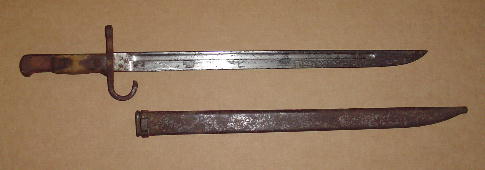
 
    Despite the claims of the passage quoted above, most sword bayonets I have handled would not be particularly good general survival knives. Most hangers resemble shortened sabres with slightly curved blades. They can fight with both point and edge but their application as brush knives means they have to be effective choppers. Most bayonets, on the other hand, then to have their weight well towards the hilt. Many of the older examples have solid brass hilts. Those that do not still have a considerable weight of metal in the grip designed to facilitate attachment to a rifle or musket. I have a number of wakizashi, barongs, machetes and kurkis of comparable weight and/or length to my sword bayonets. Just handling them makes it clear that for medium to heavy chopping the sword bayonets are inferior.
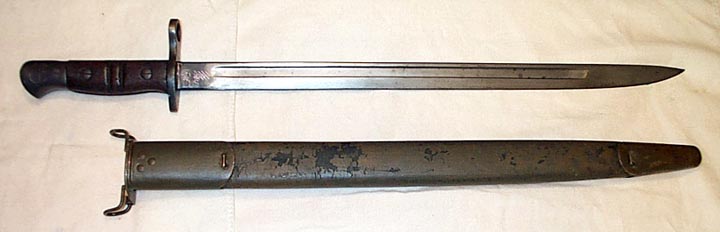
 
    The sword bayonet may have been intended to replace the soldier’s hanger but it was a poor substitute when it came to use as a general utility tool. As a bayonet if may be argued that they certainly looked impressive and provided a long reach. On the other hand their weight when fitted affected the mean point of impact when shooting. Several nations came to the conclusion that lighter, handier bayonets were more practical.
    It is the sword bayonet as a hand weapon that I intend to look into over the next few posts. Sword bayonets, as you might expect, are well suited to thrusting attacks. Their blades are long, narrowish, rigid and often provided with fullers or strengthening ribs. While chopping power is limited the length of the blades can be used to apply a draw cut against thinly protected flesh. We will look into these aspects in later posts.
         If you have enjoyed this article or it has been helpful to you please feel free to show your appreciation. Thank you.
The Books

http://www.angelfire.com/art/enchanter/epsdbook.html
http://www.lulu.com/shop/http://www.lulu.com/shop/phil-west/survival-weapons-optimizing-your-arsenal/paperback/product-21488758.html
http://www.lulu.com/shop/phil-west/crash-combat/paperback/product-22603842.html
https://www.amazon.com/Anatopismo-Underrealm-Novella-Phil-West-ebook/dp/B077G7MMFM