Friday, 5 February 2016

Fictional Measurement System.


As is the tradition, the Friday blog will be on something more abstract or light hearted than the usual topics.

Over the years I have read a number of sci-fi and fantasy books where the author has given a world its own measurement systems. Most of these seem to be fairly arbitrary rather than based on aspects of that world. It is with this in mind that I have pursued the following train of thought.

While doing some background reading for the last series of posts I came across a description of a duelling sword as being of “four palms length”. Seemed rather short for what was described as an excellent weapon for the duel! I did a little research and discovered that “palm” was a term sometimes used for a measurement based on hand length. Like many old measurement standards it varied from city to city but was between 8 and 10 inches long. 32 to 36” is about right for a handy duelling sword.

I began to read about anthropic measures. Something that occurred to me was that a “foot”, despite its name, was not an anthropic measurement. Very few people have feet twelve inches long. According to Vitruvian proportions a foot should be a seventh of your actual height. I’m about 71” tall so my feet should be over 10” long. The 15.3% value on the wiki article would give me 11” feet. Actually they are 9” long.  Someone with a 12” should be seven feet tall if Vitruvian proportions are correct! Vitruvian proportions don’t work for feet. Many people my height have feet larger or smaller than me. Many smaller people have larger feet. It has been suggested that “foot” as a measurement is a synonym for “shoe”. Coincidentally my favourite boots are exactly 12” long. My ancestors probably did not have moulded rubber soles so their shoes were probably shorter than this.


A fact I did come across was that the Romans used a measurement based on the pace. The Roman passus was a “double pace”, measured from the heelprint of a foot to the next heelprint of the same foot. It was standardized at 1.48m and also described as being five Roman “pes”. One pes or “roman foot” is 11.6 modern inches. The Romans used a decimal system for large measurements so one thousand passus or five thousand pes was a Roman mile. It seems likely that the pes was created as an increment of a passus rather than anything to do with the size of a human foot.

My reading also turned up the interesting fact that the metre was originally derived as being a ten-millionth of the distance between the equator and the north pole of the Earth. While logical there are a number of objections to this. One is that a measurement of the Earth will vary with how it is done. If we fly an aircraft from the equator to the north pole the actual distance it travels will depend on its altitude. It may occasionally have to fly higher to cross a mountain range so the distance travelled will be different to that on a map. If it was practical to walk this distance the walker would have to move up hills and down across valleys that the aircraft simply fly over. Again, the total distance travelled will be different. Perhaps our walker takes a little dog with him. Poor Fido will have to clamber across rocks and negotiate furrows and thus walk a different distance to the human beside him. Another objection is that this derivation does not make the measurement unit particularly tangible:-

      “Fred, do you think it is less than a hundred metres to the pub?”

     “Well, Bert, do you think that looks like a hundred-thousandth of a quadrant?”

Suppose, for discussion's sake, we had a measurement system based on something else. I am going to use the Roman passus (1.48 m) for this example. A pace is quite a handy, easily visualized measure. There are obvious useful real world applications for working out ranges or travel distances in paces. It is probably more useful to know something is twelve paces away than twenty yards. Pacing a distance gives a fairly accurate approximation even if your pace-length is not exactly 1.48 m.

           For reasons that will become clear in a moment I am going to suggest decimalizing the passus. Each passus is divided into ten deci-passus or “desips”, each equivalent to 14.8 cm or 5.8”. Interestingly, three desips equals 17.4”/44.4 cm, a shade under a standard (Biblical) cubit and nearly identical to the Roman cubitus. Vitruvian proportions gives the height of a male as four cubits. Twelve decips works out as 177.6cm or 5’ 9.6”, a fairly good estimation for the height of an average man. We can therefore create a second measurement called a “kupit” and use the length between a middle finger and elbow tip as an approximate measure. A cubit is quite a handy measure. It is readily to hand and in Vitruvian proportions is equal to a shoulder width. A man’s height or armspan is meant to be four cubits. The Wikpedia page on Vitruvian man defines a pace as four cubits, but this is obviously incorrect since men do not walk in bounds equal to their height. Cloth or rope can be easily measured out in “double cubits” by stretching it from centreline/nose to fingertip. This is a traditional way to measure yards but our system does not need yards (or feet) when we can use passus, kupits and double kupits.

One passus = Ten desips
One kupit = Three desips
Three passus = Ten kupit

So, our standardized measures of length are the passus, kupit and desip, two of which can be easily estimated by pacing or comparison to a body part. For smaller increments we can have the centi-passus, milli-passus  (centip and millip?) etc. For longer distances we have the kilo-passus (kilop?) equal to ten-thousand desips or 1.48 km/ 0.925 miles. A league, the distance that can be marched in an hour, is 3.25 kilo-passus. 200 passus is a shade under 300m, which is about the limits of the effective range of a rifle for many shooters. 150 passus around the battlefield range of a bow.
 
Kupits to Passus = n x 3/10
Passus to Kupits = n x 10/3
 
 A hektopassus is an area measurement equivalent to a square ten passus to each side. Ten thousand hektopassus make a square kilop.
 
Once we have a linear measurement we can move to volumes. A cubic desip works out to be 3.24 litres, not a very useful aliquot to base a system on. Instead, I am going to suggest a cubic half-desip, which is a cube of 5 centi-passus to a side. Eight of these will fit in a cubic desip and each is about 405mls. This is just under an American pint so is a handy amount to deal with. We will call this a “skulp”. Skulps can be divided into milli-skulps and micro-sculps, each milli-sculp being equivalent to a cube of 5 milli-passus sides. For larger volumes there is the kilo-skulp, eight of which make a cubic passus. Whereas the liner measurements are based on 3s and 10s the volumes are related by 5s and 8s!


For a unit of mass we might as well use the mass of a single skulp of water. We will call this a “skud” so one skulp weighs one skud or 405 gms. A milli-skud is 405 mg and a kilo-skud is 405 kg.

One milli-skulp of water masses one milli-skud and is a cube of 5 milli-passus per side.
One centi-passus cube of water masses eight milli-skud and contains eight milli-skulp

A cubical cup with internal dimensions of half a desip (2.9”) provides a handy standard. For a skulp, fill it up to the line. To weigh a skud measure a cup filled with water against its empty twin. The internal sides of this standard cup are half a desip across. The single standard cup is therefore a useful standard for mass, volume and length! All merchants should have a set! Beer mugs will hold a skulp so an improvised standard will seldom be far away. One skulp is a handy size for a scoop or ladle.
There you have it. A fairly simple but useful measurement system for a fictional realm. 

Update.
The derivation of a skulp suggests that a passus might be more logically subdivided into twenty parts rather than ten. I will call this unit a “vingt”. This is approximately a handbreadth. The desip becomes redundant. There are five centi-passus to a vingt. For convenience the centi-passus will be renamed “ort”.
 A two kupit (twelve vingt) pendulum allows the derivation of a time increment of 0.945 seconds at Earth standard gravity. This is only about 1/20th difference from an actual second so is effectively the same for most purposes. Using the system of counting to 144 on the fingers allows the use of seconds in multiples of twelve. 144 seconds is 2.4 minutes. Twelve such units (a zagier) is 28.8 minutes and 50 zaiger-seconds is 24 hours. 144 “short” seconds is just over two and a quarter minutes. A zagier of short seconds is just over 27 minutes.

One passus is 20 vingts. One kupit is 6 vingts. A skulp is a cubic vingt. A skud is the same weight as a skulp of water.


8.5 to 10 vingts would probably be a good length for the blade of a handy sword. Half a passus the height of a battle shield. A typical spear might be 5 kupits, a light lance 2 passus and a pike 12 kupits.
 
Summary.
  • A passus is a standardized double pace. One passus = 1.48 m, 58”, 20 vingt or 100 orts.
  • One kupit is a standardized cubit. One kupit = 44.4 cm, 17.4”, 6 vingts or 30 orts.
  • One vingt = 7.4 cm, 2.9” or 5 orts.
  • One ort = 14.8 mm or 0.58”.
  • One skulp = 405 mls or 14.25 fl oz. A cubic vingt.
  • One skud = 405 gms or 14.25 oz/ 0.89 lb. Weight of a skulp of water.
         If you have enjoyed this article or it has been helpful to you please feel free to show your appreciation. Thank you.
The Books

http://www.angelfire.com/art/enchanter/epsdbook.html
http://www.lulu.com/shop/http://www.lulu.com/shop/phil-west/survival-weapons-optimizing-your-arsenal/paperback/product-21488758.html
http://www.lulu.com/shop/phil-west/crash-combat/paperback/product-22603842.html
https://www.amazon.com/Anatopismo-Underrealm-Novella-Phil-West-ebook/dp/B077G7MMFM

Thursday, 4 February 2016

1796 Light Cavalry Sabre.

           Continuing our brief look at cavalry weapons.

           1796 saw the introduction of new patterns of sword for both the light and heavy British cavalry. The 1796s were the first successful official patterns of sword used by British cavalry. Today’s blog looks at the 1796 Light cavalry sabre. I may write something in the future about the 1796 heavy cavalry sabre but today I will confine my comments to the light cavalry’s weapon. “1796” in the following passages should be taken to refer to the light cavalry weapon.


           Light cavalry in the Napoleonic era were tasked with skirmishing, scouting, foraging and raiding. In the British army light cavalry were designated as either hussars or light dragoons. After the Napoleonic war Britain raised a number of lancer regiments who were also classed as light cavalry.

           In previous blogs I have mentioned that there was a long running dispute as to whether cavalry sabres should primarily be designed for thrusting or cutting. The cuirassier sword, 1908 sabre and M1913 Patton saber are examples thrusting sabres. The 1796 light cavalry sabre can be taken as one of the seminal examples of cutting sabres.

           The 1796 light cavalry sabre was the creation of the British officer John Gaspard Le Marchant and was to be the standard weapon of British light cavalry for much of the Napoleonic wars. The 1796 was officially replaced during the 1820s, although some Yeomanry regiments are known to have been using it as late as 1860.


           In the further corners of the Empire the 1796 seems to have served longer. Le Marchant was inspired by eastern weapons when designing the 1796 and many Indian fighting men took to the weapon with enthusiasm. Some 1796 blades are known to have been refurbished with tulwar-syle hilts. Victorian writers describe Indian soldiers performing fearsome feats of cutting with “old sabres” and many of these were 1796s. One unit of Indian horsemen would wear shields across their backs and lie along their horses’ necks. As the enemy’s sword harmlessly hit the shield they would make a backhand slash at him as he galloped past. These horsemen replaced their sabre’s metal scabbards with wooden sheathes, having found that the metal items tended to blunt the cutting edge.

           The sword-blades they had were chiefly old dragoon blades cast from our service (the 1796). The men had mounted them after their own fashion. The hilt and handle, both of metal, small in the grip, rather flat, not round like ours where the edge seldom falls true; they had an edge like a razor from heel to point, were worn in wooden scabbards, a short single sling held them to the waist belt, from which a strap passed through the hilt to a button in front, to keep the sword steady and prevent it from flying out of the scabbard.
           The Swords are never drawn except in action.”

 
Several other nations copied the 1796, most notably the Prussians as the 1811 “Blücher” sabre. The US Dragoons used a copy of the 1796. Large numbers of swords were exported to the USA during the war between the states and some of these were probably 1796s or Blüchers. British light infantry also seem to have taken a liking to the 1796. Rifle, Grenadier and Light Infantry company officers took to using curved swords and some of these may have been 1796s. The official curved sword that was eventually adopted for these units has a blade that looks identical to the 1796, although the pattern 1803 infantry sabre was a little shorter and lighter at 30-31½” x 1 3/8” -1 ½” and 1 lb 15oz.

           The blade of the 1796 light cavalry sabre was 32.5-33” x 1.5” x 3/8”, single edged except for the last 10” which was double edged and hatchet pointed.  The guard was 4.75” with 4” long grip area and weight was 2lb 2oz. The guard is a very simple “stirrup” knucklebow.


Handling a 1796 gives me a new found respect and insight into those hussars and light dragoons of centuries past. The 1796 has its weight towards the point and the grip needs to be grasped quite firmly if it is not going to run away from you. If you actually try swinging the thing around you find it has a lot of momentum so keeping the weapon under control and in hand requires considerable wrist and forearm strength. The 1796 is supposed to be manipulated by movement of the wrist and shoulder rather than the elbow. Light cavalry must have spent many hours of practice and exercise to master this weapon.

As a weapon for fighting on foot, opinions vary. Some claim it is a little clumsy, others claim it is perfectly balanced. I am probably more inclined to the former opinion, but might feel differently if I had put in the months of exercise needed to handle it with more confidence. In fairness, foot combat is not what it was designed for. It is intended to defend a rider and his horse and to fight from the saddle against both mounted and unmounted enemies.

The debate on whether the cavalry should have a sword primarily designed for thrusting or slashing raged through the 19th century. Napoleonic French favoured the point, and it is claimed that the thrusts from French horsemen killed more men than the slashing of British Hussars. Fatally wounding someone and eliminating them from a fight are not actually the same thing, however. This is best illustrated by two contemporary accounts:-

“We always thrust with the point of our sabres, whereas they always cut with their blade which was three inches wide. Consequently, out of every twenty blows aimed by them, nineteen missed. If, however, the edge of the blade found its mark only once, it was a terrible bloew, and it was not unusual to and arm cut clean from the body.”

Captain Charles Parquin, “Chassaurs à Cheval of the Imperial Guard”
from Charles Parquin, Military Memoires, ed (1969)
p56 The World Encyclopaedia of Swords and Sabres. Harvey J S Withers.


“Just then a French officer stooping over the body of one of his countrymen, who dropped the instant on his horse's neck, delivered a thrust at poor Harry Wilson's body; and delivered it effectually. I firmly believe that Wilson died on the instant yet, though he felt the sword in its progress, he, with characteristic self-command, kept his eye on the enemy in his front; and, raising himself in his stirrups, let fall upon the Frenchman's head such a blow, that brass and skull parted before it, and the man's head was cloven asunder to the chin. It was the most tremendous blow I ever beheld struck; and both he who gave, and his opponent who received it, dropped dead together. The brass helmet was afterwards examined by order of a French officer, who, as well as myself, was astonished at the exploit; and the cut was found to be as clean as if the sword had gone through a turnip, not so much as a dint being left on either side of it.....It is worthy of remark, that the French cavalry, in nine cases out of ten, make use of the point, whereas we strike with the edge, which is, in my humble opinion, far more effective. But, however this may be, of one fact I am quite sure, that is as far as appearances can be said to operate in rendering men timid, or the reverse, the wounded among the French were more revolting than the wounded among ourselves. It is but candid to add, that the proportion of severely wounded was pretty equal on both sides;”

Account of a skirmish on the Guadiana River in 1811, during the Peninsular War.
 George Farmer. 11th Regiment of Light Dragoons
The Light Dragoon (Ed. George Gleig,, London, 1844) Vol. I, Ch. 4.

The French had a very healthy respect of the effects of 1796. It could cleave off limbs and inflict other ghastly wounds, and one can’t overlook the psychological effects this had. One of the functions of light cavalry is to fall upon routed foot, and my personal feeling is that the hussar’s slashing sabre was far more likely to keep a foe panicked than any lance or thrusting sword. Notably, the instruction manual written for the sabre by Le Marchant illustrates six cuts with the head as the target of choice.

 
After the Napoleonic wars there were attempts to design a common sword for both heavy and light cavalry. Nearly all of these prior to the 1908 were slightly curved single edged weapons with double edged spear points. This is a form used for many successful swords over the centuries but in practice the British issued weapons never seemed to be satisfactory, there being frequent problems with metallurgy, construction, weight etc. One officer observed that a charge he saw would have inflicted more damage if the horsemen had been wielding stout sticks! Nobody appears to have pursued this alternate approach –if they had we may have seen a return of the horseman’s hammer!

         If you have enjoyed this article or it has been helpful to you please feel free to show your appreciation. Thank you.
The Books
http://www.angelfire.com/art/enchanter/epsdbook.html
http://www.lulu.com/shop/http://www.lulu.com/shop/phil-west/survival-weapons-optimizing-your-arsenal/paperback/product-21488758.html
http://www.lulu.com/shop/phil-west/crash-combat/paperback/product-22603842.html
https://www.amazon.com/Anatopismo-Underrealm-Novella-Phil-West-ebook/dp/B077G7MMFM

Wednesday, 3 February 2016

1908 Sabre


            Continuing the brief discussion on cavalry weapons started yesterday


            The simplistic popular view of history maintains that the machine gun made cavalry an obsolete anachronism by the First World War. The truth is not so clear cut. At least as early as the American Civil War infantry weapons could deliver enough firepower to devastate a cavalry charge at medium range. The increasing military use of obstacles such as wire and entrenchments were a further problem for cavalry. Cavalry continued to have an important role for strategic operations such as raiding. The horse was the best cross country system that the military had available. Tracked vehicles did not start to see wide military usage until the latter part of the First World War. Wheeled vehicles were dependent on firm ground or roads and supplies of petrol. Cavalry forces were a significant component of the Russian Civil War 1917-1922. During the invasion of Poland a cavalry attack successfully dispersed a battalion of German motorized infantry. German propaganda changed this event to a futile “charge against panzers” that many people still believe actually happened. During the Russian campaigns both the German Army and the SS expanded their cavalry components into a force of several divisions' strength.

            By the beginning of the 20th century cavalrymen mainly used their horses for transport and were encouraged to dismount for combat. The cavalryman effectively became a mounted rifleman. Recognizing this in 1904 the British Army took the controversial step of issuing both cavalry and infantry with the same pattern of rifle, the SMLE. For mounted combat multi-shot revolvers and automatic pistols saw increasing use. In the latter half of the 19th century the practice of mounting a sword on the saddle rather than the cavalryman's belt becomes increasingly common. A dismounted cavalryman no longer expected to need his sword to defend himself. Given this, it may be asked why cavalry swords were not only issued, but continued to be refined and developed.

            While large scale charges had become costly shock action could still be highly effective against disorganized or retreating infantry or softer targets such as artillery and baggage trains. A cavalry unit could not outgun a larger formation but correctly applied shock action was capable of proving decisive.

            In the latter part of the nineteenth century a debate had raged over whether a cavalry sword should primarily be a cutting or a thrusting weapon. The British 1908 sabre was a victory of the latter school of thought. Theoretically the 1908 sabre was also intended to be capable of cuts but in practice the designers seem to have not worried too much about trying to make it an effective slashing weapon. The result resembles a sort of “horseman’s rapier”. The blade is often described as “T-section”. The forte has a strengthening rib down the back and is fullered to within 8 inches of the point. The blade becomes narrower and double edged for the last six inches. While cuts can be made with a 1908 I feel it is unlikely to bite that deeply.  The grip of the trooper’s model was made of plastic. The officer’s model (the 1912 sabre) uses leather Aluminium was considered for the guard material but steel was used on the final pattern.. The grip has a curved shape and features a prominent thumb rest. For me, one of the most striking features about the grip is its length. The entire hilt is 6¾ inches long. I believe this feature is intended to allow part of the grip to rest pressing up against the wrist area and counter-balance the blade when the weapon is held in the charge position. A variant intended for Indian troopers had a shorter grip to accommodate smaller hands. The point of the blade aligns nicely with the extended arm and the 1908 does not require the wrist and forearm strength needed to manipulate some slashing sabre designs. In an age when more time had to be spent on marksmanship rather than sword exercise or when recruits were briefly trained conscripts this was an advantage.


            The 1908 has a blade of 35¼ inches length, 1 inch wide and 5/16th inch thick. Weight 2lb 15¾ oz. Balance point is 3 inches ahead of the guard. The balance is such that the 1908 feels lighter than some lighter swords such as the 1796 Light Cavalry Sabre.  The reach of the 1908 has been described as similar to a 1896 pattern cavalry demi-lance held in standard grip. As a thrusting weapon the 1908 is used in much the same way as a cavalry lance but is more convenient to carry hung from a saddle. It proved itself to be a handy weapon even against lance-armed foes during the Great War. Many potential adversaries in the colonies still used body armour that had been found to be effective against slashing cavalry weapons. In many “modern” armies heavy cavalry still wore breastplates. The thrust of a 1908 with the speed and weight of a horse behind it would counter these protections.

             I have heard it suggested that the 1908 “was not designed or intended for sword fighting” but I take that statement with some reservation. In the early 20th century the British Army was still policing the Empire and many of its enemies still made effective use of spears, lances and swords. More modern foes would be expected to use bayoneted rifles. George Patton’s manual for the similar US 1913 saber shows a number of guard positions intended to protect man and horse. Interestingly these are similar to the guards shown for use with a cavalry lance in some other manuals.

            The 1913 cavalry saber invented by George Patton had a double edged blade, although the upper edge was only sharpened for part of its length. It is often described as being influenced or derived from the British 1908. Patton studied swordsmanship in France so it is likely that French ideas and designs also made a contribution. The manual for the 1913 saber (Saber Exercise 1914) often emphasises that the speed of the horse was an important component of an attack with a saber. The manual does not bother teaching parries and encourages the trooper to ignore an enemy's blade sinceThe speed of the horses is such that the enemy will be out of reach before the trooper can make an effective lunge at him (if parrying), whereas if he disregards the other’s saber and lunges at his body, he will, in so doing, force his adversary’s saber aside and transfix him."   

            The 1908 was a logical design for an age when the cavalry had become mounted riflemen and did not routinely use shock action. To claim the 1908 was introduced after swords had become obsolete is a nonsense, however. A number of successful sword charges were conducted during the Second World War. Shock cavalry action may have been used as late as the 1970s in Rhodesia. How effective the 1908 sabre would have been if introduced a century or more earlier is hard to judge. Certainly cavalry had made effective use of thrusting swords in the past. The medieval knight had his estoc and the Polish Hussar his Koncerz.

            An interesting bit of trivia is that the first German killed by a British Solider during World War One was killed by a 1908/1912 sabre.

         If you have enjoyed this article or it has been helpful to you please feel free to show your appreciation. Thank you.
The Books

http://www.angelfire.com/art/enchanter/epsdbook.html
http://www.lulu.com/shop/http://www.lulu.com/shop/phil-west/survival-weapons-optimizing-your-arsenal/paperback/product-21488758.html
http://www.lulu.com/shop/phil-west/crash-combat/paperback/product-22603842.html
https://www.amazon.com/Anatopismo-Underrealm-Novella-Phil-West-ebook/dp/B077G7MMFM

Tuesday, 2 February 2016

French Cuirassier Sword

            I was reading about cavalry recently so some comments on cavalry use and armament may be of interest. The first topic will be the French cuirassiers and their weapon.

            To discuss cavalry, and the French cuirassiers in particular it is necessary to understand a few basic facts. While not the most intelligent of animals, most horses are not so stupid that they can be made to charge into a wall, be the wall composed of bricks or men. An infantry unit in correct formation can withstand a cavalry charge so long as it maintains its integrity, nerve and discipline. If an infantry formation can be disrupted, either physically or psychologically, it may be shattered by a cavalry charge and either destroyed or routed. On these simple facts much of the course of human history has often pivoted.


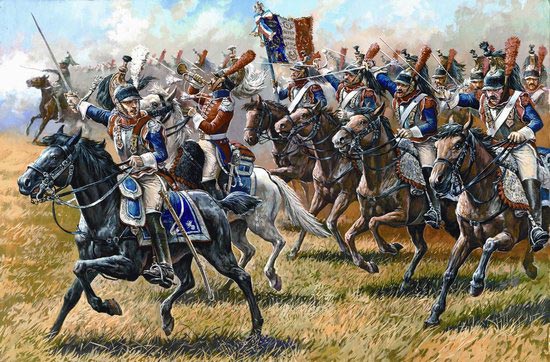
            The French cuirassiers were formed by Napoleon in 1801 and were intended for a specific purpose. The cuirassiers were intended to be a heavy cavalry reserve. Scouting, skirmishing, foraging and screening were the tasks of other cavalry. Cuirassiers were to be held back until the time and conditions were right for them to deliver a sledgehammer blow. During the Battle of Waterloo unsupported cavalry had to try and break British squares and the cuirassiers were deployed too early.
 
            A cuirassier's reason for being was the charge. The approach of massed charging cuirassiers is reported to have had a mesmerising effect on an enemy. This was recognised by the cuirassiers themselves and a gorgon head is a common decorative motif on their equipment. The psychological effect of being charged might successfully delay the enemy's adoption of a formation that could resist it. Although issued with carbines the cuirassiers often did not bother carrying them or the associated paraphernalia necessary for loading them. Only 20% of cuirassiers felt inclined to carry pistols. The cuirassier's attack of choice was the arme  blanche and the massed charge. During a charge there was not time to fire firearms. If the charge was successful the enemy would be broken and routing and the advantage would need to be pressed home with the weapon in hand.


            Now that we have some context we can examine the type of sword used by the cuirassier. Cavalry charges were made with the point of the sword directed forward like a lance. The French were also notable advocates of the thrust being superior to the cut or slash. Marshal Saxe wanted cavalry to be equipped with a triangular-section blade that could not be used to cut. Not surprisingly the blade of a cuirassier's sword was straight, long and designed for thrusting. The first swords issued to the cuirassiers had a flat blade and a hatchet point. Readers familiar with British cavalry swords of this period will know that the 1796  Heavy Cavalry sabre of this time also originally had a hatchet point and was influenced by the Austrian 1775 cavalry sword. Unlike the British weapons the French swords had a tapered blade.


            The cuirassier sword continued to evolve until it reached the form typified by the Model 1816 French Cuirassier's Sword. With minor variations swords similar to the 1816 seem to have armed the cuirassiers well into the 20th century. The 1816 had a 95cm long straight tapered blade with a spear point and double fullers for lightness and rigidity. Many earlier hatchet pointed swords were reground to have a spear point.

            The French favoured the use of the sword point since it was more likely to inflict a fatal wound. This tactic was not without its potential drawbacks, however. If delivered from a speeding horse a bad strike could result in a sword wrenched from your hand and left behind buried in your target, leaving you unarmed on a battlefield. If attacking a routing enemy their backs might be protected by their packs and equipment. In his manual on the 1913 Saber George Patton advocated thrusting at the flank of a fleeing enemy but the successful timing and execution of this from a speeding horse might prove problematic. In one of his books Bernard Cornwell describes cavalry attacking fleeing infantry with a backhand cut at the face as they passed. While not necessarily fatal the physiological effects of such attacks on a fleeing unit should not be overlooked. It is also worth remembering that in the chaos of combat even the best trained man may swing rather the thrust and there will be times when a cut can be made in less time than it takes to position a point for a thrust.

            I have never personally handled a cuirassier sword but it seems an intelligent design for heavy cavalry. It has a long reach and the taper of the blade probably helps handling. The blade appears well designed for thrusting but offering the option of cutting when needed. Some writers consider the French Model 1816 and the British 1908 as the best cavalry swords of all time.

         If you have enjoyed this article or it has been helpful to you please feel free to show your appreciation. Thank you.
The Books

http://www.angelfire.com/art/enchanter/epsdbook.html
http://www.lulu.com/shop/http://www.lulu.com/shop/phil-west/survival-weapons-optimizing-your-arsenal/paperback/product-21488758.html
http://www.lulu.com/shop/phil-west/crash-combat/paperback/product-22603842.html
https://www.amazon.com/Anatopismo-Underrealm-Novella-Phil-West-ebook/dp/B077G7MMFM