About a week ago I came across some discussion of the following article:
In brief, the author (Dr. Sturtevant) offers a hypothesis that the military flail never existed and that all (not just some) examples in museums are fakes. A friend has made the criticism that his main argument is that “flails were too difficult to use”.
“An interesting idea” was my first reaction. The second was “what about Japan?” The Japanese are known to have used a variety of chain weapons. Best known, perhaps, is the kusarigama, literally a chain (kusari) and sickle (kama). Voiced and voiceless consonants often swap in translated Japanese so kama can become gama and kusari gusari. Some kusarigama have the chain attached to the butt end of the kama, others have it attached at the head. Some have two chains attached to the head and there are variants that have one chain attached to the head and another at the butt. Some examples have the chain attached by a long hook or clip so the chain can be easily detached. The term “kusarigama” is also used for two kama joined together by a length of chain but that variant does not really concern us here.
If anything, you would expect a kama with a weighted chain to be harder to use than a simpler ball and chain without the blade. Yet, there are a number of ryu that include the kusarigama as a weapon and have a variety of techniques for using it. Kusarigama with the chain at the butt were typically used with the kama in one hand and the chain in the other. Those with a head-mounted chain were used single-handed and therefore give us some indication of how a short-handled ball flail might be used. Notably many ryu consider the kusarigama to be a “secret” weapon. More on that point later.

In another post I have talked about the chigiriki. This is similar to the familiar European medieval ball and chain flail but a two-handed weapon. Serge Mol’s “Classical Weapons of Japan” shows a variety of other chain weapons. Simplest is a chain with a weight at one end and a loop of chain at the other. The text mentions variations of this that had handles. The manrikigusari is a short chain with a weight at each end. This weapon has become relatively familiar in the west due to the popularity of the book “Spike and Chain”/ “Ninja Spike and Chain” by Charles V Grusanski. Another Japanese weapon has a weight, chain and iron truncheon. It looks like the stereotypical medieval ball and chain other than being all metal. A version with a wooden truncheon also existed.
Another weapon common in the east are the numchukas, derived from the Asian rice flail.
I had a quick glance at Cameron Stone’s book (A Glossary of the Construction, Decoration and Use of Arms and Armor: in All Countries and in All Times). He lists China and India as also being users of the flail.
If all flails are fakes, it was certainly widespread and comprehensive!
Dr. Sturtevant does state that he does not contest the existence of the long-handled flails derived from peasant tools and made with rope or leather. His stance is that it is short-handled ball flails that are fallacies The illustrations in the article only show ball flails, although at least one appears to be long-handled.
Contemporary illustrations of the use of the ball and chain are relatively hard to find on the internet. Relatively hard, that is, unless you start on Wikipedia. Dr. Sturtevant actually uses some of these illustrations in his article. One of his arguments is that the figures using flails in some of these paintings are fantasy figures. For example, in one case they are meant to represent middle-eastern horsemen but are dressed as European knights. Many medieval painters depicted ancient events such as the Siege of Troy or Biblical scenes using contemporary weapons and armour. Lacking the body of archaeological knowledge we now have they assumed fashions had not changed much. Such paintings give us considerable information about what was in use at the time that the painting was painted. I expect many medieval painters had the same approach to the depiction of events in far-off lands that they had never visited. A middle-eastern warrior would be painted as European knight and the artist would base this on the contemporary equipment he was familiar with. It was easier to copy these than to invent.

From 1025


Whilst illustrations of the ball and chain are relatively rare, this is not the case for the long-handled bar-flail, aka the “peasant flail”. For completeness I will include some.


From the Triumphs of Maximilian

Asian horseman with long-handled flail.
This page has information on a pre-1579 manual that includes techniques for using the peasant flail. The two-handed bar-flail was an implement used to thresh grain. There can be little argument that it existed. There are numerous contemporary depictions of peasants and soldiers carrying and using them. In many illustrations these flails have been “weaponized” with the addition of spikes or iron banding. Some even have a catch so the swingle (head) does not swing around during prolonged marches.
Franz Kottenkamp’s “The History of Chivalry and Armour” (p.77) provided some useful information:
“The Morgenstern, or spike-covered club varied in its dimensions. according to Meyrick (Sir Samuel R Meyrick, Armour I, p.19), its staff was from two to five feet long, and the chain on which the ball was suspended, even exceeded the length of five feet. The balls, spiked or in the form of a channelled melon, weighed eight pounds in some specimens. Single or triple chains connected the balls with the handles. This weapon did not constitute a part of knightly armour. It was employed by German citizens and the Switzers (Swiss), and surpassed in size and weight the corresponding weapons of other nations. The French probably became acquainted with it, during the sieges of the cities in Flanders.”
Earlier in the same paragraph Kottenkamp talks about the plebeian bodyguards of princes armed with clubs. It is unclear if these clubs were flails.
Very clearly the weapon described by Meyrick is not a description of a farm implement that has been pressed into service. It ball and chain weapon that existed in both short-handled and long-handed forms.
The statement that the flail was not one of the prescribed knightly weapons is informative. In other words a knight was not obligated to learn how to use this weapon. There was no restriction on using the weapon, however. Knights who favoured the flail for any reason would use it. It was an unusual weapon for a knight. Understandably, depictions or descriptions of knights using flails are therefore relatively rare.
One of the objections to articulated weapons is that they are difficult to use. Using them effectively needs more training and familiarisation than some other weapons.


For the long-handled bar flail this argument is easily countered. A peasant would spend a big chunk of the harvesting season wielding a flail. Using one in battle would not be that different. From this page on the Chinese “big sweeper” we have this informative quote:
“The flail was used as though it were threshing, with the women striking the men outside the walls.”
The weapon is being used by women, who were presumably not trained warriors and may even have been unused to threshing as farm work. The peasant flail and big sweeper have long handles and relatively shorter head sections. The probability of the head section hitting the user is very remote.
It is potentially possible to block the head of a bar-flail. The more compact head of the ball-flail addresses this. The length of a chain was selected so that the weight would not swing down and strike the hand holding the handle. The chain was either at least a hand-width shorter than the shaft or was the same length or longer. In all cases the weight would not hang at the same level at which the handle was gripped.
Articulated weapons can behave differently to rigid ones, which is why the user needs to have achieved a greater level of proficiency and familiarity. A swinging chain has a considerable reach and can threaten a large area. Nearby obstacles or obstructions can affect its behaviour. A flailman could hit a nearby comrade or entangle his weapon in an overhead branch. Learning to be aware of your surroundings and those of your intended target was a component of mastering the weapon.
If a weight on a chain encounters an object it can sometimes rebound toward the user. This is known as “snapback”. Snapback is not really a problem if the head and chain is shorter than the handle. At worst, the head will slap against the shaft well above the hand. Some flails use a longer chain, however. In these cases the potential problem of snapback is countered by correct technique. Flail strikes are made with a follow through as though the hit was being pulled through the target. Any snapbacks are overcome by the overall momentum in another direction. The physicists among you will hopefully forgive me if I have termed that wrong. See the video below for a better explanation from an actual short-handled flail user.
Another “quirk” of articulated weapons might be termed a “deadstop”. The head puts all of its energy into a target and just stops and drops. Correct follow through partially addresses this. The user also learns to recognise when this happens and how to restore momentum to the head by techniques such as a quick wrist rotation.
The Japanese ryu can give us some useful insight into how the European weapons may have been used. The chapter on chain weapons in Serge Mol’s “Classical Weapons of Japan” proved very useful here. The chigiriki chapter in Sid Cambell’s “Exotic Weapons of the Ninja” was also quite insightful.
A static chain is very little threat. To attack a ball and chain must either be moving or in a position from which it can easily begin moving. Some chain-fighting ryu recommend that a chain be spun at about 80 rpm. Obviously the idea that you can step in to attack after a chain has passed is not practical against such techniques.
Strikes with a chain are made with a follow through, which naturally leads to the use of circling and figure-eight movements to keep the weapon in motion and make successive strike attempts.
I have some familiarity with the manrikigusari. Spinning and figure-eight movements are complimented by halting the chain and quickly returning it to a position from which a new strike can be made. This is done by catching the chain and sliding the hand towards the head to bring the weapon back under control. Potentially this could have been done with the short-handled European ball flail. Possibly a spinning chain could be slowed by impacting the head with the ground or intercepting the chain with your own shield edge. Since the flail was not really a knightly weapon it seems to be neglected by most of the contemporary manuals so we do not know if this was actually done.
The flail was not a weapon for use in a packed infantry formation. The flail was of little use in slowing down massed cavalry. Flail-armed troops probably only formed a small proportion of an infantry formation. Flails were probably used to compliment more commonplace weapons. If cavalry were stalled by spears or pikes flails were useful in the following melee. A flail could take a heavily armoured man from the saddle or bring down his horse. In later periods pike squares included halberdiers who sallied forth once an enemy was locked in combat with a square. Flail equipped troops were probably used in the same way. The reach and power of a flail made it a useful weapon for fighting across obstacles. The quotation above describes the flail used to defend a city wall. The two-handed flail is often associated with the Hussites and regarded as the national weapon. It would be a useful weapon for use from a Wagenburg. For the horseman who had learnt to use it the flail offered both reach and power.
I suspect that the “tail” position from sword fighting was often used with flails. This has the weapon held pointed to the rear at a low or medium level. This is a deceptive and menacing position from which powerful attacks can be thrown from a variety of angles. If a shield is used it obscures the enemy's view of what the weapon is doing. You often see the tail position used in the movie “House of Flying Daggers”. The only photo I could find shows the swords held higher than is usual.
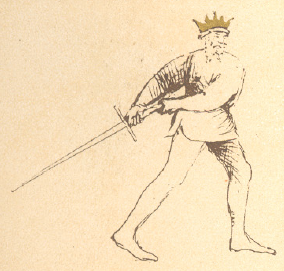

A blow from a competently wielded flail could reach over, under or around an enemy shield. This could compliment the attacks of more conventional weapons. For example, as a spearman caused a foe to raise his shield a comrade with a flail could strike beneath.
Earlier I mentioned that many Japanese ryu regarded their chain weapons as “secret” weapons. In many cases they were not weapons for the battlefield or duelling but for more personal defensive encounters and self-defence. The kusarigama is considered to be one of the weapons suited for use by women. It was probably a weapon that many sword-armed aggressors would have been unfamiliar with. Like the naginata the kusarigama offered superior reach and power compared to a sword. Ninja are also associated with a variety of chain weapons. Chain weapons offered reach and power in an easily concealed package. During night combat the chain would be even harder to see and avoid.
If Kottenkamp is describing bodyguards armed with flails then one can see some logic in the choice. The plebeian bodyguard was a professional fighter rather than a levy so could be expected to put time into mastering a difficult weapon if it offered an advantage.
If you have enjoyed this article or it has been helpful to you please feel free to show your appreciation. Thank you.The Books